BIOLOGY Volume 1 - A Guide to General Biology - 2004
7. AUTOTROPHIC NUTRITION
7.6. Biochemistry of Photosynthesis
7.6.4. Summary of Photosynthesis
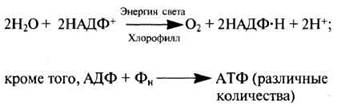
During Photosynthesis, carbon dioxide and Water are converted into sugar. Light provides the energy for the reaction, which is stored in the form of high-energy sugar molecules. It is important to understand that the energy stored in sugars is the same light energy, simply in a different form. Photosynthesis involves the transformation of light energy into the chemical energy of sugar. This conversion of light energy into chemical energy is carried out by chlorophyll, working in conjunction with other molecules located on the chloroplast membranes. The entire process consists of two stages: the light-dependent and light-independent (dark) reactions. In the light-dependent reactions, electrons are passed from one compound to another along an Electron Transport Chain, dropping to a lower energy level at each step. The released energy is channeled into The production of ATP and the reduction of NADP. Water is split into hydrogen and oxygen, with the latter serving as a by-product. In the METABOLISM/17.html">Light-Independent Reactions, hydrogen (bound to NADP) and ATP are used to reduce carbon dioxide to a 3C-sugar. The overall equation for this process is as follows:
Class="center">
Further details on The process of photosynthesis are presented in Table 7.4.
Table 7.4. Summary of photosynthesis
Light-dependent reactions |
Light-independent reactions |
|
Thylakoids |
Stroma |
|
Reactions |
Light-dependent Light energy drives a flow of electrons from an electron donor to an electron acceptor via a non-cyclic or cyclic pathway. Two Photosystems, I and II, are involved. They contain chlorophylls that release electrons upon absorbing light energy. Water acts as the electron donor in the non-cyclic pathway. The flow of electrons leads to The formation of ATP (Photophosphorylation) and reduced NADP |
Light-independent Carbon dioxide is fixed by attaching to a 5C-compound, ribulose bisphosphate (RuBP). This yields 2 molecules of a 3C-compound, specifically 2 molecules of phosphoglycerate (PGA), which is the primary product of photosynthesis. The sequence of reactions is known as The Calvin Cycle, during which the carbon dioxide acceptor RuBP is regenerated, and PGA is reduced to sugar (Fig. 7.17) |
Overall equation |
|
|
Products |
Light energy is converted into the chemical bond energy of ATP and reduced NADP. Water is split into hydrogen and oxygen. Hydrogen is used to reduce NADP, while oxygen is released as a by-product |
Carbon dioxide is reduced to CARBOHYDRATES, utilizing the chemical energy of ATP and the hydrogen from reduced NADP |
Summary of photosynthesis (excluding ATP and NADP) |
|
Sugar, which stores light energy, is synthesized from carbon dioxide and water |


Last update: 06/08/2026
Editorial and Educational Adaptation: This material has been compiled based on the primary/original source text. The project team performed an editorial review, corrected technical inaccuracies, structured sections, and adapted the content for an educational format.
What was processed:
- elimination of formatting defects (OCR errors, structural breaks, corrupted characters);
- editorial organization of content;
- standardization of terminology in accordance with academic sources;
- verification of factual statements against the original source text.
All mentions of the author, publication year, and origin of the primary text have been preserved in accordance with the source.