MEDICAL BOTANY - A.G. Serbin - 2003
SECTION 3. SYSTEMATICS
KINGDOM FUNGI — FUNGI
Fungi are an ancient group of heterotrophic, chlorophyll-free, macro- or microscopic, annual or perennial organisms characterized by A wide variety of morphological and Anatomical Features. Fungi share similarities with both plants and animals. The fungal Cell (Fig. 3.110) is distinguished by the following features: the presence of a Chitin-containing Cell wall; one or, more commonly, multiple haploid nuclei; the absence of Plastids; a primitive Golgi apparatus Structure; and the accumulation of Glycogen (animal starch), volutin, and fatty oil as reserve nutrients.
Class="center">Fig. 3.110. Diagram of a fungal cell: 1 — cell wall; 2 — Cytoplasm; 3 — Plasma Membrane; 4 — Nucleus; 5 — Ribosomes; 6 — dictyosomes; 7 — Mitochondria; 8 — Endoplasmic reticulum
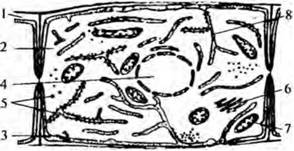
The vegetative body of fungi is called the mycelium. It consists of colorless, thread-like Cells called hyphae, which originate individually and grow by their apex or branch tips. Lower, primitively organized fungi possess a multinucleate, non-cellular (non-septate) mycelium, represented by a single cell or a plasmic mass. Higher fungi possess a multicellular (septate) mycelium with one or many haploid nuclei and perforations in the cross-walls (septa). Under unfavorable conditions, the mycelium is capable of entering a dormant stage. Closely intertwined hyphae fuse to form a "false tissue" (plectenchyma), which constitutes fruiting bodies of diverse shapes and structures. These may be located On the surface or inside the substrate and contain spore-forming asci and basidia.
Nutrition occurs via osmosis across the entire surface of the mycelium, or in some cases, by means of absorbing rhizoids (Molds) or haustoria (rust and smut fungi). Based on their mode of nutrition, fungi are classified as parasites or saprotrophs.
Reproduction in fungi occurs through sexual, asexual, and vegetative means. In most fungi, spore formation and the sexual process occur in the light. The sexual process takes several forms: hologamy, isogamy, heterogamy, oogamy, zygogamy, and somatogamy, as well as specialized modes of sexual sporulation in the form of ascospores and basidiospores. Asexual reproduction is carried out via zoospores, conidia, and sporangiospores. Zoospores are formed in sporangia in aquatic fungi. In some terrestrial fungi, the ends of hyphae bear specialized vertical branches known as conidiophores, the terminal cells of which form chains of exogenous spores called conidia. Upon maturation, the conidia detach. Other terrestrial fungi possess sporangiophores bearing globose or sac-like sporangia, inside of which sporangiospores are formed endogenously; these are adapted for dispersal by wind, insects, and animals. The sporulation capacity of terrestrial fungi is colossal: the cultivated mushroom produces up to 2 billion spores within two days, while the fruiting body of a bracket fungus yields up to 10 billion basidiospores annually. Vegetative Reproduction is accomplished in various ways: by accidental fragments of mycelium; oidia (cells resulting from the fragmentation of hyphae); budding, i.e., lateral outgrowths on the mycelium or on a single cell that enlarge, develop into independent cells, and detach from the mycelium; chlamydospores (cells with exceptionally thick walls); and sclerotia (densely interwoven hyphae covered by a hard rind). Sclerotia take the form of horns, small spheres, or cushions, accumulate reserve nutrients, are resistant to unfavorable conditions, and are capable of germinating into a fruiting body.
Significance: The Role of fungi is diverse: they mineralize Organic compounds and form humus, form mycorrhizae with higher plants, enter into Symbiosis in Lichens, cause Fermentation, and synthesize CARBOHYDRATES, Proteins, Lipids, alcohols, Enzymes, organic acids, Vitamins, Antibiotics, Steroid Hormones, and other medicinal substances. Fungi are used as a food source (the fruiting bodies of cap mushrooms), as raw Materials in biotechnology, in The production of alcohol and Pharmaceuticals, in the food industry for winemaking, brewing, cheesemaking, baking, and in other sectors of the national economy. At the same time, certain fungi parasitize plants and animals, causing diseases (mycoses), while others destroy buildings and structures or spoil food products.
Classification. There is no unified classification of fungi. Different authors distinguish varying numbers of divisions and classes (Table 3.1, p. 118). We will focus on the classes Zygomycetes, Ascomycetes, Deuteromycetes, and Basidiomycetes.
DIVISION ZYGOMYCOTA — ZYGOMYCOTA
Class Zygomycetes — Zygomycetes
There are about 600 known species of terrestrial saprophytic and parasitic organisms. The mycelium is non-septate and multinucleate, developing in soil, food products, dung, plants, animals, etc. About 100 species form endomycorrhizae with approximately 80% of higher plants. Fruiting bodies are not formed. Chitin predominates in The Cell walls. They reproduce vegetatively, via sporangiospores and conidia, and less frequently through zygogamy.
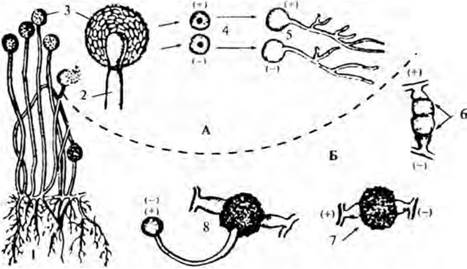
The genus Mucor — Mucor includes numerous species of mold, including the culture of the bread mold, or pin mold — Mucor mucedo (Fig. 3.111). It forms a white or gray fluffy growth on food scraps, books, plants, and animals, which turns black as the spores mature. Mucor species serve as a raw material for the production of fumaric, lactic, citric, oxalic, and succinic acids. Certain species infect the human ears, Skin, and Central Nervous system.
A — asexual reproduction; B — sexual process via zygogamy; 1 — non-septate mycelium; 2 — sporangiophore; 3 — sporangium; 4 — spores; 5 — germination of (+) and (—) spores; 6 — gametangia of (+) and (—) mycelia; 7 — zygospore; 8 — germinated zygospore
Last update: 07/08/2026
Editorial and Educational Adaptation: This material has been compiled based on the primary/original source text. The project team performed an editorial review, corrected technical inaccuracies, structured sections, and adapted the content for an educational format.
What was processed:
- elimination of formatting defects (OCR errors, structural breaks, corrupted characters);
- editorial organization of content;
- standardization of terminology in accordance with academic sources;
- verification of factual statements against the original source text.
All mentions of the author, publication year, and origin of the primary text have been preserved in accordance with the source.