PLANT BIOPHYSICS - Y. I. Posudin - 2004
II. TRANSPORT PROCESSES IN THE SOIL-PLANT-ATMOSPHERE SYSTEM
12. INFLUENCE OF ENVIRONMENTAL FACTORS ON PLANTS
12.1. EFFECT OF GRAVITY ON PLANTS
Class="center">12.1.1. Gravitaxis in Algae
The vertical migration of algae serves as a behavioral mechanism for seeking an optimal position in the aquatic environment in terms of their GROWTH AND REPRODUCTION. Both photosynthetic and non-photosynthetic microorganisms use light as an external stimulus: under low light levels, they exhibit positive phototaxis, moving toward the Water surface to receive sufficient solar radiation for vital activity. Conversely, at high solar intensities, they employ negative phototaxis, moving deeper into the water Column to prevent the damaging effects of this radiation. Photoorientation does not occur in complete darkness, but it does take place at significant depths where light is scarce. In this case, aquatic organisms use gravity as an external cue for vertical orientation.
The Earth's gravitational field is a vital environmental factor for organisms moving within the aquatic environment. The ability of organisms to orient their direction of movement relative to the gravitational field is called gravitaxis. Gravitaxis is observed in such algae as Euglena gracilis, Chlamydomonas nivalis, Cryptomonas, Peridinium gatunense and P. faeroense, Amphidinium caterea, Prorocentrum micans, and Dunaliella salina. The direction of gravitational orientation depends on the species and age of the algae. For instance, Peridinium faeroense and young populations of Euglena gracilis exhibit positive gravitaxis (movement away from the water surface), whereas Chlamydomonas nivalis, Peridinium gatunense, Amphidinium caterea, Prorocentrum micans, and older populations of Euglena gracilis display negative gravitaxis (movement toward the water surface). The degree of gravitational orientation in algae is determined by culture age and time of day, the presence of heavy metals in the environment, and exposure to solar radiation, particularly ultraviolet rays. Thus, gravitaxis is an important ecological factor that enables aquatic organisms to find more favorable living conditions.
Two hypotheses have been proposed regarding the mechanisms of algal gravitaxis. According to the first hypothesis—passive reorientation—gravitaxis is a purely physical phenomenon explained by the uneven mass distribution within The Cell [Brinkmann, 1968]. The heavier part of the cell generates a torque that sets the cell in a vertical position, allowing it to swim toward the water surface with the help of its flagellar apparatus. However, this hypothesis is not supported by recent studies. For example, the gravitaxis of Euglena gracilis is inhibited by ultraviolet radiation, while its swimming speed remains unchanged [Hader and Liu, 1990]. Furthermore, the first hypothesis fails to explain why young populations of Euglena gracilis exhibit positive gravitaxis while older ones show negative gravitaxis, nor can it account for the reversal of gravitaxis induced by heavy metals. Experiments conducted in space indicate that algal gravitaxis depends on the level of gravity rather than the Earth's magnetic or electric fields. Consequently, a second hypothesis was proposed [Lebert and Hader, 1996], which posits that gravitaxis is an active physiological process based on the density difference between the cell body (1.05 g·mL-1) and the surrounding medium (1.00 g·mL-1). As a result of sedimentation, the cell body exerts pressure on The cell membrane, causing it to shift by 1 nm and activating gravity-sensitive Ion Channels. This hypothesis is supported by experiments using specific agents—gadolinium (an inhibitor of mechanosensitive channels), the ionophore A23187, and vanadate—which inhibit gravitaxis even at very low concentrations while leaving cell motility unaffected. In addition, these results suggest the potential involvement of electrical potentials generated across the cytoplasmic membrane in the graviorientation mechanism. A typical setup for observing and evaluating algal gravitaxis is shown in Fig. 12.1.

Fig. 12.1. 1. Algal gravitaxis: a — typical setup for observing and evaluating algal gravitaxis (1 — Microscope; 2 — video camera; 3 — Image Processing system; 4 — population observation monitor; 5 — single-cell observation monitor; 6 — computer). b — histogram of the angular distribution of green algae Cells (*Dunaliella* sp.) during gravitaxis (number of cells: 1336; average speed: 25.36 µm/s; gravitaxis level: 0.352; gravitaxis direction: 192.89°).
12.1.2. Plant Gravitropism
Definition of Gravitropism. The growth response of a plant that results in the bending or curvature of a specific plant part toward an external stimulus is called tropism. If the movement is directed toward the stimulus, it is termed positive tropism; if directed away, it is negative tropism. When the external stimulus is the force of gravity, the plant's response is known as gravitropism. A plant placed in a horizontal position (Fig. 12.2) directs its SHOOT upward (negative gravitropism) and its ROOT downward (positive gravitropism). Plant Organs such as rhizomes, stolons, and lateral branches that grow at a right angle to the direction of gravity exhibit diagravitropism, while organs whose growth direction forms an angle between 0° and 90° relative to the vertical show plagiogravitropism. Organs that are insensitive to gravity are termed agravitropic. Typical gravitropic responses of plant stems and roots are illustrated in Fig. 12.3.
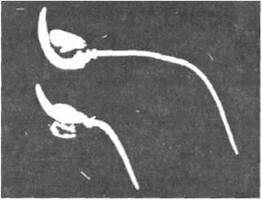
Fig. 12.2. PLANT RESPONSE TO gravity: positive gravitropism of the root and negative gravitropism of the shoot.
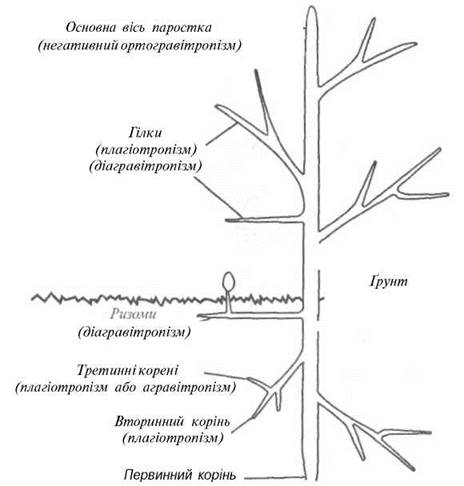
Fig. 12.3. Typical gravitropic responses of plant stems and roots.
Gravisensing. Unlike other external stimuli, gravity is a constant force that does not change in magnitude. Furthermore, gravity cannot be switched on or off, nor does it feature spatial gradients. Cells in the upper regions of a stem or root experience the same gravitational force as those in the lower regions. Consequently, an external stimulus like gravity can only be detected through the movement of specific plant or cellular structures—movement that creates cellular Asymmetry and generates mechanical pressure. In 1900, Haberlandt and Němec (cited in [Weevers, 1949]), based on meticulous cytological studies, concluded that starch grains, known as statoliths, perform the function of gravity-sensing organs in plants. According to modern concepts, the perception of gravity occurs through the sedimentation of amyloplasts—Plastids containing starch grains (ranging from 1 to 8) positioned near the membrane. These amyloplasts, which possess a specific mass and density, move through the viscous Cytoplasm; when the plant's orientation changes, they sediment downward and settle against the cell walls. Through their accumulation, they exert pressure on The Plasma Membrane or The Endoplasmic reticulum (Fig. 12.4). The movement of gravity receptors triggers the activation of specific Enzymes that regulate hormone METABOLISM. The displacement of plastids creates a gradient of growth Hormones that direct the elongation of the shoot or root.

Fig. 12.4. Schematic representation of the gravisensing mechanism. a — uniform pressure of statoliths on the endoplasmic reticulum during vertical root orientation; b — redistribution of statoliths during horizontal root orientation, resulting in asymmetric pressure on the endoplasmic reticulum (ER).
Measurement of Gravitropism. Most experiments utilize a gravitational acceleration of 1 g or less, achieved by orienting the organ (coleoptile or root) away from the vertical position. The gravitational force is proportional to the sine of the angle of inclination of the organ relative to the vertical. To eliminate the Influence of the gravitational field, researchers use clinostats—devices that rotate the plant specimen—or conduct space experiments to achieve a state of weightlessness.
12.1.3. Thigmonastic Movements in Plants
Nastic Movements occur in response to various external stimuli—such as Touch, mechanical wounding, vibration, light, or chemicals—to which the plant reacts with rapid movements. The direction of nastic movements is independent of the stimulus direction. Movements induced by touch are called thigmonastic; such movements are characteristic, for example, of the well-known sensitive plant Mimosa pudica, which folds its leaflets (and sometimes entire leaves) within seconds in response to touch. These rapid movements in *Mimosa* serve as a defense mechanism against insects and other herbivores, as well as a way to mitigate dry winds and conserve water in its native arid habitats. The external mechanical stimulus perceived by the sensory Cells of the petiole is converted into an electrical signal that rapidly propagates through the tissue until it reaches the motor cells of the pulvinus near the leaf base, which immediately alter their volume. The movement of plant organs in *Mimosa* is likely driven by changes in turgor pressure within these cells. Volume changes lead to the release of potassium ions and tannin-like substances from the cells. The movements exhibited by carnivorous plants in response to touch—such as the Venus flytrap (*Dionaea muscipula*)—can also be classified as thigmonastic. It is believed that the rapid snap-closure of the plant's leaves is associated with irreversible Cell wall stretching and localized acidification of the cell walls [Raven et al., 1990]. Another example of thigmonastic movement is the coiling of tendrils, which allows certain climbing plants (*Passiflora coerulea*, *Pisum sativum*) to support themselves in space. While growing, tendrils perform circumnutations to increase the probability of contacting a potential support, after which they alter their growth rate and direction to wrap around the support and pull the plant upward. If the lower side of a pea tendril (*Pisum sativum*) is stroked with a Glass rod, the cells on the lower side begin to contract while those on the upper side stretch; subsequently, all cells elongate, but those on the upper side stretch much faster. Evidently, The regulation of these cell size changes involves hormones such as auxin (which stimulates growth) and Ethylene (which increases membrane permeability); an increase in ethylene levels in the lower-side cells is accompanied by the loss of solutes from the vacuole, leading to cell contraction.
Last update: 07/08/2026
Editorial and Educational Adaptation: This material has been compiled based on the primary/original source text. The project team performed an editorial review, corrected technical inaccuracies, structured sections, and adapted the content for an educational format.
What was processed:
- elimination of formatting defects (OCR errors, structural breaks, corrupted characters);
- editorial organization of content;
- standardization of terminology in accordance with academic sources;
- verification of factual statements against the original source text.
All mentions of the author, publication year, and origin of the primary text have been preserved in accordance with the source.