PLANT BIOPHYSICS - Y. I. Posudin - 2004
II. TRANSPORT PROCESSES IN THE SOIL-PLANT-ATMOSPHERE SYSTEM
11. ELECTRICAL TRANSPORT
11.4. PLANT RESPONSES TO EXTERNAL STIMULI
Effect of illumination. Electrical signals are generated in the Cells of green plants. Upon switching the light on or off, signals are produced exclusively in photosynthetic cells. However, it has been established [Liumite, Higinbotham, 1984] that when working with Tissues comprising both green and non-green cells, electrical coupling exists between them: exciting a green Cell allows the electrical potential to be recorded in the non-green cell.
Effect of Temperature. The response of a plant (tomato) to a thermal stimulus applied to the upper leaf is shown in Fig. 11.4. Action potentials were recorded across various PARTS OF THE plant, from the apex down to the roots. The experimental setups were as follows: A - stimulus: a flame applied to the apex; sensing electrode attached to the petiole with the reference electrode immersed in the soil; B - stimulus: heated metal applied to the apex, calomel sensing electrode attached to the petiole; C - use of two sensing electrodes placed on the petiole 28 MM apart; D - sensing electrode attached to the stem, reference electrode immersed in the soil; E - comparison of signals recorded on the petiole and the stem; F - comparison of signals on roots immersed in Water or a 2 mM aspirin solution; stimulus applied to the apex, signal recording on the petiole.
Class="center">
Fig. 11.4. Recording of action potentials in response to a thermal stimulus at various locations on the plant (details in text).
Electrical Shock. The results of measuring electrical potentials induced by an applied electric field with an amplitude of 10 V are presented in Fig. 11.5. The propagation velocity of the signal along the sieve tubes toward the Base of the plant is 3-5 cm·s-1.
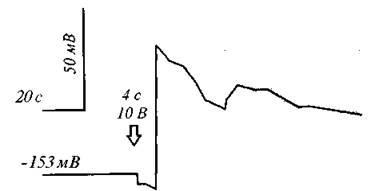
Fig. 11.5. Recording of electrical potentials induced by an electric field with an amplitude of 10 V.
Effect of chemical stimuli. Treatment of potato leaves with an aqueous solution of pentachlorophenol, followed by electrical potential measurements at a distance of 9 cm along the plant stem, demonstrates a monotonic decrease in potential amplitude from 30 mV to 0 ± 3 mV over the course of one hour. The signal propagation velocity in this case was 0.05 cm-s1.
Changes in water regime. If a plant grows in sufficiently moist soil, subsequent addition of water does not alter Resting Potential parameters. However, if the plant grows in dry soil, watering or water spraying sharply increases the potential amplitude to 7 ± 2 mV within 20-30 min (Fig. 11.6).

Fig. 11.6. Potential difference between electrodes inserted into the potato stem As a result of spraying: a - 0.3 ml of distilled water on moist soil; b - 50 ml of distilled water on dry soil.
Effect of insects. The changes in electrical potential parameters measured on the stem following the placement of Colorado potato beetles on the leaves are shown in Fig. 11.7. The signal propagates from the apex to the tuber.

Fig. 11.7. Appearance of a mirrored potential difference between electrodes in response to placing Colorado potato beetles on potato leaves.
Thus, plants process and exchange information via electrical signals in response to fluctuations in various environmental parameters.
Control Questions
1. What is the excitability of plant cells?
2. What is The Essence of electrochemical Methods for measuring resting and action potentials?
3. How do plants respond to external stimuli?
Last update: 07/08/2026
Editorial and Educational Adaptation: This material has been compiled based on the primary/original source text. The project team performed an editorial review, corrected technical inaccuracies, structured sections, and adapted the content for an educational format.
What was processed:
- elimination of formatting defects (OCR errors, structural breaks, corrupted characters);
- editorial organization of content;
- standardization of terminology in accordance with academic sources;
- verification of factual statements against the original source text.
All mentions of the author, publication year, and origin of the primary text have been preserved in accordance with the source.