BIOLOGY Volume 3 - A Guide to General Biology - 2004
22. GROWTH AND DEVELOPMENT
22.4. Growth and development of flowering plants
22.4.2. Germination
Germination marks the beginning of embryo growth, typically following a period of dormancy. The Structure of a seed at the time of germination is described in Section 21.5.
Environmental requirements for germination
Water. The initial uptake of water by a seed occurs through imbibition. Water is absorbed via the micropyle (a tiny pore in the testa, or seed coat) and the seed coats through a purely physical process of water adsorption by the colloids contained within the seed. These include Proteins, starch, and Cell wall constituents such as hemicelluloses and Pectins. The Swelling of these substances generates a powerful force, sufficient to rupture the seed coat or pericarp surrounding the seed. Subsequently, water moves from Cell to Cell driven by osmotic forces. It is essential for activating the biochemical processes associated with germination, as these reactions take place in an aqueous solution. At this stage, water also participates in the Hydrolysis (Digestion) of stored nutrient reserves.
MINIMUM OR OPTIMUM Temperature. For each type of seed, There is a temperature range outside of which it will not germinate. This range depends on the environmental conditions typical for the given plant and usually lies between 5 and 40 °C. Temperature affects the Rate of Enzymatic reactions (Section 4.3.3).
OXYGEN. Oxygen is required for aerobic Respiration, which, if necessary, can be supplemented by anaerobic processes.
Physiology of germination
A typical seed contains reserves of CARBOHYDRATES, Lipids, and proteins stored either in its endosperm or in the embryonic cotyledons. The primary reserve is usually lipids in the form of oils, with the exception of the legume and cereal families, whose seeds contain predominantly starch. Almost all agricultural crops cultivated by humans belong to these two groups, providing the bulk of our dietary carbohydrates. Legumes, particularly soybeans, are also rich in proteins, which is why soybeans are used as a protein source in many modern food products. In addition, seeds are rich in mineral elements, especially phosphorus, and contain standard cytoplasmic components such as Nucleic Acids and Vitamins.
As a result of imbibition and osmosis, the embryo becomes hydrated, leading to the activation of certain Enzymes, particularly respiratory ones. Other Enzymes must be synthesized de novo by the plant using Amino Acids released during the digestion of stored proteins.
In general, a germinating seed can be considered to have two active zones: the reserve storage zone and the growth zone (the embryo). The major events occurring in the reserve storage zone are catabolic in nature—meaning they involve breakdown processes—with the exception of enzyme synthesis.
The digestion of nutrient reserves occurs primarily via hydrolysis:
Class="center">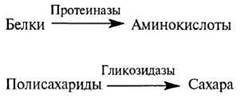
(for example,

The soluble products of digestion are then transported to the growth Zones of the embryo. Sugars, Fatty acids, and glycerol serve as respiratory substrates in both the storage and growth zones; in the latter, they may also be utilized in anabolic reactions, i.e., synthesis-related processes. Glucose and Amino acids are of particular importance for these reactions. Glucose is used mainly for the synthesis of Cellulose and other cell wall components. Amino acids are utilized primarily for the synthesis of proteins, which play a vital role as enzymes and Structural components of the Cytoplasm. Furthermore, many of the processes listed in Tables 7.7 and 7.8 require mineral nutrients.
Both the reserve storage zone and the growth zone derive the energy they need from respiration. Respiration involves The oxidation of a substrate, typically a sugar, into CO2 and water. This is accompanied by a decrease in the dry mass of the seed, since carbon dioxide gas escapes, and its mass exceeds that of the oxygen consumed during aerobic respiration. Another product of respiration—water—is generally not factored into dry mass measurements. This reduction in dry mass continues until the seedling develops small leaves and begins to synthesize its own food (Fig. 22.10).
A well-studied example of polysaccharide-rich seed germination is that of barley. Research has shown that in barley, the synthesis of α-amylase and other enzymes occurs in the outer layers of the endosperm under METABOLISM/18.html">The Influence of gibberellin released by the embryo. The outer layers of the endosperm contain reserve protein, which serves as a source of amino acids for Protein Synthesis. This process and the corresponding experimental studies are described in Section 16.2.6. Fig. 16.20 illustrates The Role of Hormones in the Cytology/cytology/16.html">Early stages of germination. The appearance of amylase in germinating barley grains can also be studied by grinding the grains in water, filtering the suspension, centrifuging the filtrate, and then assaying the amylase activity of the resulting clear extract using a starch solution. By sampling barley grains at various intervals after the onset of germination, one can determine the increase in amylase activity per grain over the course of a week.
22.4. Explain the results presented in Fig. 22.13.

Fig. 22.13. Relative Changes in the dry mass of the endosperm and embryo during barley germination.
Lipid-storing seeds convert their lipids into Fatty Acids and glycerol. Each lipid molecule yields three fatty acid molecules and one glycerol molecule (Section 3.3). The Fatty acids are either directly oxidized in respiration or converted into sucrose, which is subsequently transported to the embryo.
22.5. (These questions are designed to test your knowledge of general chemistry and Lipid Chemistry in particular. Lipid chemistry is covered in Section 3.3.)
Suppose that in 51.2 g (dry mass) of seeds containing 50% (by mass) fatty acids, all the fatty acids were converted into sugar via the reaction:

a) Assuming that no other processes occurred that could alter the dry mass, calculate the increase or decrease in the dry mass of the seeds.
(Relative atomic masses: C = 12, H = 1, O = 16.)
b) What other important change could affect the dry mass?
c) Calculate the volume of carbon dioxide released from the seeds at standard temperature and pressure.
(1 mole of gas at standard temperature and pressure occupies 22.4 l).
d) How can a fatty acid be obtained from a lipid, and what other component must the lipid contain?
e) How many carbon atoms must a single molecule of the starting lipid contain if the only fatty acid obtained from it was C16H32O2?
f) What sugar is produced as a result of the above reaction?
g) How does oxygen reach the storage Tissues?
Respiration of Germinating Seeds
The respiration rate of both the storage tissue and the embryo is high, reflecting the intense METABOLIC ACTIVITY OF these two seed regions. Respiratory substrates in these regions may vary and can also change during germination, as evidenced by shifts in the respiratory quotient (Section 9.5.9).
22.6. An analysis of castor bean seeds for lipid and sugar content during germination in the dark yielded the results shown in Fig. 22.14. Measurements of the respiratory quotient (RQ) of the seedlings on the fifth day showed that it was approximately 1.0 for the embryo and roughly 0.4–0.5 for the cotyledon remnants.
a) Provide as comprehensive an explanation of these results as possible (using the data from Section 22.4.2).
b) What will the respiratory quotient of the seedling as a whole be on the 11th day? Briefly explain your reasoning.

Fig. 22.14. Changes in lipid and sugar content in castor bean seeds during germination in the dark. (After R. Desveaux, M. Kogane-Charles, 1952, Annals. Inst. Natn. Rech. Agron, Paris, 3, 385–416).
22.7. The respiratory quotient of pea seeds During the first 7 days of germination ranges between 2.8 and 4, but if their seed coats are removed, it drops to 1.5–2.4.
In both cases, ethanol accumulates in the seeds, but in significantly smaller amounts when the seed coat is removed. Explain these observations.
Embryo Growth
Embryo growth occurs through Cell Division, cell enlargement, and differentiation. The amounts of proteins, cellulose, nucleic acids, and other substances in the growing PARTS OF THE embryo gradually increase, while the dry mass of nutrient reserves decreases. The first visible sign of growth is The Emergence of the radicle (embryonic ROOT). This root exhibits positive geotropism, i.e., it grows downwards, anchoring the seed in the soil. Next, the SHOOT bud—the plumule—appears, which exhibits negative geotropism (and positive phototropism if it is above ground) and grows upwards.
Two Types of germination are distinguished depending on whether the cotyledons remain underground or are lifted above the surface. In dicotyledons, if the internode located directly beneath the cotyledons (the hypocotyl) elongates, the cotyledons are brought to the surface (epigeal germination); if the internode located directly above the cotyledons (the epicotyl) elongates, the cotyledons remain underground (hypogeal germination).
In epigeal germination, the hypocotyl pushes through the soil while remaining curved (Fig. 22.15, B)—meaning it is the hypocotyl, rather than the delicate tip of the plumule, that overcomes soil resistance, with the plumule additionally protected by the covering cotyledons. In hypogeal germination in dicotyledons, the epicotyl is curved, so the tip of the plumule is once again protected (Fig. 22.15, C). In both cases, as soon as the curved region reaches the light, it straightens out immediately—a response controlled by Phytochrome.

Fig. 22.15. A. Seed structure. B. Epigeal germination. C. Hypogeal germination.
In grasses, which are monocotyledons, the plumule is protected by a sheath called the coleoptile, which exhibits positive phototropism and negative geotropism (section 16.1.1). The first leaf punches through the coleoptile and unfolds upon exposure to light.
Upon exposure to light, intensive phytochrome-controlled reactions are triggered in the leaves. Known as photomorphogenesis, these responses drive the transition from etiolated growth (section 16.4.1) to normal growth. The major changes associated with this process are summarized in Table 16.5; they include the expansion and unfolding of the cotyledons or first true leaves, and chlorophyll synthesis (“greening”). At this stage, Photosynthesis begins alongside an increase in the seedling's dry mass; it is now independent of nutrient reserves and shifts to an autotrophic mode of life. Once exposed to light, the shoot also exhibits phototropic responses, though these are not mediated by phytochrome.
Table 22.1. Types of Meristems and their Functions
Meristem type |
Role |
Result |
|
Apical |
At the tips of roots and shoots |
Drives primary growth by forming the primary plant body |
Increase in length |
Lateral (cambium) |
Found in older parts of the plant; arranged parallel to the long axis of the organ, e.g., cork cambium (phellogen) and vascular cambium |
Drives Secondary Growth. The vascular cambium gives rise to secondary Vascular Tissues, including wood (secondary xylem); the cork cambium produces periderm, which replaces the epidermis and contains cork |
Increase in thickness |
Intercalary |
Located between regions of permanent tissue, e.g., at the nodes in many monocotyledons and at the base of leaves in grasses |
Facilitates growth in length at intercalary regions rather than at the tips. This is crucial for plants whose apical regions are frequently damaged or destroyed—such as being grazed by herbivores (in grasses) or battered by waves (in brown Algae)—while eliminating The Need for branching |
Increase in length |
Last update: 06/08/2026
Editorial and Educational Adaptation: This material has been compiled based on the primary/original source text. The project team performed an editorial review, corrected technical inaccuracies, structured sections, and adapted the content for an educational format.
What was processed:
- elimination of formatting defects (OCR errors, structural breaks, corrupted characters);
- editorial organization of content;
- standardization of terminology in accordance with academic sources;
- verification of factual statements against the original source text.
All mentions of the author, publication year, and origin of the primary text have been preserved in accordance with the source.