BIOLOGY Volume 1 - A Guide to General Biology - 2004
5. CELLS
5.10. Cellular Structures
5.10.10. Cell Walls
Plant Cells, much like prokaryotic and fungal cells, are enclosed within a relatively rigid Cell wall, which is secreted by the living cell (protoplast) contained within it. The chemical composition of Plant Cell Walls differs from that of prokaryotic and fungal cell walls (Table 2.2). The Cell wall laid down during plant Cell Division is called the primary cell wall. Later, through thickening, it may develop into a secondary cell wall. Fig. 5.30 shows an electron micrograph capturing one of the Cytology/cytology/16.html">Early stages of this process.
Structure OF THE Cell Wall
The primary cell wall consists of Cellulose fibrils embedded in a matrix composed of other Polysaccharides. Cellulose is also a polysaccharide (its chemical structure is described in Section 3.2.3). It possesses high tensile strength, comparable to that of steel. The matrix consists of polysaccharides, which are generally divided for convenience into Pectins and hemicelluloses. Pectins are acidic polysaccharides with relatively high solubility. The middle lamella, which cements the walls of adjacent cells together, consists of adhesive, gelatinous magnesium and calcium pectates (salts of pectin).
Hemicelluloses are a mixed group of alkali-soluble polysaccharides. Like cellulose, hemicellulose molecules are chain-like, but their chains are shorter, less ordered, and more heavily branched.
Cell walls are hydrated, with Water typically accounting for 60–70% of their mass. Water moves freely through the free space of the cell wall.
In some cells, such as leaf mesophyll cells, only the primary cell wall is present throughout their lifespan. In most cells, however, additional layers of cellulose are deposited on the inner surface of the primary cell wall (external to The Plasma Membrane), forming a secondary cell wall. In any given layer of secondary thickening, the cellulose fibers run at the same angle, but this angle varies between different layers, providing even greater structural strength. This arrangement of cellulose fibers is illustrated in Fig. 5.35.
Class="center">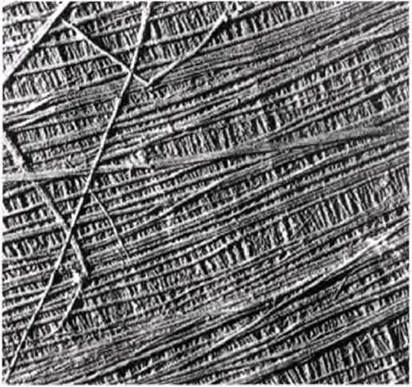
Fig. 5.35. Electron micrograph showing cellulose microfibrils in individual layers of the cell wall of the green alga Chaetomorpha melagonium. The cellulose microfibrils are 20 nm thick. The specimen was shadow-cast with a platinum-gold alloy to enhance contrast.
Some cells, such as xylem tracheary elements and sclerenchyma cells, undergo extensive lignification. During this process, all cellulose layers become impregnated with Lignin, a complex polymer that is not a polysaccharide. Protoxylem cells undergo only partial lignification. In other cases, lignification is complete, save for so-called pit fields—regions in the primary cell wall that facilitate contact between adjacent cells via groups of plasmodesmata (Sections 6.1.3 and Fig. 6.8). Lignin binds the cellulose fibers together and locks them in place. It acts as a hard, rigid matrix that enhances the tensile and, particularly, compressive strength of cell walls (preventing buckling). Lignin serves as the primary structural support material in wood and also protects cells from Physical and Chemical damage. Together with the residual cellulose in the cell walls, lignin imparts the unique properties that make wood an irreplaceable construction material.
Box 5A. Composite Materials
Materials with high mechanical strength that, like cell walls, consist of more than one component are known as composite materials, or composites. The strength of such materials is generally greater than that of any of their individual components. Fiber-reinforced matrix systems are widely used, making The Study of their properties an important field in both modern engineering and biology. The composite matrix transfers applied loads to the high-tensile-strength fibers while also increasing resistance to compression and shear forces. A familiar construction example of a composite is reinforced concrete, where concrete acts as the matrix and steel bars serve as the reinforcement. More modern and lightweight structural materials include fiberglass and carbon-fiber-reinforced polymers, in which a plastic matrix is reinforced with Glass or carbon fibers, respectively. Rigid biological composites include wood, bone, Cartilage, and arthropod exoskeletons, while flexible Examples include certain types of Connective Tissue and Skin.
Functions of the Cell Wall
The Main Functions of plant cell walls are listed below.
1. Cell walls provide mechanical strength and support to individual cells and the plant as a whole. In certain Tissues, this strength is enhanced by extensive lignification (small amounts of lignin are present in all cell walls). Lignification plays a particularly crucial role in woody trees and shrubs.
2. The relative rigidity of cell walls and their resistance to stretching allow cells to develop turgor pressure when water enters osmotically. This enhances structural support across all plants and serves as the sole means of support for herbaceous plants and Organs such as leaves, where Secondary Growth is absent. Cell walls also prevent cells from bursting in hypotonic environments.
3. The orientation of cellulose microfibrils limits and helps regulate both cell growth and cell shape, as a cell's capacity for expansion depends on how these microfibrils are arranged. For example, if microfibrils are oriented transversely, girdling the cell like hoops, an influx of water via osmosis will cause the cell to elongate longitudinally.
4. The interconnected system of cell walls (the apoplast) serves as the primary pathway for the Movement of water and dissolved nutrients (Chapter 13). Cell walls are cemented together by middle lamellae. Small pores within the walls allow cytoplasmic strands known as plasmodesmata to pass through. Plasmodesmata connect the living contents of adjacent cells, thereby uniting all protoplasts into a single functional system known as the symplast (Chapter 13).
5. The outer cell walls of epidermal cells are covered by a specialized layer called the cuticle, composed of the waxy substance cutin, which minimizes water loss and reduces the risk of pathogen invasion. In cork tissue, cell walls become impregnated with suberin upon the completion of secondary growth, serving a similar protective function.
6. The cell walls of xylem vessels and phloem sieve tubes are adapted for long-distance Transport of substances throughout the plant, as discussed in Chapters 6 and 13.
7. The cell walls of ROOT endodermal cells are impregnated with suberin, allowing them to act as a barrier to water movement (Chapter 13).
8. In some cells, modified cell walls function as nutrient storage reserves; for example, hemicelluloses are stored this way in certain seeds.
9. Transfer cells have an increased cell wall surface area and, consequently, a larger plasma membrane surface area, which enhances the efficiency of substance transport via Active Transport (Chapter 13).
Last update: 06/08/2026
Editorial and Educational Adaptation: This material has been compiled based on the primary/original source text. The project team performed an editorial review, corrected technical inaccuracies, structured sections, and adapted the content for an educational format.
What was processed:
- elimination of formatting defects (OCR errors, structural breaks, corrupted characters);
- editorial organization of content;
- standardization of terminology in accordance with academic sources;
- verification of factual statements against the original source text.
All mentions of the author, publication year, and origin of the primary text have been preserved in accordance with the source.