BIOLOGY Volume 1 - A Guide to General Biology - 2004
5. CELLS
5.10. Cellular structures
5.10.6. Lysosomes
Lysosomes are found in almost all Eukaryotic Cells. They are simple membrane-bound vesicles (bounded by a single membrane) filled with digestive Enzymes—proteases, Nucleases, and lipases—which break down Proteins, Nucleic Acids, and Lipids, respectively. These enzymes, which catalyze Hydrolysis reactions (Reactions Involving the addition of Water), function best in an acidic environment; consequently, the contents of lysosomes are acidic. The aforementioned enzymes must be kept separated from all other cellular components and structures, otherwise they would destroy them. In animal cells, lysosomes are typically spherical with a diameter of 0.2—0.5 µm (Fig. 5.31).
Class="center">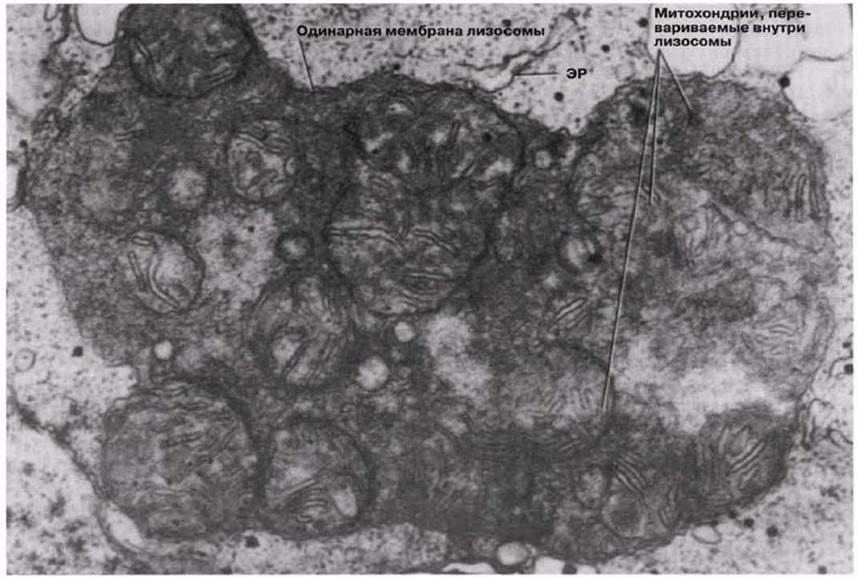
Fig. 5.31. Electron micrograph of a lysosome digesting old Cell/35.html">Mitochondria engulfed by it, ×90,750.
In plant cells, large central vacuoles may play The Role of lysosomes. However, bodies resembling animal cell lysosomes can sometimes be observed in the Cytoplasm of plant cells.
The enzymes enclosed within lysosomes are synthesized on the rough ER and transported to the Golgi apparatus. Subsequently, Golgi vesicles containing the appropriately modified enzymes bud off from it. These vesicles then transform into lysosomes. Lysosomes perform A number of Functions, which are described below and listed in Fig. 5.32.

Fig. 5.32. Three processes involving lysosomes. The numbers 1, 2, and 3 indicate the order in which these processes are described in the text.
Digestion of Materials taken up by endocytosis
(pathway 1, Fig. 5.32)
The process of endocytosis is described in Section 5.9.8. Lysosomes can fuse with vesicles or vacuoles formed As a result of endocytosis, release their enzymes into them, and digest the materials contained within the vesicles or vacuoles. Sometimes this process serves as a method of food uptake, as, for example, in certain Protozoans. In other cases, it performs a defensive function, such as when specialized white Blood Cells (phagocytes) engulf and digest Bacteria that have entered the body (Fig. 5.23). The digestion products are absorbed and assimilated by the Cell Cytoplasm, but some material remains undigested. The vacuole, along with this residual material, moves to The Plasma Membrane, where its contents are expelled outward via exocytosis.
Lysosomes play a unique role in the cells of The Thyroid Gland, which take up thyroglobulin by pinocytosis (Section 5.9.8). The resulting pinocytotic vesicles fuse with lysosomes, and thyroglobulin is converted into the active hormone thyroxine under the action of lysosomal enzymes. Afterward, by fusing with the plasma membrane, the lysosomes discharge their contents—releasing this hormone into the bloodstream.
Autophagy
(pathway 2, Fig. 5.32)
Autophagy is the process by which a cell engulfs and digests its own unneeded structures within lysosomes. First, these structures are surrounded by a single membrane, typically originating from the smooth Endoplasmic reticulum, and then this membrane-bound vesicle containing the Structure fuses with a lysosome to form a so-called autophagic vacuole, in which the structure is digested. This sequence of events is an integral part of the natural turnover of cytoplasmic Organelles, whereby old organelles are replaced by new ones.
Secretion of enzymes from cells (exocytosis)
(pathway 3, Fig. 5.32)
Sometimes the enzymes contained within lysosomes are released outside The Cell. This occurs, for example, during Organism development when Cartilage is replaced by Bone tissue. A similar phenomenon can be observed when the bone matrix is broken down during bone remodeling in response to injury, increased mechanical stress, etc. Spermatozoa contain specialized lysosomes called acrosomes. Immediately prior to Fertilization, enzymes are released from them directly to the outside, allowing the sperm to carve its way through the surrounding cellular layers toward the egg by digesting the material separating it from the egg.
Autolysis
Autolysis is the self-destruction of a cell resulting from the release of its lysosomal contents within the cell itself. It is precisely for this reason that lysosomes were once aptly termed "suicide bags." During certain differentiation processes, autolysis is a normal phenomenon: it can extend to an entire tissue, as, for example, in the resorption of a tadpole's tail during metamorphosis. Another example is the transformations undergone by the Uterus. During Pregnancy, the uterus enlarges greatly to accommodate the growing fetus. After childbirth, it gradually returns to its normal size as a result of the self-digestion of A large number of cells. Autolysis is also observed in Muscles that remain disused for a long time. Autolysis also occurs following cell death; this is precisely why food spoils if it is not frozen. Sometimes autolysis is the consequence of certain lysosomal storage diseases.
Last update: 06/08/2026
Editorial and Educational Adaptation: This material has been compiled based on the primary/original source text. The project team performed an editorial review, corrected technical inaccuracies, structured sections, and adapted the content for an educational format.
What was processed:
- elimination of formatting defects (OCR errors, structural breaks, corrupted characters);
- editorial organization of content;
- standardization of terminology in accordance with academic sources;
- verification of factual statements against the original source text.
All mentions of the author, publication year, and origin of the primary text have been preserved in accordance with the source.