BIOCHEMISTRY - L. Stryer - 1984
VOLUME 2
PART III. BIOSYNTHESIS OF MACROMOLECULE PRECURSORS
CHAPTER 21. BIOSYNTHESIS OF AMINO ACIDS AND HEME
21.3. Amino Acids Are Synthesized from Intermediates of the Tricarboxylic Acid Cycle and Other Key Metabolites
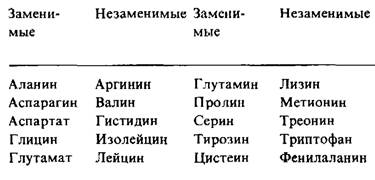
So far, we have examined The conversion of N2 into NH4+and the incorporation of NH4+into glutamate and glutamine. We now turn to The Biosynthesis of Other Amino Acids. Bacteria, such as E. coli, can synthesize all twenty standard amino acids, whereas The Human Body produces only about half of them. Amino acids that must be obtained from the diet are called essential, while the rest are nonessential (Table 21.1). These terms reflect the requirements of the Organism under specific conditions. For instance, The Urea Cycle synthesizes enough Arginine to meet the needs of an adult, but not those of a growing child. A deficiency in even a single amino acid leads to a negative nitrogen balance. In this state, the body breaks down more protein than it synthesizes, resulting in greater nitrogen excretion than retention.
Class="center">Table 21.1. The Twenty Standard Amino Acids
The biosynthetic PATHWAYS OF AMINO acids are diverse. However, they share one important common feature: the carbon skeletons of Amino acids are derived from intermediates of Glycolysis, the Pentose Phosphate Pathway, or The Tricarboxylic Acid Cycle. Furthermore, the situation is simplified by the fact that amino acids fall into just six biosynthetic families (Fig. 21.4).
Fig. 21.4. Biosynthetic families of amino acids. The main metabolic precursors are shown in blue. Amino acids that serve as precursors for other amino acids are shown in red. Essential Amino Acids are marked with asterisks

Nonessential amino acids are synthesized via relatively simple reactions, whereas the biosynthetic pathways of essential amino acids are highly complex. For example, the nonessential amino acids Alanine and aspartate are synthesized in a single step from Pyruvate and oxaloacetate, respectively. Both amino acids receive their amino group from glutamate via a Transamination reaction with Pyridoxal phosphate as a cofactor (Section 18.2):
Pyruvate + Glutamate ⇄ Alanine + α-Ketoglutarate,
Oxaloacetate + Glutamate ⇄ Aspartate + α-Ketoglutarate.
Following this, asparagine can be synthesized by the amidation of aspartate:
Aspartate + NH4+ + ATP→ Asparagine + AMP + PPi + H+.
In mammals, the nitrogen donor in asparagine synthesis is glutamine rather than NH4+.
Another single-step synthesis of a nonessential amino acid is the hydroxylation of phenylalanine (an essential amino acid) to form Tyrosine. This reaction occurs in mammals:
Phenylalanine + O2 + NADPH + Н+ → Tyrosine + NADP+ + H2O.
This reaction is catalyzed by phenylalanine hydroxylase, a monooxygenase discussed earlier (Section 18.16). It is worth noting that for animals lacking this enzyme, tyrosine is an essential amino acid.
21.4. Glutamate Is the Precursor of Glutamine and Proline
The synthesis of glutamate via the reductive amination of α-ketoglutarate has already been discussed (Section 21.2), as has the conversion of glutamate into glutamine (Section 21.2). Glutamate is also the precursor of another nonessential amino acid, proline. First, the γ-carboxyl group of glutamate reacts with ATP to form an acyl phosphate. This mixed anhydride is reduced to an aldehyde. Glutamate γ-semialdehyde then cyclizes with the elimination of H2O to yield Δ'-pyrroline-5-carboxylate, which is reduced by NADPH to form proline.
21.5. Serine Is Synthesized from 3-Phosphoglycerate
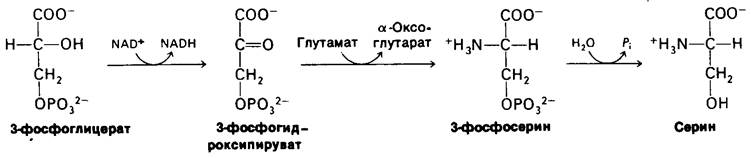
Serine is synthesized from 3-phosphoglycerate, an intermediate of glycolysis. The first step is The oxidation of 3-phosphohydroxypyruvate. This α-keto acid undergoes transamination to form 3-phosphoserine, which is subsequently hydrolyzed to yield serine.
Alternatively, the Hydrolysis of the phosphate group may precede oxidation and transamination:
3-phosphoglycerate → Glycerate → Hydroxypyruvate → Serine
Serine is a precursor of Glycine and Cysteine. During The formation of glycine, the β-carbon atom of the serine side chain is transferred to tetrahydrofolate, a carrier of single-carbon units, which we will examine below:
Serine + Tetrahydrofolate → Glycine + Methylenetetrahydrofolate + H2O.
This conversion is catalyzed by serine hydroxymethyltransferase, an enzyme whose prosthetic group is pyridoxal phosphate. The bond between the α- and β-carbon atoms of serine is labilized due to the formation of a Schiff base between serine and pyridoxal phosphate. Then, the β-carbon atom of serine is transferred to tetrahydrofolate. Glycine can also be formed from CO2, NH4+, and methylenetetrahydrofolate via a reaction catalyzed by glycine synthase. The conversion of serine into cysteine requires the replacement of the side-chain oxygen atom with a sulfur atom derived from Methionine. We will discuss the corresponding sequence of reactions after examining the METABOLISM of single-carbon units.

21.6. Tetrahydrofolate Carries Activated Single-Carbon Units with Various Oxidation States
Tetrahydrofolate (also known as tetrahydropteroylglutamate) is a versatile carrier of single-carbon units. The tetrahydrofolate molecule consists of three structural units: a substituted pteridine, p-aminobenzoate, and glutamate. Mammals are incapable of synthesizing the pteridine ring; they acquire pteridine from food or from intestinal flora microorganisms.

The single-carbon unit carried by tetrahydrofolate is attached to either the N-5 or N-10 nitrogen atom (designated as N5 and N10), or to both. This unit can exist in three oxidation states (Table 21.2). The most reduced form is the methyl group, and the intermediate form is the methylene group. The most oxidized forms are the methenyl, formyl, or formimino groups. The single-carbon unit with the highest possible oxidation state, CO2, is carried not by tetrahydrofolate, but by biotin (Section 15.15).
These single-carbon units are interconvertible (Fig. 21.5). N5, N10-methylenetetrahydrofolate can be reduced to N5-methyltetrahydrofolate or oxidized to N5-methenyltetrahydrofolate. N5, N10-methenyltetrahydrofolate can be converted into N5-formiminotetrahydrofolate and N10-formyltetrahydrofolate, in which the carbon atom is at the same oxidation state. N10-formyltetrahydrofolate can also be synthesized from formate and ATP:
Formate + ATP + Tetrahydrofolate ⇄ N10-formyltetrahydrofolate + ADP + Pi.

These tetrahydrofolate derivatives serve as Donors of single-carbon units in A wide variety of biosynthetic reactions. Methionine is synthesized from homocysteine via The transfer of the methyl group from N5-methyltetrahydrofolate, as described below. Some of the carbon atoms of Purines are derived from the N5, N10-methenyl and N10-formyl derivatives of tetrahydrofolate. The methyl group of thymine (a pyrimidine base) is derived from N5, N10-methylenetetrahydrofolate. This tetrahydrofolate derivative also serves as a single-carbon donor in the synthesis of glycine from CO2 and NH4+ in the reaction catalyzed by glycine synthase:
CO2 + NH4+ + N5, N10-methylenetetrahydrofolate + NADH ⇄ Glycine + Tetrahydrofolate + NAD+.
Thus, biosynthetic reactions utilize single-carbon units of all three oxidation states. In addition, tetrahydrofolate acts as an acceptor of single-carbon units in catabolic reactions. The primary source of single-carbon units is the conversion of serine to glycine, which, as noted above, yields N5, N10-methylenetetrahydrofolate. Serine can be formed from 3-phosphoglycerate (Section 21.5); thus, through this reaction sequence, The Cell is able to generate single-carbon units de novo from CARBOHYDRATES. The breakdown of Histidine yields N-formiminoglutamate, which transfers its formimino group to the N5 atom of tetrahydrofolate.
Table 21.2. Single-Carbon Groups Carried by Tetrahydrofolate
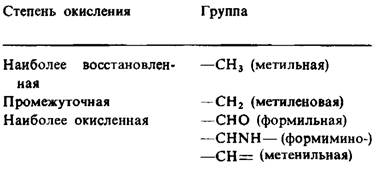
Fig. 21.5. Interconversions of single-carbon units attached to tetrahydrofolate

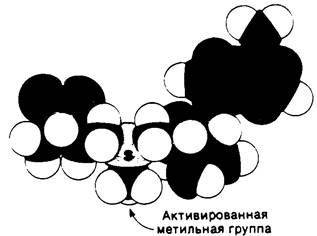
Fig. 21.6. Molecular model of S-adenosylmethionine
Last update: 06/08/2026
Editorial and Educational Adaptation: This material has been compiled based on the primary/original source text. The project team performed an editorial review, corrected technical inaccuracies, structured sections, and adapted the content for an educational format.
What was processed:
- elimination of formatting defects (OCR errors, structural breaks, corrupted characters);
- editorial organization of content;
- standardization of terminology in accordance with academic sources;
- verification of factual statements against the original source text.
All mentions of the author, publication year, and origin of the primary text have been preserved in accordance with the source.