BIOCHEMISTRY - L. Stryer - 1984
VOLUME 2
PART III. BIOSYNTHESIS OF MACROMOLECULE PRECURSORS
CHAPTER 21. BIOSYNTHESIS OF AMINO ACIDS AND HEME
This chapter examines the Biosynthesis OF AMINO Acids and several molecules derived from them. First, we will look at the reactions leading to the incorporation of nitrogen into Amino Acids. This pathway begins with the reduction of N2 to NН4 in the Cells of nitrogen-fixing microorganisms. Next, NH4 is incorporated into amino acids via glutamate and glutamine, two key compounds of Nitrogen METABOLISM. Ten of the standard set of twenty Amino acids are synthesized from intermediates of The Tricarboxylic Acid Cycle and other metabolic pathways through straightforward reactions. We will examine these biosynthetic pathways and describe The biosynthesis of aromatic Amino Acids and Histidine as Examples of amino acids synthesized in a more complex manner. In fact, humans must obtain these Ten amino acids from their diet, which is why they are called Essential Amino Acids. Two highly fascinating Cofactors participate in these reactions: tetrahydrofolate, a versatile carrier of one-carbon units at three oxidation levels, and S-adenosylmethionine, the primary methyl group donor. Another major focus of our interest is The regulation of Amino acid metabolism. Using Glutamine Synthetase as an example, we will illustrate some general Principles of Metabolic regulation. The final section of this chapter is devoted to the Synthesis and degradation of heme.
21.1. Microorganisms Use ATP and a Strong Reductant to Convert N2 to NH4
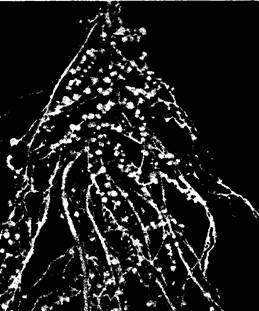
The nitrogen atoms of amino acids, Purines, Pyrimidines, and other biological molecules originate from NH4+. Higher organisms are incapable of incorporating N2 into Organic compounds. This conversion—Nitrogen Fixation—is carried out exclusively by Bacteria and blue-green Algae (cyanobacteria). Some of these microorganisms, specifically Rhizobium bacteria, infect the roots of legumes and form ROOT nodules where nitrogen fixation takes place (Fig. 21.2). The relationship between the bacteria and the plant is symbiotic. It is estimated that microorganisms convert approximately 2 • 1011 kg of N2 per year into organic form.
Class="center">Fig. 21.1 Electron micrograph of E. coli glutamine synthetase. This enzyme plays a key role in nitrogen metabolism
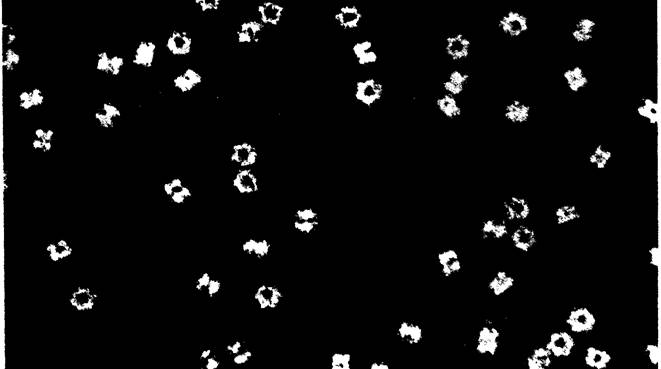
Fig. 21.2. Nodules on The Root System of a soybean plant—the site of Nitrogen fixation by Rhizobium bacteria
The N=N bond energy is 225 kcal/mol. This bond is remarkably resistant to chemical attack. Indeed, Lavoisier named this element "azote" due to its inertness, meaning "lifeless." An industrial process for nitrogen fixation was developed by Fritz Haber in 1910 and is currently used in fertilizer production:
N2 + 3H2 ⇄ 2NH3.
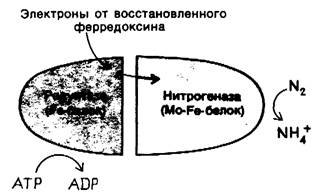
This reaction is typically carried out in the presence of an iron catalyst at a Temperature of about 500°C and a pressure of 300 atm. It is hardly surprising, therefore, that the biological process of Nitrogen fixation is catalyzed by a complex enzyme. The Nitrogenase complex, which catalyzes this reaction, consists of Two Types of protein components: a reductase that supplies electrons with high reducing power, and the nitrogenase itself, which utilizes these electrons to reduce N2 to NH4+ (Fig. 21.3). Both components are iron-sulfur Proteins (Fe-S proteins) in which iron is coordinated to the sulfur atoms of Cysteine residues and to inorganic sulfide (Sec. 14.4). The nitrogenase component of the complex also contains one or two molybdenum atoms, which is why it was formerly called the Mo-Fe protein. Its subunit Structure is α2β2, and its molecular mass is 200 kDa. The reductase component (also referred to as the Fe protein) consists of two identical Polypeptides. Its molecular mass is 65 kDa. In the nitrogenase complex, one or two Fe proteins are bound to the Mo-Fe protein.
Fig. 21.3. Schematic representation of the nitrogenase complex. Before N2 is converted to NН4, the complex dissociates and the reductase separates from the nitrogenase component
The conversion of N2 to NH4+ by the nitrogenase complex requires ATP and a potent reductant. In most nitrogen-fixing microorganisms, the source of high-potential electrons for this six-electron reduction is reduced ferredoxin, an electron carrier that we previously encountered in our Discussion of Photosynthesis (Sec. 19.9). Whether reduced ferredoxin is subsequently regenerated via photosynthesis or through
oxidative processes depends on the Organism. The Reactions Catalyzed by the nitrogenase complex have the following stoichiometry:
N2 + 6e- + 12ATP + 12H2O → 2NH4+ + 12ADP + 12Pi + 4H+.
Recent studies on nitrogenase suggest the following reaction sequence. First, reduced ferredoxin transfers electrons to the reductase component of the complex. In the second step, ATP binds to the reductase and shifts its oxidation-reduction potential from -0.29 to -0.40 V by inducing a conformational change. This increase in the reducing power of the reductase enables it to transfer electrons to the nitrogenase component. In the Third Stage, electron transfer occurs, ATP is hydrolyzed, and the reductase dissociates from the nitrogenase component. Finally, N2 binds to the nitrogenase component of the complex and is reduced to NH4+. As the Energy Sources for the chemical production of ammonia via the Haber process become depleted and increasingly expensive, researchers are showing a growing interest in enhancing Biological Nitrogen Fixation by microorganisms. One potential approach is to introduce the genes required for nitrogen fixation into non-leguminous plants, such as cereals. A major hurdle to overcome is the extreme sensitivity of the nitrogenase complex to inactivation by oxygen. Legumes maintain an extremely low concentration of O2 in their root nodules by binding O2 to leghemoglobin. Another challenge in developing new nitrogen-fixing species is the requirement for an extraordinarily rapid rate of ATP generation. Indeed, nitrogen-fixing bacteria in legume roots consume approximately one-fifth of all the ATP produced by the plant. An alternative approach is to increase The rate of nitrogen fixation in blue-green algae, which generate their own ATP through photosynthesis and are therefore independent of the energetic reactions of a symbiotic partner.
21.2. NH4+ is Incorporated into Amino Acids via Glutamate and Glutamine
The next stage in incorporating nitrogen into biological molecules is the assimilation of NH4+ into amino acids. Glutamate and glutamine play a central role in this process. The α-amino group of Most amino acids is derived from the α-amino group of glutamate via Transamination reactions. Another important nitrogen donor, glutamine, contributes its side-chain nitrogen to the biosynthesis of numerous vital compounds.
Glutamate is synthesized from NH4+ and α-oxoglutarate, an intermediate of the tricarboxylic acid cycle, through the action of Glutamate dehydrogenase. We have already encountered this enzyme in the section on amino acid degradation (Sec. 18.1). When the reaction proceeds in the biosynthetic direction, NADPH is utilized as the reductant; conversely, when the reaction is catabolic, NAD+ participates as the oxidant:
NH4+ + α-Oxoglutarate + NADPH + H+ ⇄ L-Glutamate + NADP+ + H2O.
The ammonium ion is incorporated into glutamine through the action of glutamine synthetase. This amidation reaction is coupled to the Hydrolysis of ATP. The regulation of glutamine synthetase plays a crucial role in controlling overall nitrogen metabolism. We will discuss this topic shortly.
Glutamate Dehydrogenase and glutamine synthetase are present in all organisms. In addition, most prokaryotes possess glutamate synthase, which catalyzes the reductive amination of α-oxoglutarate. The nitrogen donor in this reaction is glutamine, yielding two molecules of glutamate As a result;
α-Oxoglutarate + Glutamine + NADPH + Н+ → 2 Glutamate + NADP+.
If the intracellular concentration of NH4+ is the rate-limiting factor, the bulk of glutamate is synthesized via sequential reactions catalyzed by glutamine synthetase and glutamate synthase. The overall reaction is described by the following equation;
NH4+ + α-Oxoglutarate + NADPH + АТР → L-Glutamate + NADP+ + ADP + Pi.
Note that the stoichiometry of this reaction differs from that catalyzed by glutamate dehydrogenase, as ATP is hydrolyzed here. Why does E. coli sometimes utilize this more energetically costly pathway? The answer lies in the fact that the Km of glutamate dehydrogenase for NH4+ is high (~1 mM); consequently, the enzyme is not saturated with the substrate when NH4+ concentrations are low. Conversely, glutamine synthetase exhibits an exceptionally high affinity for NH4+.
Last update: 06/08/2026
Editorial and Educational Adaptation: This material has been compiled based on the primary/original source text. The project team performed an editorial review, corrected technical inaccuracies, structured sections, and adapted the content for an educational format.
What was processed:
- elimination of formatting defects (OCR errors, structural breaks, corrupted characters);
- editorial organization of content;
- standardization of terminology in accordance with academic sources;
- verification of factual statements against the original source text.
All mentions of the author, publication year, and origin of the primary text have been preserved in accordance with the source.