Chemistry and Biology of Proteins - F. Haurowitz 1953
Insoluble Proteins (Scleroproteins)
Keratins
Keratins are formed in Cells located On the surface of the Skin. They are a major component of Hair, wool, feathers, horns, Nails, and hooves. Keratin is extracted from these tissues by first grinding them and treating them successively with hot organic Solvents, Water, and finally Pepsin and Trypsin. Treating skin, Nervous Tissue, and certain other Organs in this manner yields small amounts of keratin-like substances known as pseudokeratins. Pseudokeratins are less resistant to Proteolytic Enzymes than true keratins, the so-called eucheratins [1]. The pseudokeratin group includes neurokeratin from nervous tissue [2], egg keratin from chicken eggs [3], and possibly koilin—a keratin-like substance found in the crop of birds.
Eucheratins are exceptionally rich in cystine. For example, human hair keratin and wool keratin contain approximately 11–12% cystine (i.e., 3% sulfur). Other eucheratins contain 3 to 5% sulfur, whereas pseudokeratins contain only 1–3% [4]. Eucheratins and pseudokeratins also differ in their content of basic Amino Acids. Thus, Histidine, Lysine, and Arginine are incorporated into the eucheratin molecule in a ratio of 1:4:12, whereas in the pseudokeratin molecule The ratio of lysine to arginine is 1:1 [4]. The characteristic unpleasant odor of burnt wool, likely caused by The formation of mercaptans, is due to the high cystine content of keratin. When wool is boiled in a 2% sodium carbonate solution and subsequently hydrolyzed in boiling Hydrochloric acid, lanthionine is formed instead of cystine [5], with the formula СООН ∙ CHNH2∙ СН2∙ S ∙ СН2∙ CHNH2∙ СООН.
The presence of large amounts of cystine in the keratin molecule is clearly responsible for both its insolubility and its resistance to enzymatic degradation. It has long been known that hair dissolves under the action of sulfides (which is why sulfides are used to remove hair from experimental animals prior to surgery, as well as for cosmetic purposes). This action of sulfides is presumably due to their ability to reduce the Disulfide Bonds of cystine, forming sulfhydryl groups. A similar effect is observed upon Treatment with thioglycolic acid or cyanides [6]:
Class="center">R—S—S—R + HCN → RSH + NCS—R.
If the reduction is carried out in the presence of alkylene dibromides, an alkylene group inserts itself between the two sulfur atoms [57]:
R—S—S—R → R—S—СН2—S—R.
Reduced keratin, known as keratein, can be cleaved by proteolytic enzymes [6]. Disulfide bonds (—S—S—) in keratin can also be cleaved by oxidizing agents such as bromine or hydrogen peroxide. Upon mild oxidation, hair retains its original shape and water insolubility while acquiring The ability to be digested by proteolytic enzymes [7]. Keratin preparations obtained from hair, feathers, turtle shells, and other similar Materials exhibit varying amino acid compositions. Based on this, the existence of an entire group of keratins must be recognized [8, 9]. It remains unknown whether keratins and pseudokeratins possess species Specificity, since their water insolubility precludes conducting relevant immunological studies.
The resistance of keratin to various solvents and enzymes decreases not only upon treatment with the aforementioned chemical Reagents, but also under METABOLISM/18.html">The Influence of mechanical factors. For instance, finely ground wool is cleaved by enzymes [10], and horn powder partially dissolves in water [11].
Hair and wool fibers exhibit significant elasticity: under certain conditions, they can stretch and subsequently return to their original shape. This property of hair is utilized in the manufacture of hair hygrometers, instruments used to determine atmospheric humidity. X-Ray Diffraction Analysis of normal and stretched hair has demonstrated that hair elongation is accompanied by Changes in the X-ray diffraction pattern. Keratin fibers in unstretched and stretched hair represent two distinct modifications designated as α- and β-keratins, respectively. The identity period lengths along the main valence chains are 5.1 Å for α-keratin and 3.4 Å for β-keratin [12]. This provided grounds to hypothesize that in the β-keratin molecule, peptide chains are in an extended state (Scheme I), whereas the peptide chains of α-keratin possess a folded conformation, forming regularly alternating loops with a diameter of 5.1 Å (Scheme II) [55].

The folding of α-keratin peptide chains According to the pattern shown in Scheme (III) [12] is inconsistent with the presence of long amino acid side chains in the α-keratin molecule [13, 14]. It must be taken into account that The Nature of keratin X-ray diffraction patterns may also be due to the parallel orientation of peptide chains relative to the central axis, in the absence of any orientation in other directions. This parallel arrangement of peptide chains is maintained, in part, due to the disulfide bonds of cystine. Cystine, being a diaminodicarboxylic acid, is capable of forming bridges between individual parallel peptide chains
chains:

Water does not cleave disulfide bonds at room Temperature. The Swelling of hair and wool in a humid atmosphere is most likely caused by the rupture of bonds between the peptide chains that form the keratin fiber. This may involve the breaking of either salt-like bonds (Scheme IV) between oppositely charged amino acid side chains [15], or Hydrogen Bonds between NH and CO groups within the peptide chain (Scheme II) or between two adjacent peptide chains (Scheme V) [16].
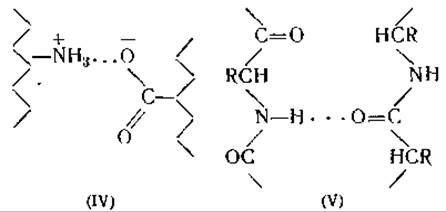
The longitudinal elongation of a wetted hair is clearly visible to the naked eye, whereas the corresponding increase in hair diameter can only be determined using sensitive measuring instruments [17].
In addition to their swelling capacity, keratin fibers also exhibit the ability to undergo supercontraction. In all likelihood, this phenomenon is likewise driven by the presence of salt bridges and hydrogen bonds in keratin. It is well established that wool undergoes irreversible shrinkage in hot water. The cause of such shrinkage appears to be the thermal disruption of weak cross-links at elevated temperatures (while disulfide bonds remain intact). As a result of these bonds breaking, the peptide chains adopt a more random conformation, which is accompanied by an increase in Entropy [18]. The disruption of salt bridges and hydrogen bonds during the stretching of a keratin fiber is reversible, whereas The breakdown of these bonds in hot water, leading to fiber contraction (supercontraction), is an irreversible process (Fig. 38).

Fig. 38. Keratin fibers.
A — active state; B — supercontracted state. Dashed lines indicate hydrogen bonds.
Electrovalent bonds between oppositely charged groups of the peptide chain play a crucial role in the stretching and supercontraction of keratin fibers. Two observations support this Conclusion: 1) The Effect of keratin deamination on both phenomena [19, 20], and 2) the loss of the shrinkage capacity in wool upon the binding of acidic or basic compounds to ionic groups [21].
In addition to the 5.1 and 3.4 Å identity periods revealed by X-ray diffraction analysis, keratin fibers exhibit higher-order repeating periods of approximately 110 Å, which can be detected using Electron Cell/15.html">Microscopy [22]. This finding suggests that keratin fibers are composed of chains of globular subunits, each spanning 110 Å along the fiber axis.
Feather keratin dissolves upon boiling in a neutral solution of dodecylbenzenesulfonic acid in sodium bisulfite. Osmometric and sedimentation analyses of these solutions have shown that the size of the dissolved particles corresponds to a Molecular Weight of 75,000. The particles consist of approximately 40% detergent (dodecylbenzenesulfonic acid) and 60% keratin. Assuming that each particle contains only a single keratin molecule, the molecular weight of the soluble keratin particles would be close to 40,000 [23]. Attempts to determine the Nature of the terminal amino acids in these particles by blocking free amino groups with dinitrofluorobenzene (see p. 124) led to unexpected results. It was found that seven different amino acids react with dinitrofluorobenzene [24]. The following molar ratios of dinitrofluoro-amino acids were obtained: 18 molecules of Glycine, 8 of Threonine, 4 of valine, 2 of Alanine, 2 of Serine, 2 of glutamic acid, and 1 of aspartic acid. On this basis, it was concluded that the minimum molecular weight of keratin is 2,000,000 and that the keratin molecule consists of 37 chains, each with an average molecular weight of 55,000 [24].
Last update: 06/08/2026
Editorial and Educational Adaptation: This material has been compiled based on the primary/original source text. The project team performed an editorial review, corrected technical inaccuracies, structured sections, and adapted the content for an educational format.
What was processed:
- elimination of formatting defects (OCR errors, structural breaks, corrupted characters);
- editorial organization of content;
- standardization of terminology in accordance with academic sources;
- verification of factual statements against the original source text.
All mentions of the author, publication year, and origin of the primary text have been preserved in accordance with the source.