Biological Chemistry - Berezov, T. T., & Korovkin, B. F. 1998
Metabolism of Simple Proteins
Specific Metabolic Pathways of Certain Amino Acids
Metabolism of Sulfur-Containing Amino Acids
Three Sulfur-Containing Amino Acids (Methionine, Cysteine, and cystine), which are metabolically closely interrelated, have been found in protein molecules. Due to the presence of a highly reactive SH group in cysteine, an enzymatic redox reaction between cysteine and cystine readily occurs in Tissues*.
Class="center">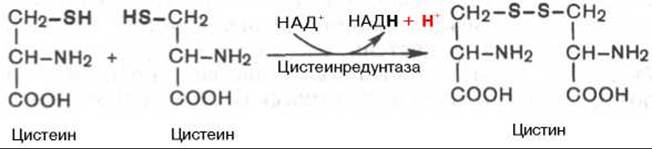
A disulfide bond is frequently formed between two cysteine residues within a single polypeptide chain or between two polypeptide chains, thereby contributing to the stabilization of the protein molecule. Cysteine is a constituent part of the tripeptide Glutathione, abbreviated as G—SH, which emphasizes the Functional Significance of its thiol group and the potential for disulfide bond formation in oxidized glutathione (G—S—S—G).
It is known that many Enzymes contain SH groups in their active sites, which are absolutely essential for the catalytic reaction. Upon oxidation, these enzymes lose their activity. It is hypothesized that one of the primary Functions of glutathione is to maintain these enzymes in their active, reduced form. Oxidized glutathione can be reduced by glutathione reductase using NADPH. Furthermore, glutathione can exert an inhibitory effect on certain Proteins. A notable example is the known reaction of Insulin inactivation mediated by glutathione-insulin transhydrogenase, in which SH-glutathione acts as a donor of hydrogen atoms that cleave the Disulfide Bonds between the two polypeptide chains of the insulin molecule. The coenzyme function of glutathione has also been established, specifically for glyoxalase I. The participation of glutathione in the Transport of Amino acids across The Cell membrane was discussed previously.
* The oxidation of cysteine to cystine can also proceed via a non-enzymatic pathway.
During Catabolism, the sulfur of methionine in tissues is largely converted into the sulfur of cysteine, and the interconversion of cystine and cysteine occurs readily. Therefore, Structure/149.html">The problem of sulfur oxidation for all amino acids practically reduces to the oxidation of cysteine. The main pathway has proven to be oxidative, involving the oxidation of cysteine to cysteinesulfinic acid, Transamination of the latter with a-ketoglutarate, and The formation of Pyruvate and sulfite According to the following scheme:

Sulfite is then rapidly oxidized in tissues and excreted in the urine as nontoxic sulfates and ethereal sulfates. The utilization of cysteine and its oxidation products—cysteinesulfinic and cysteic acids—in the formation of taurine was examined earlier.
The Metabolic pathways of methionine conversion in tissues are considerably more diverse than those of other sulfur-containing amino acids; nevertheless, methionine catabolism proceeds via cysteine. This conversion of methionine into cysteine has been shown to be an irreversible process. It has also been found that the carbon Skeleton of cysteine originates from another amino acid, namely Serine. The actual donor of methyl groups in Transmethylation reactions is not free methionine, but the so-called active methionine, S-adenosylmethionine, which is formed via an ATP-dependent reaction catalyzed by methionine adenosyltransferase.
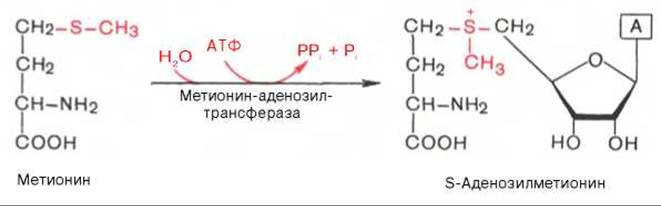
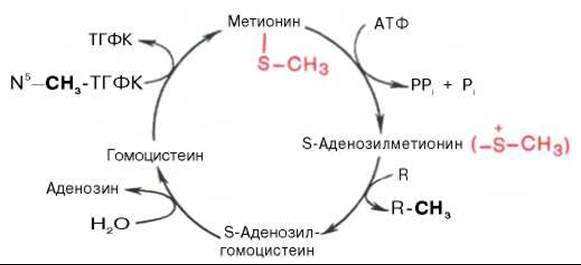
The peculiarity of this reaction lies in the fact that the CH3 group of methionine is activated by the positive charge of the adjacent sulfur atom. S-Adenosylmethionine participates in all reactions where the methyl group is utilized in biosynthetic pathways: for instance, in the synthesis of adrenaline, creatinine, thymine, phosphatidylcholine, betaine, etc. Following the Cleavage of the methyl group, the resulting S-adenosylhomocysteine undergoes Hydrolysis into adenosine and homocysteine; the latter is utilized in serine synthesis (this is the primary metabolic pathway) or serves as a methyl group acceptor from N5—CH3—FH4 in the synthesis of methionine (this reaction is catalyzed by homocysteine methyltransferase), thereby completing a unique cycle of methyl Group activation.
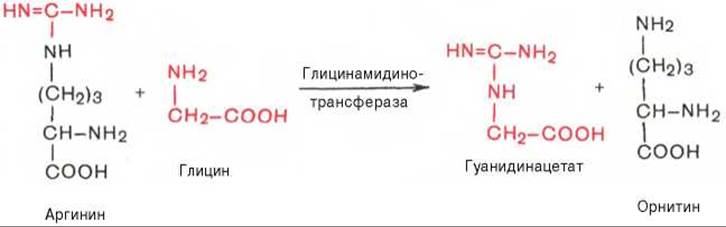
As an example, we present the scheme of creatine Biosynthesis, which involves Three amino acids: Arginine, Glycine, and methionine. The synthetic pathway proceeds in two stages. The First stage—The biosynthesis of guanidinoacetate—takes place in the Kidneys with the participation of glycine amidinotransferase (EC 2.1.4.1):
The Second Stage of creatine synthesis occurs in the Liver with the participation of guanidinoacetate methyltransferase (EC 2.1.1.2):
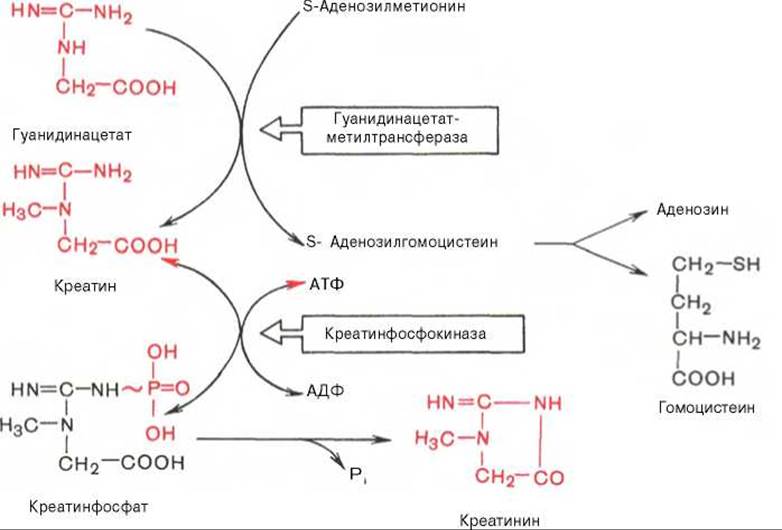
Creatine undergoes phosphorylation to yield creatine phosphate, which, upon dephosphorylation (an irreversible reaction), is converted into creatinine and excreted in the urine.
Homocysteine can be reconverted into methionine via methylation. However, the main pathway of further homocysteine transformation is linked to its utilization in cysteine synthesis, which can be represented as two consecutive enzymatic reactions.
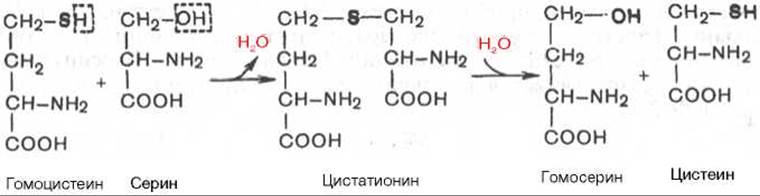
The enzymes catalyzing the Synthesis and Breakdown of cystathionine (cystathionine β-synthase and cystathionase) contain PLP. Cysteine is subsequently subjected to oxidation via the previously described pathway, whereas homoserine, following transamination with a-ketoglutarate, is converted into a-ketobutyric acid; the latter can also be formed directly from cystathionine, bypassing the homoserine stage.
Last update: 06/08/2026
Editorial and Educational Adaptation: This material has been compiled based on the primary/original source text. The project team performed an editorial review, corrected technical inaccuracies, structured sections, and adapted the content for an educational format.
What was processed:
- elimination of formatting defects (OCR errors, structural breaks, corrupted characters);
- editorial organization of content;
- standardization of terminology in accordance with academic sources;
- verification of factual statements against the original source text.
All mentions of the author, publication year, and origin of the primary text have been preserved in accordance with the source.