Biological Chemistry - Berezov, T. T., Korovkin, B. F. 1998
Metabolism of Simple Proteins
Specific Pathways of Metabolism for Certain Amino Acids
Metabolism of Glycine and Serine
In addition to the general metabolic pathways characteristic of Most Amino Acids, individual pathways for The conversion of nearly all amino acids that make up protein molecules have now been investigated in considerable detail in animal Tissues. Although some of these transformations are of secondary quantitative importance, the reaction products derived from them can play a vital, and sometimes decisive, role in metabolic processes. The following sections provide a selective Overview of the METABOLISM of those amino acids whose specific (so-called particular) pathways of transformation in the Human and Animal Organism largely determine its physiological state.
Glycine is the only protein-derived amino acid whose molecule lacks an asymmetric carbon atom. Nevertheless, its metabolic connections to the Cell/6.html">Chemical Components of the organism are more extensive than those of any other amino acid.
Class="center">
As shown in the diagram, glycine plays an indispensable role in several syntheses, notably in The formation of Proteins, purine NUCLEOTIDES, the heme moiety of Hemoglobin, conjugated Bile acids, creatine, Glutathione, and others. Most of these reactions are covered in the relevant sections of the textbook. Here, we focus on the reactions responsible for the Interconversion of Glycine, Serine, and Threonine, as well as the pathways of Glycine Catabolism. It has been demonstrated that tetrahydrofolic acid participates in the interconversion of glycine and serine; this reaction is catalyzed by the pyridoxal enzyme serine hydroxymethyltransferase:

There is also Evidence for the interconversion of threonine and glycine via the threonine aldolase reaction:

However, the primary catabolic pathway of glycine in animal tissues is its degradation into CO2, NH3, and N5, N10-methylenetetrahydrofolate According to the equation:

The Mechanism of this reaction, recently elucidated by K. Tada, involves a mitochondrial glycine Cleavage enzyme system that is distinct from glycine synthase and consists of four proteins: the P-protein, containing Pyridoxal phosphate (glycine decarboxylase); the H-protein, containing Lipoic Acid; the T-protein, which requires the presence of THF; and the L-protein, designated as lipoamide dehydrogenase:
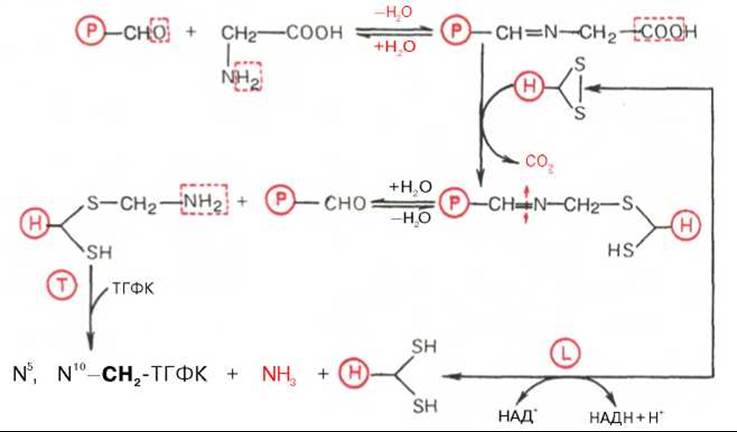
The Biological Significance of this glycine catabolic pathway lies most likely in the generation of an active single-carbon unit (N5, N10—CH2—THF) utilized in unique synthetic reactions involving Methionine, purine nucleotides, thymidylic acid, etc. Evidence has been obtained indicating that hereditary nonketotic hyperglycinemia (elevated Blood glycine levels) is caused by a deficiency of either the P- or T-protein of the hepatic or cerebral glycine cleavage system, and that each of these proteins is controlled by a separate Gene.
Serine is readily converted into Pyruvate by the action of serine dehydratase. Consequently, conditions exist in tissues for the conversion of glycine (via serine) into pyruvate. This is the pathway through which glycine participates in Carbohydrate Metabolism. Serine also plays a crucial role in The Biosynthesis of complex proteins, such as Phosphoproteins, as well as phosphoglycerides. In addition to phosphatidylserine, the carbon Skeleton and nitrogen of serine are utilized in the biosynthesis of phosphatidylethanolamine and phosphatidylcholine (see Chapter 11).
Several other essential Functions of glycine—specifically its Participation in the formation of 5-aminolevulinic acid during the Synthesis of Porphyrins (heme) and purine nucleotides—are discussed below (see Chapter 13).
Last update: 06/08/2026
Editorial and Educational Adaptation: This material has been compiled based on the primary/original source text. The project team performed an editorial review, corrected technical inaccuracies, structured sections, and adapted the content for an educational format.
What was processed:
- elimination of formatting defects (OCR errors, structural breaks, corrupted characters);
- editorial organization of content;
- standardization of terminology in accordance with academic sources;
- verification of factual statements against the original source text.
All mentions of the author, publication year, and origin of the primary text have been preserved in accordance with the source.