Biochemistry - The Chemical Reactions of Living Cells, Volume 3 - D. Metzler 1980
Metabolism of Nitrogen-Containing Compounds
Serine and Glycine
Glycine Catabolism
If Glycine is formed from glyoxylate via Transamination, the reverse conversion of excess glycine into glyoxylate can be carried out by amino acid oxidase (Table 8-4). The existence of primary hyperoxaluria [67] indicates that this pathway is also quantitatively significant for humans. It is believed that in this condition, one of the normal glyoxylate disposal pathways is blocked, leading instead to its oxidation to oxalate. The Nature of this biochemical defect remains unclear, but it may involve a thiamine-dependent enzyme that catalyzes the Condensation of glyoxylate with a-ketoglutarate to yield 2-hydroxy-3-ketoadipate [equation (14-31)].
Class="center">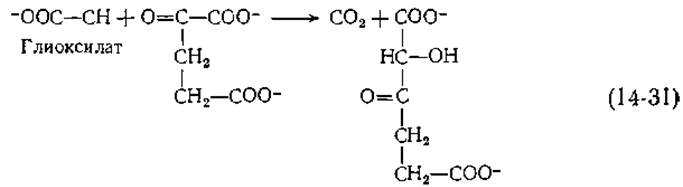
Although the physiological significance of this reaction is unknown, it is readily apparent that the product can undergo further decarboxylation and oxidation with the regeneration of a-ketoglutarate. Thus, the enzyme provides a cyclic pathway for glyoxylate oxidation (closely coupled with the Dicarboxylic Acid Cycle; Fig. 9-5) that is independent of oxalate formation. It should be noted that numerous Reactions Involving the enzymatic condensation of glyoxylate have been demonstrated, and the METABOLISM of glyoxylate in most organisms is still not fully understood.
Another catabolic pathway is utilized in Cells of Diplococcus glycinophilus, which can grow on glycine as the sole source of energy, carbon, and nitrogen [71]. The initial reaction is the decarboxylation of glycine coupled with oxidation by NAD+, accompanied by the release of ammonia and The transfer of the a-carbon atom of glycine to tetrahydrofolic acid (H4Fоl), yielding methylenetetrahydrofolic acid. In this compound, the methylene group occupying the C-1 position can condense with another glycine molecule [the reverse of the reaction described by equation (8-19)] to form Serine, which in turn can be converted into Pyruvate [equation (14-32)]:

Pyruvate can be oxidized as an energy source or utilized for the synthesis of cellular components. This entire pathway apparently plays an important role in both PLANT AND ANIMAL metabolism [72], as well as in bacterial metabolism.

The decarboxylation step shown in equation 14-32 requires the participation of four Proteins, one of which (P1, mol. wt. ~125,000) contains two molecules of PLP and presumably reacts with glycine to form a Schiff base. The hypothetical mechanism for the subsequent course of the reaction [equation (14-33)] is based on proposals put forward by Baginsky and Huennekens [73].
At stage a, one of the a-hydrogens of glycine is presumably abstracted to form a quinonoid intermediate, which then (at stage b) reacts with protein P2, a small heat-stable molecule with a mol. wt. of ~10,000 resembling thioredoxin (Chap. 8; Sec. II, 2). Following decarboxylation (stage c), the reduced P2 is released (stage d) and reoxidized at stage e by the flavoprotein P3 (with a mol. wt. of ~120,000, containing one molecule of FAD). The reduced P3 is, in turn, oxidized by NAD+.
Only a CH2 fragment and an amino group remain from the glycine attached to PLP in protein P1. The reader can easily write out a series of substitution and elimination reactions in which the nitrogen at the 5-position (N-5) of tetrahydrofolic acid (Chap. 8, Sec. XII, 1) captures the CH2 group, while simultaneously, with The formation of an internal Schiff base between PLP and the ε-amino group of the enzyme (stage f), NH3 is released. The Role of protein P4 is unknown, but it may be involved in transferring the CH2 group to tetrahydrofolic acid.
Last update: 06/08/2026
Editorial and Educational Adaptation: This material has been compiled based on the primary/original source text. The project team performed an editorial review, corrected technical inaccuracies, structured sections, and adapted the content for an educational format.
What was processed:
- elimination of formatting defects (OCR errors, structural breaks, corrupted characters);
- editorial organization of content;
- standardization of terminology in accordance with academic sources;
- verification of factual statements against the original source text.
All mentions of the author, publication year, and origin of the primary text have been preserved in accordance with the source.