Biological Chemistry - Berezov, T. T., & Korovkin, B. F. 1998
Lipid Metabolism
Fatty Acid Oxidation
It has been established that Fatty acid oxidation takes place in the Liver, Kidneys, skeletal and cardiac Muscles, and adipose tissue. In Brain tissue, The rate of fatty acid oxidation is extremely low; Glucose serves as the primary energy source in the brain.
In 1904, F. Knoop proposed the hypothesis of ß-Oxidation of Fatty acids based on experiments in which dogs were fed various Fatty acids in which a single hydrogen atom at the terminal methyl group (the w-carbon atom) was replaced by a radical (С6Н5—).
F. Knoop suggested that The oxidation of a fatty acid molecule in body Tissues occurs at the ß-position. As a result, two-carbon fragments are successively cleaved from the fatty acid molecule on the carboxyl group side.
Fatty acids that make up natural animal and plant fats have an even number of carbon atoms. Any such acid, from which pairs of carbon atoms are successively cleaved, eventually passes through the butyric acid stage. Following the next ß-Oxidation step, butyric acid is converted into acetoacetic acid. The latter is subsequently hydrolyzed into two molecules of acetic acid. F. Knoop's theory of fatty acid ß-oxidation largely served as the foundation for modern concepts regarding The Mechanism of fatty acid oxidation.
The delivery of fatty acids to their site of oxidation—the Cell/35.html">Mitochondria—occurs via a complex pathway: transport into The Cell is mediated by albumin; transport within the Cytosol involves specialized Proteins (fatty acid binding proteins, FABP); and Transport from the cytosol into the mitochondria is mediated by carnitine.
The process of fatty acid oxidation consists of the following main stages.
Fatty acid activation. Free fatty acids, regardless of the length of their hydrocarbon chain, are metabolically inert and cannot undergo any biochemical transformations, including oxidation, until they are activated. Fatty acid activation takes place on the outer surface of the mitochondrial membrane with the participation of ATP, coenzyme A (HS-CoA), and Mg2+ ions. The reaction is catalyzed by the enzyme acyl-CoA synthetase:
Class="center">
The reaction yields acyl-CoA, which is the active form of the fatty acid.
It is believed that fatty acid activation proceeds in two steps. First, the fatty acid reacts with ATP to form acyl adenylate, which is a mixed anhydride of the Fatty acid and AMP. Next, the sulfhydryl group of CoA attacks the enzyme-bound acyl adenylate to form acyl-CoA and AMP.
Transport of fatty acids into the mitochondria. The coenzyme form of a fatty acid, much like free fatty acids, is incapable of penetrating into the mitochondria, where their oxidation actually takes place. Carnitine acts as the carrier for long-chain activated fatty acids across The inner mitochondrial membrane. The acyl group is transferred from the sulfur atom of CoA to the hydroxyl group of carnitine, forming acylcarnitine, which diffuses across the inner mitochondrial membrane:
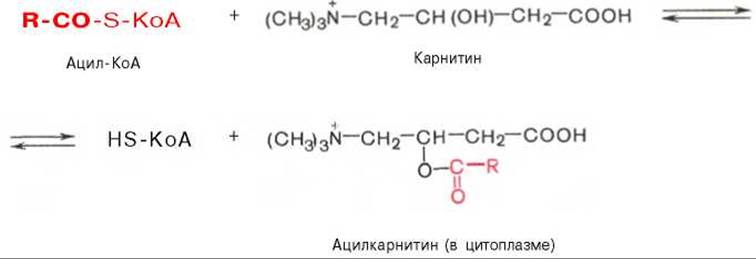
The reaction proceeds with the participation of the specific cytoplasmic enzyme carnitine acyltransferase. On the inner side of the membrane facing the matrix, the acyl group is transferred back to CoA—a thermodynamically favorable process because the O-acyl bond in carnitine possesses a high group-transfer potential. In other words, once the acylcarnitine crosses the mitochondrial membrane, the reverse reaction takes place: the Cleavage of acylcarnitine in the presence of HS-CoA and mitochondrial carnitine acyltransferase:

Intramitochondrial fatty acid oxidation. The process of fatty acid oxidation within cell mitochondria comprises several sequential enzymatic reactions.
First dehydrogenation stage. In the mitochondria, acyl-CoA first undergoes enzymatic dehydrogenation, during which acyl-CoA loses two hydrogen atoms from the a- and ß-positions, converting into a CoA ester of an unsaturated acid. Thus, the first reaction in each cycle of acyl-CoA breakdown is its oxidation by acyl-CoA dehydrogenase, leading to The formation of enoyl-CoA with a double bond between C-2 and C-3:
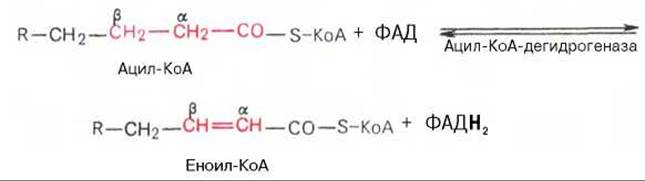
There are several FAD-containing acyl-CoA dehydrogenases, each exhibiting Specificity toward acyl-CoA molecules with a specific carbon chain length.
Hydration stage. The unsaturated acyl-CoA (enoyl-CoA) adds a molecule of Water with the participation of the enzyme enoyl-CoA hydratase. This results in the formation of ß-hydroxyacyl-CoA (or 3-hydroxyacyl-CoA):

It should be noted that the hydration of enoyl-CoA is stereospecific, similar to the hydration of fumarate and aconitate (see p. 348). The hydration of the trans-∆2 double bond yields exclusively the L-isomer of 3-hydroxyacyl-CoA.
Second dehydrogenation stage. The resulting ß-hydroxyacyl-CoA (3-hydroxyacyl-CoA) is then dehydrogenated. This reaction is catalyzed by NAD+-dependent dehydrogenases:
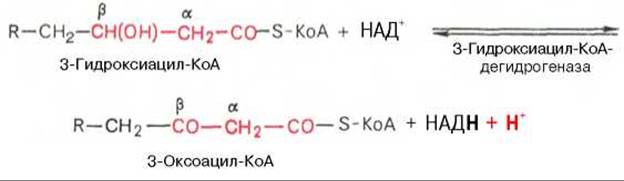
Thiolase reaction. The preceding reactions involved the oxidation of the methylene group at C-3 into an oxo group. The thiolase reaction represents the cleavage of 3-oxoacyl-CoA by means of the thiol group of a second CoA molecule. As a result, an acyl-CoA shortened by two carbon atoms and a two-carbon fragment in the form of acetyl-CoA are produced. This reaction is catalyzed by acetyl-CoA acyltransferase (ß-ketothiolase):
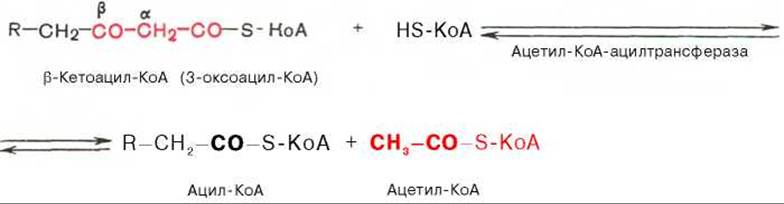
The resulting acetyl-CoA undergoes oxidation in The Tricarboxylic Acid Cycle, whereas the acyl-CoA, shortened by two carbon atoms, repeatedly goes through the entire pathway of ß-oxidation until the formation of butyryl-CoA (a 4-carbon compound), which in turn is oxidized to 2 molecules of acetyl-CoA (Fig. 11.2). For example, the oxidation of palmitic acid (C16) involves 7 repeating cycles of ß-oxidation. It should be noted that for the oxidation of a fatty acid containing n carbon

Fig. 11.2. Fatty acid oxidation (the "Lynen spiral"). The first oxidation cycle is shown in detail—the shortening of the fatty acid chain by two carbon atoms. The remaining cycles are identical to the first one (adapted from A.N. Klimov and N.G. Nikulcheva).
1 - acyl-CoA dehydrogenase (EC 1.3.99.3); 2 - enoyl-CoA hydratase (EC 4.2.1.17); 3 - ß-hydroxyacyl-CoA dehydrogenase (EC 1.1.1.35); 4 - thiolase (EC 2.3.1.9).
atoms, n/2—1 cycles of ß-oxidation take place (i.e., one cycle fewer than n/2, because the oxidation of butyryl-CoA immediately leads to the formation of
2 molecules of acetyl-CoA), yielding a total of n/2 molecules of acetyl-CoA. Consequently, the overall equation for the ß-oxidation of an activated acid can be written as follows:

Energy balance. Each cycle of ß-oxidation produces one molecule of FADH2 and one molecule of NADH. Upon subsequent oxidation in the Respiratory Chain and coupled phosphorylation, these yield: FADH2 — 2 ATP molecules and NADH — 3 ATP molecules, meaning that a total of 5 ATP molecules are generated per cycle. The oxidation of palmitic acid yields 5 × 7 = 35 ATP molecules. During the ß-oxidation of palmitic acid, 8 molecules of acetyl-CoA are formed; each of these, upon being "burned" in the tricarboxylic acid cycle, yields 12 ATP molecules, and 8 molecules of acetyl-CoA will give 12 × 8 = 96 ATP molecules.
Thus, the complete ß-oxidation of palmitic acid yields a total of 35 + 96 = 131 ATP molecules. Taking into account the single ATP molecule consumed at the very beginning to form the active form of palmitic acid (palmitoyl-CoA), the net energy yield from the Complete oxidation of one palmitic acid molecule in the animal Organism amounts to 131 — 1 = 130 ATP molecules. The change in Free energy AF during the complete combustion of 1 mole of palmitic
acid is 2338 kcal, and the energy-rich phosphate bond of ATP is characterized by a value of 7.6 kcal/mol. It is easy to calculate that approximately 990 kcal (7.6 × 130), or 42% of the total potential energy of palmitic acid during its oxidation in the body, is utilized for ATP resynthesis, while the remaining portion is evidently dissipated as heat.
Consequently, the METABOLISM/25.html">Efficiency of Energy storage resulting from fatty acid oxidation under standard conditions is ~ 40%, which is close to the corresponding value for Glycolysis, the tricarboxylic acid cycle, and Oxidative Phosphorylation.
Last update: 06/08/2026
Editorial and Educational Adaptation: This material has been compiled based on the primary/original source text. The project team performed an editorial review, corrected technical inaccuracies, structured sections, and adapted the content for an educational format.
What was processed:
- elimination of formatting defects (OCR errors, structural breaks, corrupted characters);
- editorial organization of content;
- standardization of terminology in accordance with academic sources;
- verification of factual statements against the original source text.
All mentions of the author, publication year, and origin of the primary text have been preserved in accordance with the source.