Biological Chemistry - Berezov T. T., Korovkin B. F. 1998
Carbohydrate Metabolism
Glycolysis
Glycolysis (from Greek glycys — sweet and lysis — dissolution, breakdown) is a sequence of enzymatic reactions leading to The conversion of glucose into Pyruvate with the simultaneous generation of ATP.
Under aerobic conditions, pyruvate enters the Cell/35.html">Mitochondria, where it is completely oxidized to CO2 and H2O. If oxygen availability is insufficient, as may occur in actively contracting Muscle, pyruvate is converted into lactate.
Thus, glycolysis is not only the principal pathway for glucose utilization in Cells, but also a unique pathway because it can utilize oxygen when available (aerobic conditions), yet can proceed in the absence of oxygen as well (anaerobic conditions).
* As noted previously, unlike the Liver, Muscle tissue lacks glucose-6-phosphatase. The pathways of Glycogen breakdown and synthesis in the liver are generally similar to those in muscle; however, there are significant differences in The Structure of hepatic and muscular metabolic Enzymes, as well as in the mechanisms regulating their activity.
Anaerobic Glycolysis is a complex enzymatic process of glucose breakdown that occurs in Human and Animal Tissues without oxygen consumption. The end product of glycolysis is lactic acid. ATP is generated during the glycolytic process. The overall equation for glycolysis can be represented as follows:
Class="center">
Under anaerobic conditions, glycolysis is the sole energy-supplying process in the animal Organism. It is precisely thanks to glycolysis that human and animal organisms can sustain a range of physiological Functions for a certain period under conditions of oxygen deprivation. In cases where glycolysis proceeds in the presence of oxygen, it is referred to as aerobic glycolysis*.
The sequence of reactions in anaerobic glycolysis, as well as their intermediates, has been thoroughly studied. The glycolytic process is catalyzed by eleven enzymes, most of which have been isolated in homogeneous, crystalline, or highly purified forms, and whose properties are well characterized. It should be noted that glycolysis takes place in the hyaloplasm (Cytosol) of The Cell.
The first enzymatic reaction of glycolysis is phosphorylation, i.e., The transfer of an orthophosphate group to glucose at the expense of ATP. The reaction is catalyzed by the enzyme hexokinase:
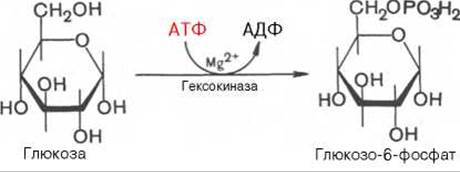
The formation of glucose-6-phosphate in the hexokinase reaction is accompanied by the release of a significant amount of Free energy from the system and can be considered a practically irreversible process.
The most important property of hexokinase is its inhibition by glucose-6-phosphate, meaning the latter serves simultaneously as a reaction product and an allosteric inhibitor.
The enzyme hexokinase is capable of catalyzing the phosphorylation not only of D-glucose, but also of other hexoses, notably D-fructose, D-mannose, etc. In the liver, alongside hexokinase, there is an enzyme called glucokinase, which catalyzes the phosphorylation exclusively of D-glucose. This enzyme is absent in muscle tissue (for details, see Chapter 16).
* Under aerobic conditions, the glycolytic breakdown of glucose to pyruvic acid can be viewed as the initial stage of glucose oxidation to the ultimate products of this process — CO2 and H2O.
The second reaction of glycolysis is the conversion of glucose-6-phosphate into fructose-6-phosphate, mediated by the enzyme glucose-6-phosphate isomerase:
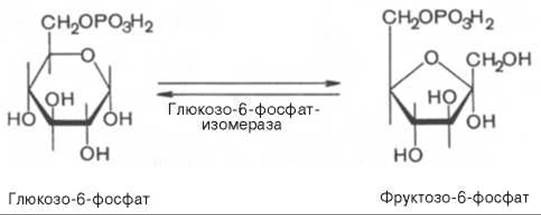
This reaction proceeds readily in both directions and does not require any Cofactors.
The third reaction is catalyzed by the enzyme Phosphofructokinase; the resulting fructose-6-phosphate is phosphorylated once again at the expense of a second ATP molecule:
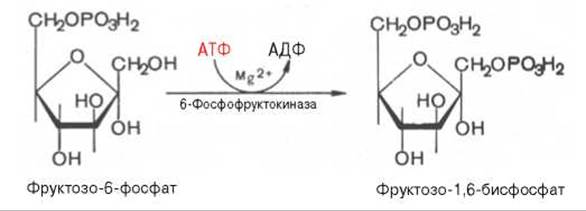
Similar to the hexokinase reaction, this reaction is practically irreversible, proceeds in the presence of magnesium ions, and is the slowest step in glycolysis. In fact, this reaction determines the overall rate of glycolysis.
Phosphofructokinase belongs to the class of allosteric enzymes. It is inhibited by ATP and stimulated by AMP*. At high ATP/AMP ratios, phosphofructokinase activity is suppressed, and glycolysis slows down. Conversely, when this ratio decreases, The rate of glycolysis increases. Thus, in resting muscle, phosphofructokinase activity is low, while the ATP concentration is relatively high. During Muscle contraction, intensive consumption of ATP occurs, leading to an increase in phosphofructokinase activity, which accelerates glycolysis.
The fourth reaction of glycolysis is catalyzed by the enzyme aldolase. Under METABOLISM/18.html">The Influence of this enzyme, fructose-1,6-bisphosphate is cleaved into two phosphotrioses:
* Phosphofructokinase activity is also inhibited by citrate. It has been shown that in diabetes, starvation, and certain other states when fats are intensively utilized as an energy source, the citrate content in tissue cells can increase severalfold. Under these conditions, a sharp inhibition of phosphofructokinase activity by citrate takes place.
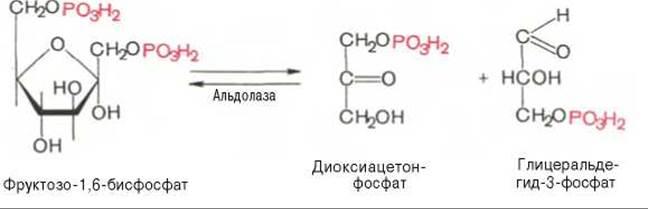
This reaction is reversible. Depending on Temperature, equilibrium is established at different levels. As the temperature rises, the reaction shifts toward a greater formation of triose phosphates (dihydroxyacetone phosphate and glyceraldehyde-3-phosphate)*.
The fifth reaction is the isomerization of triose phosphates, catalyzed by the enzyme triose phosphate isomerase:
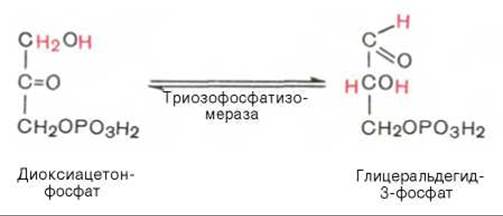
The equilibrium of this isomerization reaction lies heavily toward dihydroxyacetone phosphate: 95% dihydroxyacetone phosphate and about 5% glyceraldehyde-3-phosphate. Only one of the two resulting triose phosphates—specifically, glyceraldehyde-3-phosphate—can directly enter subsequent glycolytic reactions. Consequently, as the aldehyde form of the phosphotriose is consumed in further transformations, more dihydroxyacetone phosphate is continuously converted into glyceraldehyde-3-phosphate.
The Formation of glyceraldehyde-3-phosphate effectively marks the completion of The First stage of glycolysis. The Second Stage is the most complex and critical one. It involves an oxidation-reduction reaction (known as the glycolytic oxido-reduction) coupled with substrate-level phosphorylation, during which ATP is generated.
As a result of the sixth reaction, glyceraldehyde-3-phosphate undergoes a unique oxidation in the presence of the enzyme glyceraldehyde-3-phosphate dehydrogenase, the coenzyme NAD+, and inorganic phosphate, yielding 1,3-bisphosphoglyceric acid** and reduced NAD (NADH). This reaction, which is blocked by iodoacetate or bromoacetate, proceeds in several steps:
* Animal tissues contain at least three distinct aldolases, specific to muscle, liver, and Brain, respectively. All of these aldolases cleave fructose-1,6-bisphosphate into dihydroxyacetone phosphate and glyceraldehyde-3-phosphate, and can also catalyze the reverse Condensation of dihydroxyacetone phosphate with various oxyaldehydes, albeit at varying rates.
** Glyceraldehyde-3-phosphate is the final carbohydrate in the glucose degradation pathway. Subsequent transformations involve organic acids that exist in a dissociated form; therefore, alongside the names of the free acids, their corresponding anions are also commonly used, such as 3-phosphoglycerate, pyruvate, etc.
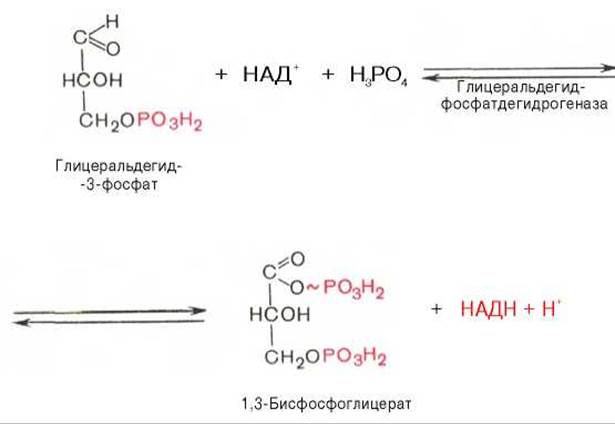
1,3-Bisphosphoglycerate is a high-energy compound (with the high-energy bond conventionally denoted by a tilde, ~). The Mechanism of glyceraldehyde-3-phosphate dehydrogenase action is as follows: in the presence of inorganic phosphate, NAD+ acts as an acceptor for the hydrogen removed from glyceraldehyde-3-phosphate. During the formation of NADH, glyceraldehyde-3-phosphate binds to the enzyme molecule via the latter's SH groups. The resulting bond is energy-rich yet labile, and is cleaved by inorganic phosphate to yield 1,3-bisphosphoglyceric acid.
The seventh reaction is catalyzed by phosphoglycerate kinase, which transfers the high-energy phosphate group (at the C-1 position) to ADP, producing ATP and 3-phosphoglyceric acid (3-phosphoglycerate):
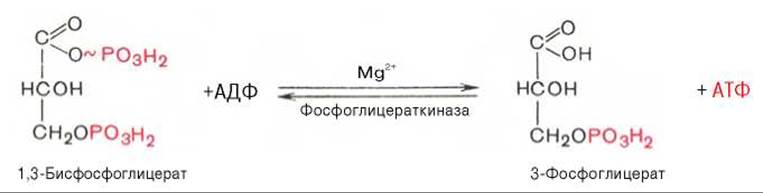
Thus, through the combined action of two enzymes—glyceraldehyde-3-phosphate dehydrogenase and phosphoglycerate kinase—The energy released during The oxidation of the aldehyde group of glyceraldehyde-3-phosphate to a carboxyl group is conserved in the form of ATP. Unlike Oxidative Phosphorylation, the synthesis of ATP from high-energy intermediates is termed substrate-level phosphorylation.
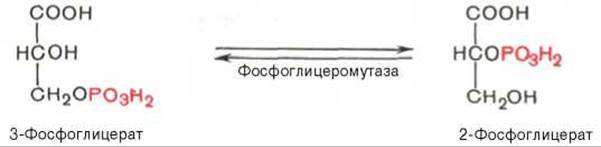
The eighth reaction involves an intramolecular shift of the remaining phosphate group, converting 3-phosphoglyceric acid into 2-phosphoglyceric acid (2-phosphoglycerate).
This reaction is readily reversible and proceeds in the presence of Mg2+ ions. The enzyme also requires 2,3-bisphosphoglyceric acid as a cofactor, much like glucose-1,6-bisphosphate acts as a cofactor in the phosphoglucomutase reaction:
The ninth reaction is catalyzed by enolaza, whereby 2-phosphoglyceric acid undergoes dehydration (loss of a Water molecule) to form phosphoenolpyruvic acid (phosphoenolpyruvate), converting the phosphate ester bond at the C-2 position into a high-energy bond:
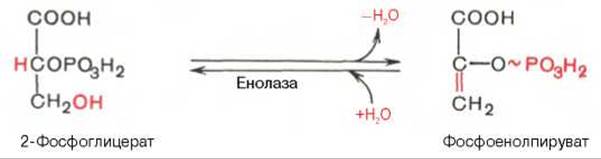
Enolase is activated by divalent cations such as Mg2+ or Mn2+ and is inhibited by fluoride.
The tenth reaction features the Cleavage of this high-energy bond and the transfer of the phosphate group from phosphoenolpyruvate to ADP (substrate-level phosphorylation). This step is catalyzed by pyruvate kinase:
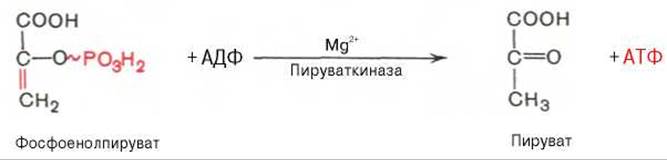
Pyruvate kinase requires Mg2+ ions as well as monovalent alkali metal cations (such as K+) for its activity. Inside the cell, this reaction is practically irreversible.
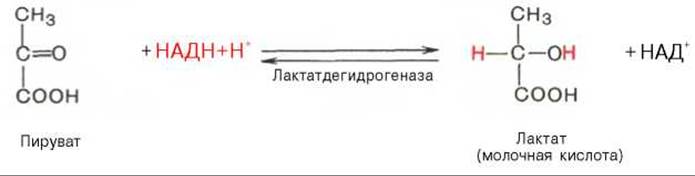
In the eleventh reaction, pyruvic acid is reduced to lactic acid. This process is mediated by Lactate dehydrogenase using the NADH coenzyme generated in the sixth reaction:
The sequence of reactions comprising glycolysis is illustrated in Fig. 10.3.
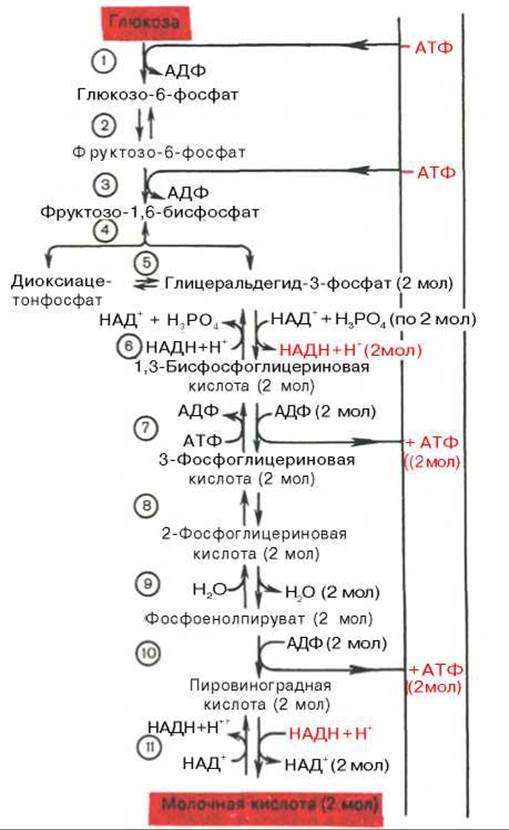
Fig. 10.3. Sequence of glycolysis reactions.
1 - hexokinase; 2 - phosphoglucoisomerase; 3 - phosphofructokinase; 4 - aldolase; 5 - Triosephosphate isomerase; 6 - glyceraldehyde-3-phosphate dehydrogenase; 7 - phosphoglycerate kinase; 8 - phosphoglyceromutase; 9 - enolase; 10 - pyruvate kinase; 11 - lactate dehydrogenase.
The pyruvate reduction reaction completes the internal redox cycle of glycolysis. NAD+ acts here as an intermediate hydrogen carrier from glyceraldehyde-3-phosphate (the 6th reaction) to pyruvic acid (the 11th reaction); in the process, it is regenerated and can re-enter the cyclic process known as glycolytic oxidoreduction.
The Biological Significance of glycolysis lies primarily in the generation of energy-rich phosphate compounds. In the Initial Stages of glycolysis, 2 molecules of ATP are consumed (the hexokinase and phosphofructokinase reactions). In the subsequent stages, 4 molecules of ATP are produced (the phosphoglycerate kinase and pyruvate kinase reactions). Thus, the net energy yield of glycolysis under anaerobic conditions is 2 molecules of ATP per molecule of glucose.
As noted, the primary rate-limiting reaction of glycolysis is the phosphofructokinase reaction. The second rate-limiting and regulatory reaction is the hexokinase reaction. In addition, glycolysis is controlled by LDH and its Isoenzymes. Tissues with aerobic metabolism (such as Heart and Kidney tissues) are dominated by the LDH1 and LDH2 isoenzymes (see Chapter 4). These isoenzymes are inhibited even by low concentrations of pyruvate, which prevents lactic acid accumulation and promotes more Complete oxidation of pyruvate (specifically, acetyl-CoA) in The Tricarboxylic Acid Cycle.
In human tissues that heavily rely on glycolytic energy (e.g., Skeletal Muscle), the predominant isoenzymes are LDH5 and LDH4. The activity of LDH5 is maximal at pyruvate concentrations that inhibit LDH1. The prevalence of the LDH4 and LDH5 isoenzymes drives intensive anaerobic glycolysis with the rapid conversion of pyruvate to lactic acid.
As mentioned earlier, the anaerobic breakdown of glycogen is termed Glycogenolysis. The incorporation of glycogen D-glucose units into The Glycolytic Pathway involves 2 enzymes: phosphorylase a and phosphoglucomutase. The glucose-6-phosphate formed via the phosphoglucomutase reaction can then enter the glycolysis pathway. Following the formation of glucose-6-phosphate, the subsequent steps of glycolysis and glycogenolysis are identical:
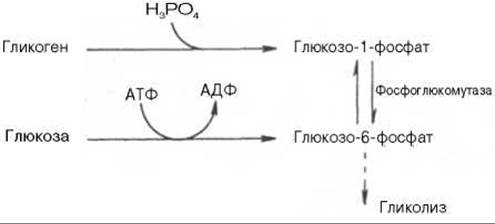
During glycogenolysis, three molecules of ATP rather than two are accumulated as high-energy compounds (since no ATP is expended to form glucose-6-phosphate). At first glance, the energy efficiency of glycogenolysis appears somewhat higher than that of glycolysis; however, this efficiency is only realized in the presence of active phosphorylase a. It should be noted, however, that the activation of phosphorylase b consumes ATP (see Fig. 10.2).
Last update: 06/08/2026
Editorial and Educational Adaptation: This material has been compiled based on the primary/original source text. The project team performed an editorial review, corrected technical inaccuracies, structured sections, and adapted the content for an educational format.
What was processed:
- elimination of formatting defects (OCR errors, structural breaks, corrupted characters);
- editorial organization of content;
- standardization of terminology in accordance with academic sources;
- verification of factual statements against the original source text.
All mentions of the author, publication year, and origin of the primary text have been preserved in accordance with the source.