Protein Chemistry - Part 1 - General Protein Chemistry - Ashmarin, I. P. 1968
Chemical Composition of Proteins
Chemical Reactions of Amino Acids
Reactions of the Amino Group
The chemical properties of Amino Acids are so diverse that they cannot be covered comprehensively in this manual. This diversity arises from the presence of multiple reactive groups within amino acid molecules (amino, carboxyl, and side chains). Consequently, amino acids not only exhibit all the General Properties of primary amines and carboxylic acids but also undergo a wide range of specific individual reactions. Furthermore, the simultaneous presence of both carboxyl and amino groups in an amino acid molecule imparts several distinct special properties to these compounds. Therefore, this section will focus exclusively on those Chemical Reactions of Amino Acids that are of biochemical interest and prove useful in The Study of Proteins. These can be categorized into reactions involving the amino group, the carboxyl group, and reactions involving both groups. Properties of amino acids determined by the R group will not be discussed here (some of these reactions are covered in Chapter III).
N-Alkylation. Alkylation is the substitution of a hydrogen atom in the amino group by a corresponding hydrocarbon radical. Thus, the interaction of amino acids with methyl halides or dimethyl sulfate yields N-mono- or N-dimethyl derivatives of these acids:
Class="center">(CH3)2 SO4 + H2N—CHR—COOH →
→ (CH3)2N — CHR — COOH + H2SO4
The aforementioned Reagents also possess a limited ability to substitute hydrogen in the carboxyl group and the R radical. This reaction is occasionally utilized to study how the substitution of hydrogen at the terminal amino groups of a protein affects its biological activity.
Arylation. In a mildly alkaline medium at 35–37°C, the free amino groups of amino acids react with 2,4-dinitro-1-fluorobenzene to form the corresponding dinitrophenyl derivatives (DNP derivatives):
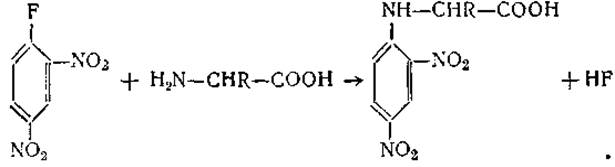
Generally, only one DNP radical attaches to the α-amino group; however, Lysine, Histidine, Cysteine, and Tyrosine attach a second radical to the ε-NH2 group, imidazole, hydroxyl, and SH groups, respectively. All DNP derivatives, except O-mono-DNP-tyrosine and S-mono-DNP-cysteine, are yellow and readily soluble in ether. In an acidic environment, the bond between the aromatic ring and The amino acid is more stable than the peptide bond and does not cleave during Hydrolysis. This property of DNP derivatives formed The basis of Sanger's METHOD FOR DETERMINING N-terminal amino acids in proteins and Polypeptides. The reaction to obtain arylsulfonyl derivatives using p-iodophenylsulfonyl chloride (pipsyl chloride) can be employed for the same purpose:

Acylation. Acylation of Amino acids encompasses a broad range of reactions involving the Introduction of organic acid residues, arylsulfonic acids, esters of various acids, as well as reactions with isocyanates, isothiocyanates, and Other Compounds. The simplest Examples of amino acid acylation are their interactions with formic acid, acetic anhydride (carried out in glacial acetic acid), and gaseous ketene upon heating:

The introduction of an organic acid residue is frequently used to assess how the Acetylation of N-terminal α-amino groups and lysine ε-amino groups affects the Functional Properties of a protein.
The interaction of amino acid amino groups with arylsulfonic acids and organic acid esters is widely applied for analytical and synthetic purposes. Specifically, as noted above, the reaction of the amino group with an iodosulfonic acid derivative—p-iodophenylsulfonyl chloride—is used to identify N-terminal amino acids. In Peptide Synthesis, benzyl esters of chlorocarbonic acid (carbobenzoxy chlorides) have proven highly valuable for protecting free amino groups:

However, The most significant acylation reactions are those involving isocyanates and isothiocyanates. Generally, the reaction of amino groups with aryl isocyanates can be represented by the following equation:

This yields substituted ureas known as arylcarbamino acids, which undergo cyclization into the corresponding hydantoins upon Treatment with anhydrous Hydrochloric acid:

The reaction of amino acid amino groups with aryl isothiocyanates proceeds similarly. This reaction was utilized by Edman to determine N-terminal amino acids in protein molecules (see Chapter III), employing phenyl isothiocyanate as the aryl isothiocyanate:

The reaction takes place in a pyridine-Water medium at pH 8–9 and a Temperature of 40°C. The resulting phenylthiocarbamyl Amino Acid Derivatives are treated with anhydrous hydrochloric acid, which converts them into phenylthiohydantoins. Phenylthiohydantoins of various Amino acids can be separated chromatographically; upon alkaline hydrolysis, they break down into phenyl isothiocyanate and the corresponding amino acid, which is then identified chromatographically.
Van Slyke Reaction. Amino acids containing a primary amino group readily react with nitrous acid to yield the corresponding hydroxy acid and nitrogen gas:

This reaction is a classic technique for monitoring the progression of Protein Hydrolysis by converting liberated amino groups into nitrogen gas, which can be quantified using manometric Methods. The advantage of the Van Slyke method is that only the α-amino groups of Amino Acids and the N-Terminal Groups of resulting Peptides react rapidly with nitrous acid (within 5–10 minutes). Neither the ε-amino groups of lysine nor the ammonia cleaved from aspartic and glutamic acid amides reacts rapidly in this assay.
Reaction with Formaldehyde (Formol Titration). Originally developed by Sørensen, this reaction is frequently used to assess the degree of protein hydrolysis based on the number of released carboxyl groups. In this Procedure, the Amino groups are blocked with formaldehyde, while the carboxyl groups are titrated with alkali. The reaction between formaldehyde and the amino group occurs in two stages. First, hydrated formaldehyde forms an N-monohydroxymethyl amino acid derivative, which then reacts with a second molecule of the aldehyde to convert into a dihydroxymethyl derivative:

Formaldehyde is also capable of forming methylene bridges between an amino group and another group containing labile hydrogen atoms (imidazole, guanidine, indole, SH, and OH groups). This reaction is widely used to produce toxoids and other modified proteins (see Ch. III).
Last update: 06/08/2026
Editorial and Educational Adaptation: This material has been compiled based on the primary/original source text. The project team performed an editorial review, corrected technical inaccuracies, structured sections, and adapted the content for an educational format.
What was processed:
- elimination of formatting defects (OCR errors, structural breaks, corrupted characters);
- editorial organization of content;
- standardization of terminology in accordance with academic sources;
- verification of factual statements against the original source text.
All mentions of the author, publication year, and origin of the primary text have been preserved in accordance with the source.