Molecular Biology: Protein Structure and Function - Stepanov V.M. 2005
Amino Acids
Chemical Reactions of α-Amino Acids
These reactions are divided into those characteristic of a-amino groups, a-carboxyl groups, and those involving both functional groups simultaneously.
1.2.1. Reactions of Amino Groups
In general, these reactions are analogous to those of aliphatic amines. Acylation with activated acid derivatives in the presence of a base that binds the released acid proceeds quite readily. Such reactions include, for example:
✵ Acylation of Amino acids with acetic anhydride:
Class="center">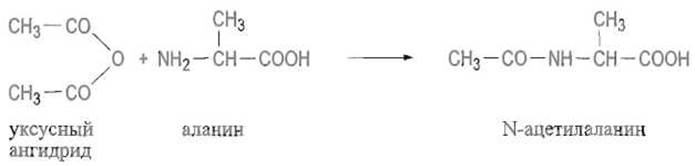
✵ reaction with 5-dimethylaminonaphthalenesulfonyl chloride (dansyl chloride) — Dansylation, which allows The conversion of an amino acid into a fluorescent compound:
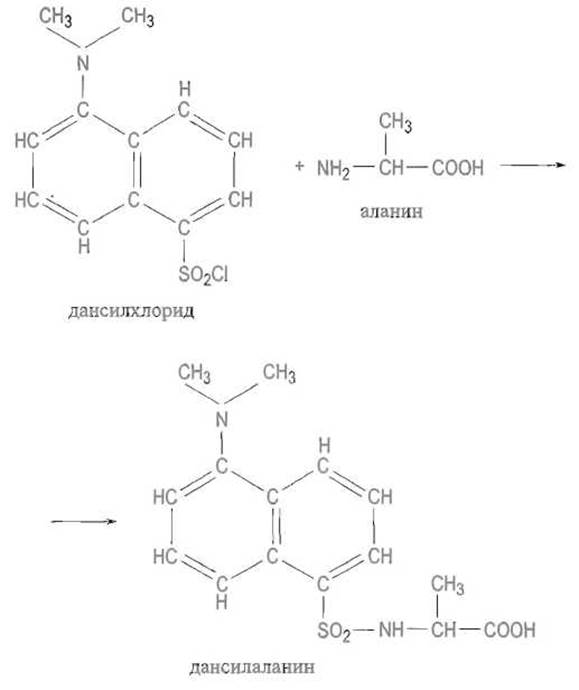
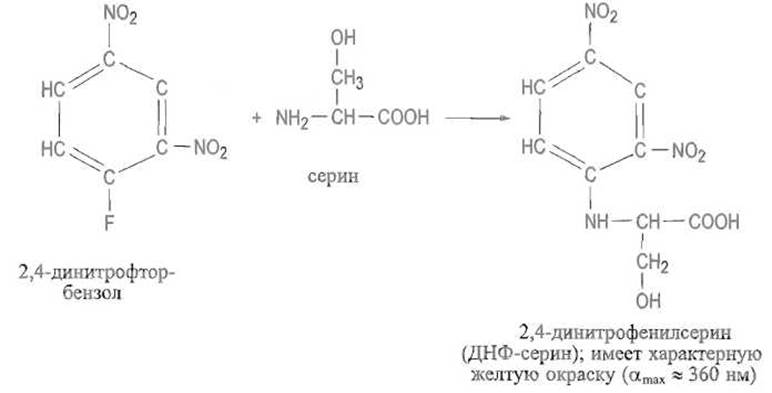
A similar pathway is followed by the cross-linking (armirovanie) with highly reactive 1-fluoro-2,4-dinitrobenzene—the dinitrophenylation reaction, which played a major role in determining Peptide Structure.
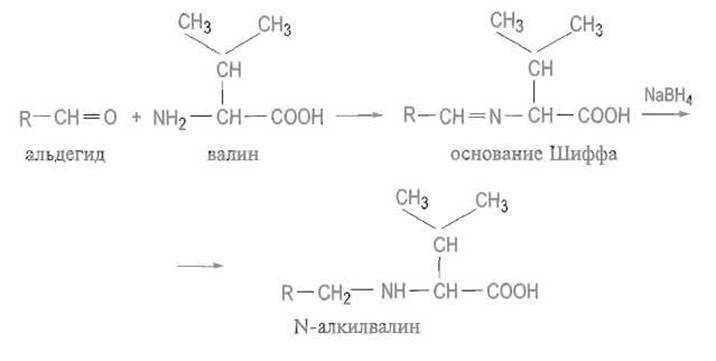
The reaction of an amino group with aldehydes leads to The formation of an unsaturated compound, known as a Schiff base, in which the basicity of the nitrogen atom is significantly reduced. This reaction is reversible, and in an acidic environment, the aldehyde is cleaved, regenerating The amino acid. A characteristic feature of the Schiff base is the proximity of the double bond to the asymmetric center, which can promote Amino Acid Racemization due to the migration of the double bond toward the a-carbon atom. Hydrogenation of the double bond in the Schiff base, for example with sodium borohydride, stabilizes the C—N bond:
Analytically important reactions involving carbonyl compounds include the interaction of Amino Acids with triketohydrindene hydrate (ninhydrin):
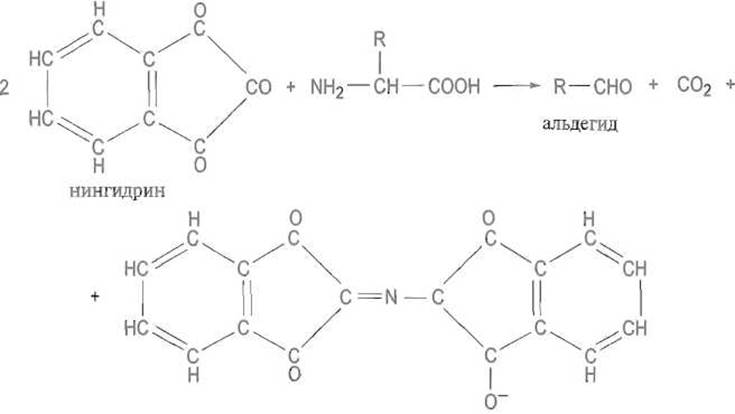
Ruhemann's purple (λmax = 570 nm)
This reaction serves as the basis for both qualitative and Quantitative determination of amino acids (including automated analyzers). Fluorescent derivatives are formed upon the reaction of α-amino acids with o-phthalaldehyde in the presence of mercaptoethanol. This reaction makes it possible to detect extremely small, picomole-range quantities of amino acids:
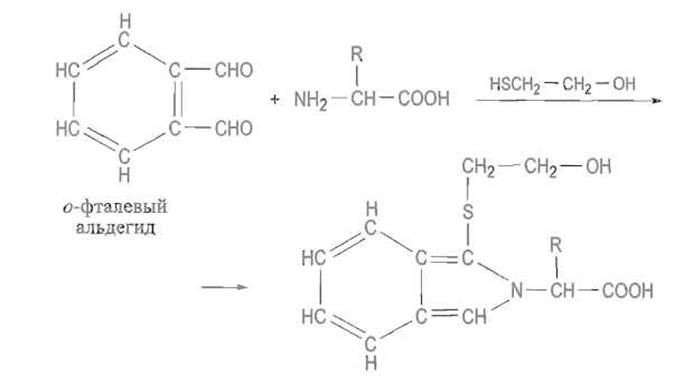
Reaction product, an isoindole derivative; intensely fluorescent, λmах = 455 nm (excitation λmах is 360 nm)
1.2.2. Reactions of carboxyl groups
These amino acid reactions largely parallel those of aliphatic carboxylic acids. Esterification proceeds in anhydrous alcohols in the presence of acid catalysts. For instance, phenylalanine undergoes near-quantitative esterification in anhydrous methanol in the presence of Hydrochloric acid or (preferably) thionyl chloride;
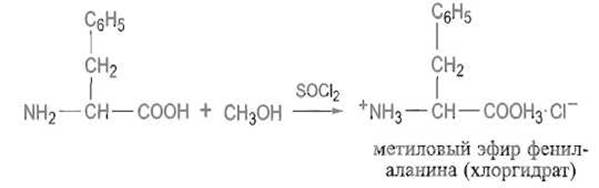
Amino acid esters—important starting Materials for Peptide Synthesis—can undergo Hydrolysis, particularly in alkaline environments (saponification):

Treatment of amino acid esters with anhydrous ammonia converts them into amides.
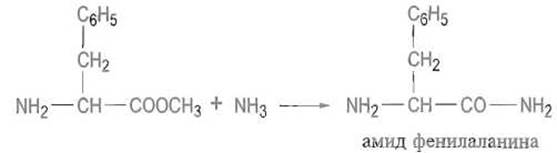
For the temporary protection of α-carboxyl groups required in peptide synthesis, they are converted into tert-butyl esters via reaction with isobutylene in the presence of sulfuric acid:
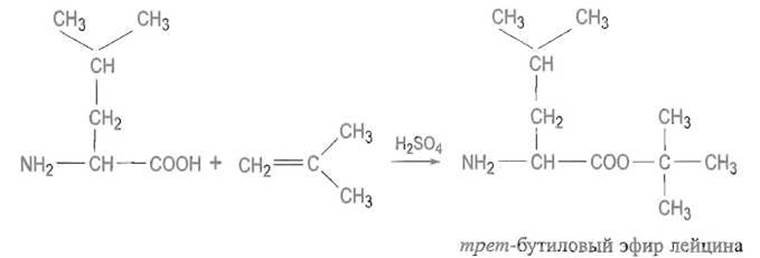
Such esters are stable in weakly alkaline environments, but are selectively cleaved by acids to regenerate the free carboxyl group.
1.2.3. Reactions involving both the α-amino and α-carboxyl groups
Salts of amino acids with certain Metal Ions, notably divalent copper, nickel, and cobalt, are formed with the participation of both the carboxylate ion (ionic bond) and the amino group (coordination bond), resulting in highly stable bicyclic (pincer-like, or chelate) structures in which the metal ion is coordinated with two amino acid molecules, for example
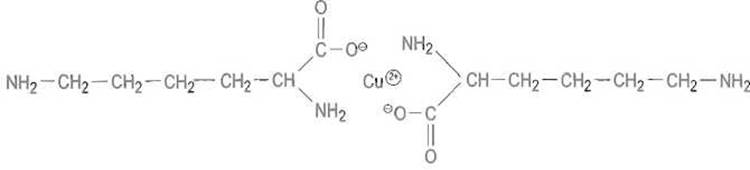
Copper salt of Lysine, in the formation of which the carboxyl and amino groups at the α-carbon atom participate. The ε-amino group is not included in the complex and remains free, which can be utilized to carry out reactions specifically targeting only the remote amino group.
Such complexes are intensely colored; for instance, copper complexes with amino acids exhibit a violet-blue color.
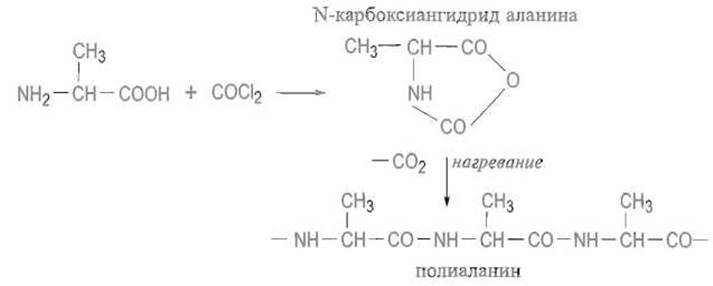
Reactions are known that convert amino acids involving both the amino and carboxyl groups into cyclic structures. For example, phosgene converts α-amino acids into the so-called N-carboxyanhydrides, which readily polymerize with the elimination of CO2 to form polyamino acids:
The reaction of amino acids with phenyl isothiocyanate is of great importance, initially yielding an α-amino group derivative—a phenylthiocarbamyl amino acid:
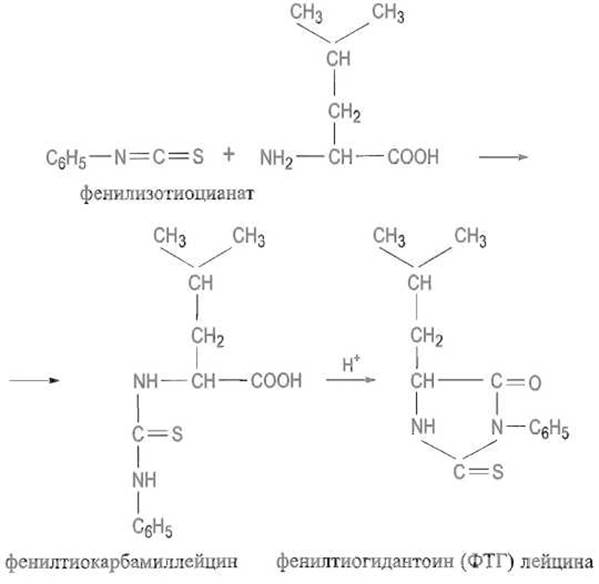
Phenylthiocarbamyl Amino Acids and some of their analogues strongly absorb in ultraviolet light, a property utilized for the quantitative Determination of Amino acids via High-Performance Liquid Chromatography. Acid treatment induces intramolecular cyclization of the phenylthiocarbamyl amino acid, resulting in the formation of a phenylthiohydantoin derivative.
These Amino Acid Derivatives play a crucial role in the analysis of Primary Cell/13.html">Protein Structure.
Last update: 13/08/2026
Editorial and Educational Adaptation: This material has been compiled based on the primary/original source text. The project team performed an editorial review, corrected technical inaccuracies, structured sections, and adapted the content for an educational format.
What was processed:
- elimination of formatting defects (OCR errors, structural breaks, corrupted characters);
- editorial organization of content;
- standardization of terminology in accordance with academic sources;
- verification of factual statements against the original source text.
All mentions of the author, publication year, and origin of the primary text have been preserved in accordance with the source.