Human Biochemistry Volume 1 - Murray R. 1993
Structure and Functions of Proteins and Enzymes
Peptides
Peptide Structure
General Information on peptide Structure
Fig. 4.1 shows a tripeptide composed of Alanine, Cysteine, and valine amino acid residues. Note that a tripeptide contains three residues, but not three peptide bonds. By convention, the peptide structure is depicted with the N-terminal residue (containing the free a-amino group) on the left and the C-terminal residue (with the free a-carboxyl group) on the right. Such a peptide has only one free a-amino group and only one a-carboxyl group. This holds true for all Polypeptides formed exclusively by amino acid residues linked to each other by peptide bonds created between the a-amino group and the a-carboxyl group. In some Peptides, the terminal amino group or terminal carboxyl group is modified (Examples include an acyl derivative of the amino group or an amide of the carboxyl group) and, therefore, is not free.
Class="center">
Fig. 4.1. Structural formula of a tripeptide. Peptide bonds are shaded for clarity.
Writing the structural formula of peptides
Let us consider the simplest writing method. First, we draw the "backbone" consisting of interconnected a-NH2 and a-COOH groups and a-carbon atoms. These groups alternate along the backbone of the chain. Next, we attach the corresponding side groups to the a-carbon atoms. Let us describe this Procedure in more detail.
1. Draw a zigzag line of arbitrary length and add the N-terminal amino group on the left:

2. Insert the a-carbon atoms, a-carboxyl, and a-amino groups into the chain:

3. Attach the corresponding R-groups (shaded) and a-hydrogen atoms to the a-carbon atoms:
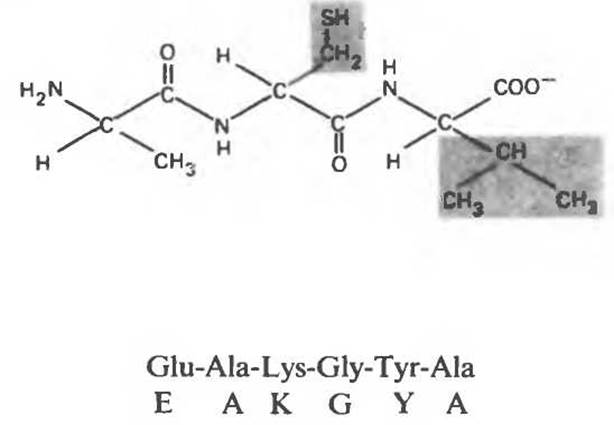
Fig. 4.2. Representation of the Introduction/19.html">Primary Structure of a hexapeptide using three-letter and one-letter Abbreviations for amino acid residues. This hexapeptide contains glutamate (Glu, E) at the N-terminus and alanine (Ala, A) at the C-terminus.
Primary structure of a peptide
The linear sequence of amino acid residues in a polypeptide chain is called the primary structure of a peptide. To determine the primary structure of a polypeptide, it is necessary to establish the number, chemical structure, and arrangement order of all amino acid residues making up its composition.
Polypeptides (Proteins) may contain 100 or more residues, making traditional structural formulas inconvenient for representing primary structure. "Chemical shorthand" utilizes either three-letter or one-letter amino acid abbreviations listed In the second Column of Table 3.3 (Fig. 4.2). When naming a peptide, it is treated as a derivative of the C-terminal amino acid residue.
Once the primary structure is unambiguously established, three-letter abbreviations of amino acid residues are connected by hyphens. One-letter abbreviations are not connected by hyphens. If the exact sequence of amino acid residues in a certain region of the polypeptide chain is unknown, these residues are enclosed in parentheses and separated by commas (Fig. 4.3).

Fig. 4.3. A heptapeptide containing a region whose exact primary structure has not been established.
Physiological consequences of changes in primary structure
The substitution of just a single amino acid in a linear sequence of 100 or more Amino Acids can lead to a decrease or complete loss of the peptide's biological activity, which entails very serious consequences (Sickle-Cell Anemia serves as an example; see Ch. 6). Many inherited Metabolic Disorders are caused precisely by such single substitutions. With The Development of powerful new Methods for determining protein and DNA Structure, researchers have been able to elucidate the BIOCHEMICAL BASIS OF many inherited metabolic diseases.
Last update: 06/08/2026
Editorial and Educational Adaptation: This material has been compiled based on the primary/original source text. The project team performed an editorial review, corrected technical inaccuracies, structured sections, and adapted the content for an educational format.
What was processed:
- elimination of formatting defects (OCR errors, structural breaks, corrupted characters);
- editorial organization of content;
- standardization of terminology in accordance with academic sources;
- verification of factual statements against the original source text.
All mentions of the author, publication year, and origin of the primary text have been preserved in accordance with the source.