Vertebrate Zoology - Practical Course - V. V. Kuibida - 2007
MODULE 5. Class Mammalia
IDENTIFICATION OF REPRESENTATIVES OF THE CLASS MAMMALIA
Materials and Equipment
The following items are required for the work:
1. Live traps (50-100 pcs), measuring tape, millimeter scale ruler or Vernier caliper, a set of dissection tools, and hand lenses — one set per team.
2. Small cloth bags, specialized boxes, or cages for transporting small mammals, a video camera, and a camera.
3. Millimeter rulers and measuring compasses for general use at each desk.
4. Identification keys, charts illustrating Methods for measuring the bodies of mammals and their individual parts.
Lesson Plan
1. To acquaint students with the methodology of observing mammals in nature and assessing their population numbers.
2. To teach students how to identify the presence of mammals in a specific habitat through characteristic structures, markings, and traces of activity left in nature (muskrat lodges, beaver gnaw marks, roe deer beds, wild boar rootings, predator and rodent burrows, otter feeding sites, lagomorph and ungulate droppings, etc.).
3. To reinforce knowledge regarding the Structural Features of Representatives of the main mammalian orders.
4. To teach students how to use mammalian identification keys and navigate confidently through the systematic features that characterize a mammal's belonging to a specific order and family.
5. To learn and master the Latin names and key characteristics of 25 species representing the main mammalian orders.
6. To explain 10 vernacular names of mammals from a biological perspective, accounting for factors such as body shape, fur color, behavioral and locomotor characteristics, similarity to other animals, feeding habits, burrow construction, habitat types, associative connections with human activity, various objects, myths, legends, folklore, and symbolic meaning, etc.
Task Execution:
1. Familiarize yourself with the core specialized terminology encountered during mammal identification; review the names of individual bones and dental formulas studied during the practical session dedicated to the mammalian skull.
Class="center">
Fig. 65. SKULL OF A rabbit:
I — lateral view; II — ventral view; III — longitudinal section.
1 — basioccipital; 2 — exoccipital (2' — occipital condyle); 3 — supraoccipital; 4 — basisphenoid; 5 — squamosal (5' — zygomatic process of the squamosal); 6 — jugal; 7 — tympanic (7' — tympanic bulla); 8 — parietal; 9 — presphenoid; 10 — frontal (10' — supraorbital process); 11 — lacrimal; 12 — Maxilla (12' — palatine process of the maxilla); 13 — premaxilla; 14 — nasal; 15 — palatine; 16 — petrosal; 17 — cribriform plate; 18 — nasal conchae; 19 — superior nasal concha; 20 — maxilloturbinal; 21 — orbitosphenoid; 22 — alisphenoid; 23 — pterygoid; 24 — Vomer.
1. Most mammals are extremely cautious or lead a secretive, nocturnal lifestyle, making them rarely visible during field excursions. Learn to detect their presence in a given area by:
✵ active or abandoned burrows (mole, rodents, fox, badger) — measure the burrow diameter, length, and depth of the soil trough in front of a badger burrow, sketch the shape of the entrance, soil mounds, presence of tracks, food remains, etc.;
✵ lodges or dams (muskrat, beaver) — sketch their general appearance and explain their purpose;
✵ shallow depressions in the ground (made by roe deer, hares, wild boars, and elks) — note the CHARACTERISTICS OF THE habitat, the presence of bedding or undigested remains, measure the length, width, and depth of the beds, and sketch their shape;
✵ characteristic marks on tree trunks (made by beavers) — sketch the shape of gnawed trunks and thin branches, indicate the tree species that the beaver uses and ignores, and examine The surface of thin willow twigs from which the animal has stripped the bark;
✵ rootings (made by wild boars) — compare the number of disturbed patches in forests dominated by oaks, hornbeams, and pines; in wetland areas near streams, locate boar wallowing sites, examine the nearby tree trunks for bark rubbed off by the animals, and explain The Significance of mud baths and scratching behavior for the animals; search for wild boar Hair in bark crevices and spots, and examine its tips;
✵ scales, bones, uneaten fish, and their characteristic odor (left by otters) — in forest ponds or a fish-rich river, locate an otter feeding site, and among the food remains, find crayfish carapaces and waterfowl feathers;
✵ excrement (of beavers, hares, roe deer, elks, and foxes) — determine the diet composition based on undigested remains; explain the biological necessity of coprophagy.
✵ tracks in moist soil near forest or field puddles, streams, swamps, and on river silt (of beavers, otters, wild boars, roe deer, etc.) — try to identify the species, estimate the number of animals and their age Structure by measuring track length and width, as well as stride or jump length; determine whether the animals were resting or simply moving from one place to another; if the tracks were left by a single animal, draw a diagram of them.
2. Learn how to catch small mammals using live traps and pitfall lines. Small rodents and insectivores live in
burrows and emerge to the surface to feed at dusk or at night. Therefore, set the live traps in the evening to prevent ants and other diurnal insects from consuming the bait. A cube of bread fried in oil can be used as bait. The bait is impaled on a hook held by a trigger mechanism. In a set live trap, the trigger should be held only by its very tip so that the trap is triggered easily. Live traps are set in several ways. Place at least 20 traps in a line, every 5 m in a homogeneous biotope (in a forest, clear-cut, meadow, near a field, or in an orchard). It is advisable to remove the top layer of soil with a shovel to create a flat, vegetation-free patch of a few square decimeters. To make it easier to find the live traps, you can tie a colored ribbon to a branch or grass stems above them or leave another marker. Take standard measurements of the captured animals (body length, tail, ear, hind FOOT, weight, etc.), record the results in your field journal, and calculate the trap success rate per 100 trap-nights. If 100 traps are placed in a 100 x 100 m grid, their population density per 1 hectare of a given habitat type can be determined.
3. Learn how to construct pitfall lines (Fig. 66). They are dug in dense weeds, forest clearings, ravines, and orchards at a safe distance from bushes and trees to avoid ROOT damage. Dig a trench the width of a shovel, 25-30 cm deep, with a pocket depth of 60-70 cm. It is crucial that the walls slightly overhang the trench and that the pocket has vertical walls. The pitfall pockets (recesses) are placed at the ends of the trench. Recently, plastic bottles with cut-off bottoms have been used instead of dug pockets. Bury them neck-down so that the cut edge is level with, or slightly below, the bottom of the trench. Throw the excavated soil beyond the ends of the trench rather than to the sides to avoid trampling the vegetation. The next morning, collect the animals that have fallen into the pockets or plastic bottles. Use the trench for several nights, after which it must be backfilled.
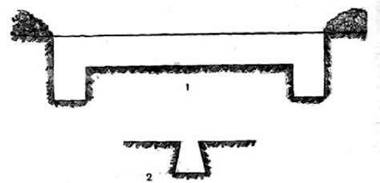
Fig. 66. Pitfall line:
1 — side view; 2 — cross-section.
4. Study and sketch the layout of a vole or mouse burrow. Excavate a burrow in an open area, because in a forest, burrow tunnels inevitably run under roots and tree stumps. Start with a vole burrow because all its tunnels and nesting chambers are located at a shallow depth. A burrow is currently inhabited if it features fresh soil near the entrance, a smooth opening, newly dragged blades of grass, and fresh vole droppings. Block all exits except one with bundles of grass, and insert a flexible willow twig into the chosen entrance to serve as a marker. Position the shovel perpendicular to the direction of the tunnel and begin digging, taking care not to go below the tunnel floor. Pay attention to turns and dead ends, and measure the length, width, and height of the nesting chambers. Ensure that the excavated tunnels do not get filled with soil. Measure the total length and diameter of the burrow tunnels, as well as the maximum depth, and sketch the burrow layout in two projections: horizontal and vertical.
5. Familiarize yourself with the specific measurement techniques used in species identification. Learn how to use a vernier caliper.
6. It is easier to learn mammal identification by starting with the taxonomic features of familiar animals. Therefore, the objects of identification should be the most well-known mammal species. Record the step-by-step identification process for several mammal species in your workbook.
7. Make schematic drawings of specific body PARTS OF THE mammals you are identifying that have unique structures and serve as taxonomic features (such as the forelimbs of a mole, the enamel fold pattern on vole Teeth, etc.).
Grading of Knowledge and Skills
The maximum score for the "Mammals" module is 30. Breakdown: for species identification skills — 5 points; for The ability to identify mammals based on their characteristic structures, markings, signs, and tracks left in nature — 5 points; for Latin names and species characteristics — 15 points; for explaining the common names of mammals — 5 points.
List of Key Terms Encountered in Mammal Identification
Specific measurement techniques characteristic of the class are used when identifying mammalian specimens. The most important of them are the following:
1. HEAD and body length — in small and medium-sized mammals, measured from the tip of the snout to the anus using a caliper while the animal is placed on its back; in large mammals (starting from the hare), measured from the tip of the snout to the Base of the tail using a tape measure along the back (Fig. 67).
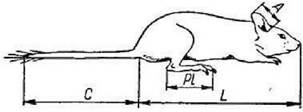
Fig. 67. Methods for measuring small mammals: L — body length, C — tail length, PI — hind foot length, A — ear length.
2. Tail length — measured from the anus to the last vertebra, excluding the terminal hairs (Fig. 67).
3. Foot length — measured from the heel joint to the tip of the longest toe, excluding the claw (Fig. 67).
4. Ear height — from the lower notch to the tip of the pinna; however, if such a notch does not correspond to the base of the ear (in hares, jerboas, and ungulates), measured along the pinna to its tip (Fig. 67).
5. Forearm length (in bats) — measured from the dorsal side with the wing folded, spanning the most prominent parts of this bone.
6. Total skull length — from the most protruding point of the upper jaw to the rearmost point projecting on the back of the skull (Fig. 68).
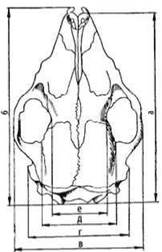
Fig. 68. Hedgehog skull: Measurement scheme: a — condylobasal length; b — greatest length; c — zygomatic breadth; d — greatest breadth; e — braincase breadth; f — interorbital width.
7. Condylobasal skull length — from the most protruding point of the upper jaw to the posterior margin of the occipital condyle.
8. Basal skull length — from the midpoint of the ventral margin of the foramen magnum to the posterior edge of the alveoli of the front incisors.
9. Zygomatic breadth of the skull — the greatest distance between the outer margins of the zygomatic arches.
10. Interorbital width of the skull — the shortest distance between the inner margins of the eye sockets.
Identification keys for the vast majority of animals lead down to the species level. However, for animals that are rare or distributed across a very limited territory in Ukraine (such as the Russian desman, lesser horseshoe bat, brown bear, wildcat, bobak marmot, mole-vole, moose, etc.), identification is brought only to the genus or even family level, with a note that the given species is the sole or representative form in our fauna.
Identification key to the Orders of Mammals of Ukraine
Skin covered with hair, bristles, or spines.
Limbs well developed.
Skin smooth. Hind limbs absent, forelimbs modified into flippers.
Order Cetacea — Delphiniformes
Digits of the forelimbs (except the first) are excessively elongated and connected by a thin, nearly hairless flight membrane which, forming wings, connects the forelimbs, hind limbs, and tail.
Order Chiroptera — Chiroptera.
Forelimbs are not modified into wings and their digits are not connected by a flight membrane.
Digits terminating in claws.
Digits terminating in broad horny hooves.
Order Artiodactyla — Artiodactyla.
Tooth rows form a continuous series. Canines generally stand out prominently among the other teeth.
Tooth rows characterized by a wide toothless gap (diastema). Canines absent.
Small-sized animals. Snout terminating in a mobile proboscis. The inner pair of incisors is significantly larger than the lateral ones.
Order Insectivora — Insectivora.
Large or medium-sized mammals. The muzzle does not end in a proboscis. The inner pair of incisors is smaller than the lateral ones.
Molars vary in both size and shape. Limbs are typical, not modified into swimming flippers.
Order Carnivora — Carnivora.
All molars are similar to each other in both size and shape. Limbs are modified into swimming flippers.
Order Pinnipedia — Pinnipedia.
The fauna of Ukraine features only one species — Mediterranean monk seal — Monachus monachus (Herm.).
There are 2 incisors in the upper jaw.
Order Rodentia — Rodentia.
There are 4 incisors in the upper jaw. Behind each large sharp incisor lies a small blunt-tipped tooth.
Order Lagomorpha — Lagomorpha.
A typical representative of the fauna of Ukraine is the European hare — Lepus europaeus (Pall.).
Order Insectivora Family Identification Key
The upper part of the animals' body is covered with well-developed, rigid spines, about 25 mm long. The body is short, sturdy, and capable of rolling into a ball.
Family Erinaceidae — Erinaceidae.
A typical representative of the fauna of Ukraine is the southern white-breasted hedgehog — Erinaceus concolor (Mart.).
The upper part of the body is covered with short, soft hair.
Small mammals, about the size of a house mouse or smaller. Pinnae are present on the head. There are no zygomatic arches on the skull. There are 32 teeth or fewer.
Family Soricidae — Soricidae.
Animals significantly larger in size than a house mouse. Pinnae are absent. Eyes are small, almost hidden in the fur. Zygomatic arches are present on the skull. There are 44 teeth.
Family Talpidae — Talpidae.
Genus and Species Identification Table
The head and body length of the animal does not exceed 155 mm. The tail is short, up to 40 mm, rounded, and densely covered with hair. The muzzle is elongated into a short proboscis.
The wide, five-toed front limbs with outwardly turned soles, armed with blunt, flattened claws, are significantly larger than the hind limbs and adapted for burrowing (Fig. 69). The digits are not connected by swimming webs.
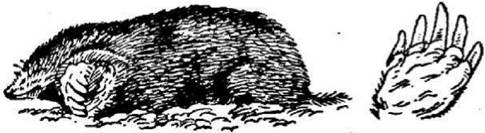
Fig. 69. Mole and its forelimb
A short, velvety fur coat, uniform without a noticeable division into guard hairs and underfur.
Dental formula: i — 3/3; c — 1/1; p — 4/4, m — 3/3 — total 44 teeth; the upper canines are significantly larger than the incisors (Fig. 70).
Genus Mole — Talpa.
The fauna of Ukraine includes only one species — the European mole — Talpa europaea (L.).
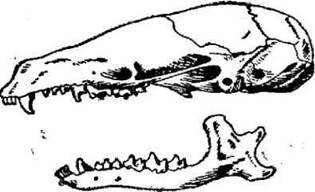
Fig. 70. Skull of a mole
The head and body length of the animal is about 200 mm. The tail is long, exceeding 100 mm, paddle-shaped laterally compressed and covered with scales, between which sparse hairs grow. The digits of the fore and hind limbs are connected by broad swimming membranes that reach the very claws.
Genus Desman — Desmana.
The fauna of Ukraine includes only one species — the Russian desman — Desmana moschata (L.).
Family Shrews — Soricidae
Identification key for genera
The tail, on the top and sides, is covered with uniform short hairs that adhere tightly to it. The tips and chewing surfaces of the teeth on both the upper and lower jaws have a dull red coloration.
The tail, In addition to uniform short hairs that adhere tightly to it, also has sparse long hairs, clearly visible when viewing the tail against the light (Fig. 71).
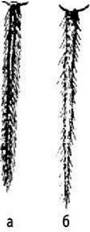
Fig. 71. Structure of shrew tails: a — shrew (Sorex); b — white-toothed shrew (Crocidura)
The tips and chewing surfaces of the teeth on both the upper and lower jaws are entirely white.
There are 3 intermediate teeth on each side of the upper jaw (Fig. 72). Dental formula: front incisors — 1/1; intermediate teeth — 3/2; multicuspid molars — 4/3 — total 28 teeth.
Genus White-toothed Shrew — Crocidura.
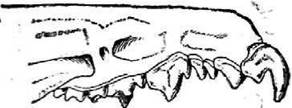
Fig. 72. Upper jaw teeth of the white-toothed shrew
There are 5 intermediate teeth on each side of the upper jaw between the bicuspid incisor and the first multicuspid molar (Fig. 73).
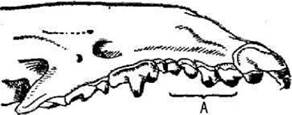
Fig. 73. Upper jaw teeth of the common shrew: A — intermediate teeth
The front incisors in the lower jaw have pronounced blunt-tipped tubercles. The edges of the hind foot soles are not bordered with comb-like stiff hairs.
Dental formula: front incisors — 1/1; intermediate teeth — 5/2; multicuspid molars — 4/3; total 32 teeth.
Genus Shrew — Sorex.
In the upper jaw on each side, between the bicuspid incisor and the first multicuspid molar, there are 4 intermediate teeth (Fig. 74).
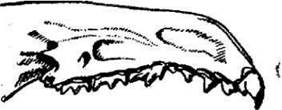
Fig. 74. Upper teeth of the Water shrew
The anterior incisors in the lower jaw are smooth or only slightly wavy.
The edges of the hind feet are fringed with stiff hairs.
Dental formula: anterior incisors — 1/1; intermediate teeth — 4/2; multicuspid molars — 3/4 — total 30 teeth.
Genus Water Shrew — Neomys.
A typical representative of the fauna of Ukraine is the Eurasian water shrew — N. fodiens (Penn.).
Genus Shrew — Sorex Key to Species
Both intermediate teeth of the lower jaw are bicuspid. The tail, covered with short uniform hair, is almost equal in length to the head and body.
Alpine shrew — S. alpinus (Schinz.).
The first intermediate tooth of the lower jaw has only one cusp. The tail length does not exceed the length of the head and body.
Sizes are relatively small; head and body length in adults is 41–57 mm, hind foot length is less than 11 mm. Skull width is no more than 8 mm; total skull length generally does not exceed 16 mm; condylobasal skull length is 14.8–16 mm. The second upper intermediate tooth is noticeably smaller than or equal to the third. The fur on the upper parts is dingy grayish, and on the belly, light gray. The tail is covered with long uniform hair, bicolored: dingy gray above and silvery gray below.
Eurasian pygmy shrew — S. minutus (L.).
Sizes are medium: head and body length in adults is 50–80 mm. The second upper intermediate tooth is noticeably larger than the third and fourth. Condylobasal skull length exceeds 18 mm. The fur on the upper parts is dark brown, sometimes with a brownish tinge.
Common shrew — S. araneus (L.).
Genus White-toothed Shrew — Crocidura Key to Species
Condylobasal skull length does not exceed 17.9 mm.
The distance between the antorbital foramina is up to 3.5 mm. Tail length usually exceeds half the body length. The silvery coloration of the belly does not extend high up the flanks and therefore is not sharply demarcated from the grayish-brown coloration of the animal's back.
Lesser white-toothed shrew — C. suaveolens (Pall.).
Condylobasal skull length exceeds 17.9 mm.
The distance between the antorbital foramina usually exceeds 3.6 mm. Tail length equals half the body length or slightly exceeds it. The bright white coloration of the belly extends high up the flanks and is sharply demarcated from the dark coloration of the animal's back.
Bicolored shrew — C. leucodon (Herm.).
Order Bats — Chiroptera Key to Families
The muzzle features a complex bare skin formation (Fig. 75). The auricle is shaped like a twisted, pointed leaf. The tragus is absent.
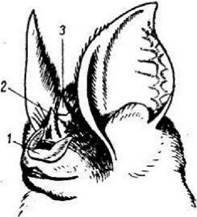
Fig. 75. Head of a horseshoe bat: 1 — horseshoe; 2 — sella; 3 — lancet
The upper incisors (only a single pair) are located on a cartilaginous plate. There are two pairs of lower incisors.
Family Horseshoe Bats — Rhinolophidae.
A typical representative of the fauna of Ukraine is the lesser horseshoe bat — Rh. hipposideros (Bechstein).
The muzzle of the bat lacks a complex bare skin formation. The auricle has a rounded apex. The tragus is always well-developed. The upper incisors (two pairs) are situated on the premaxillary bones. There are three pairs of lower incisors (Fig. 76).
Family Vesper Bats — Vespertilionidae.
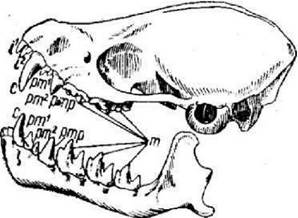
Fig. 76. Bat skull: Pm1–Pm2 — small premolars, Pmr — large premolars, m — molars
Family Vesper Bats — Vespertilionidae Identification Key for Genera
Both the upper and lower jaws bear two small premolars on each side. The calcar, or epiblema, is undeveloped, and there is no muscular thickening at the base of the calcar. The ears extend
more than halfway above the fur level. The elongated tragus is tapered and pointed at the apex. Dental formula: i — 2/3; c — 1/1; pm — 2/2; pmr — 1/1; m — 3/3 — total 38 teeth.
Genus Mouse-eared Bats — Myotis.
A typical representative of the fauna of Ukraine is Daubenton's bat — M. daubentoni (Kuhl.).
There is only one small premolar on each side of the upper jaw.
The second phalanx of the third digit is almost three times longer than the first phalanx of the same digit (Fig. 77).
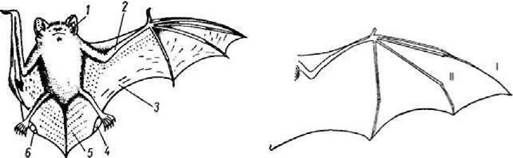
Fig. 77. General appearance of a bat and the wing of a bent-winged bat:
1 — tragus; 2 — forearm; 3 — wing membrane; 4 — epiblema; 5 — uropatagium; 6 — calcar; I — first phalanx;
II — second phalanx of the third digit.
The braincase is large compared to the nasal region of the skull, rising steeply above the frontal part. The zygomatic width exceeds the skull width across the auditory bullae. The auricles are very short, barely protruding above the fur. The tragus is narrow, blunt-tipped, and uniform in width throughout its length. Dental formula: i — 2/3; c — 1/1; pm — 1/1; pmr — 1/1; m — 3/3 — total 36 teeth.
Genus Bent-winged Bats — Miniopterus.
Represented in the fauna of Ukraine by a single species — Schreiber's long-fingered bat — M. schreibersi (Kuhl.).
The second phalanx of the third digit is no more than one and a half times longer than the first phalanx of the same digit.
The ears meet in front or even fuse together and reach a considerable size. The zygomatic breadth is less than the skull width across the auditory bullae.
The ears do not meet in front and are separated from each other by the full width of the head.
The zygomatic breadth exceeds the skull width across the auditory bullae.
The ears are relatively small, with a length shorter than half the forearm length. They fuse at the base. There is one small premolar on each side of the lower jaw. Dental formula: i — 2/3; c — 1/1; pm — 1/1; m — 3/3, total 34 teeth.
Genus Barbastelle — Barbastella.
The fauna of Ukraine is represented by a single species — the Western Barbastelle — B. barbastella.
The ears are very large, with a length almost equal to that of the forearm. They are joined at the base. There are two small lower premolars on each side of the lower jaw. Dental formula: i — 2/3; c — 1/1; pm — 1/2; m — 3/3, total 36 teeth.
Genus Long-eared Bat — Plecotus.
A typical representative in the fauna of Ukraine is the Brown Long-eared Bat — P. auritus (L.).
The ears do not meet in front and are separated from each other by the full width of the head. The zygomatic breadth exceeds the skull width across the auditory bullae.
The metacarpal bone of the third digit is 8–12 mm longer than that of the fifth digit. The inguinal region of the wing membrane is covered with soft hair. The free margin of the membrane attaches above the base of the outer-most toe of the foot. The tragus is club-shaped, widest at a point above its middle. Reddish-chestnut tones predominate in the fur coloration. The bare parts of the auricles and flight membranes are dark brown. Dental formula: i — 2/3; c — 1/1; pm — 1/1; m — 3/3, total 34 teeth.
Genus Noctule — Nyctalus.
The metacarpal bone of the third digit is 3–4 mm longer than the metacarpal bone of the fifth digit.
The inguinal region of the wing membrane is not covered with soft hair.
The free margin of the membrane attaches to the base of the outermost toe of the foot.
The tragus is narrower at the tip, with its maximum width in the middle part or below its middle (except in parti-colored bats).
Dental formula: i — 2/3; c — 1/1; pm — 1 or 0/1; m — 3/3, total 34 or 32 teeth.
Genera: Serotine — Eptesicus, Pipistrelle — Pipistrellus, and Parti-colored Bat — Vespertilio.
Genus Noctule — Nyctalus. Key for Species Identification
Bats of considerable size. Forearm length over 51 mm.
The condylobasal skull length of adults is at least 17.4 mm.
Small bats. Forearm length 42.5–46 mm.
A small premolar is clearly visible between the upper canine and the large upper premolar. The fairly thick and relatively long fur features a distinctly bicolored pattern: dark chestnut-brown at the base and significantly lighter at the tips. Head and body length 58–72 mm, tail length 37–48 mm. The condylobasal skull length of adults is 15.2–16.1 mm.
Lesser Noctule — N. leisleri (Kuhl.).
The upper small premolar is so small,
that it is almost invisible between the canine and the large premolar. Two-toned coloration of the fur is weakly expressed; the base is lighter than the tips.
Medium-sized bats. Forearm length 51—57 mm. The free edge of the wing membrane attaches to the base of the foot. The fur on the back is relatively short, uniform, and smooth, ranging from pale reddish to chestnut-brown, noticeably lighter on the belly. Head and body length 64—81 mm, tail length 46—54 mm. Condylobasal skull length in adults 17.4—19.4 mm.
Noctule bat — N. noctula (Schreb.).
Very large bats. Forearm length 65—69 mm. The free edge of the wing membrane attaches to the middle of the metatarsus. Fur coloration is pale or chestnut-red, lighter on the belly. Head and body length 84—100 mm, tail length 55—65 mm. Condylobasal skull length in adults 22.2—23 mm.
Greater noctule bat — N. lasiopterus (Schreb.).
Genera: Eptesicus (Serotine bats), Pipistrellus (Pipistrelles), Vespertilio (Vespertilio bats)
Key to species identification
The flight membrane connects to the tail, leaving a free tip of the tail no longer than 2—3 mm. A small upper premolar is present. The epiblema is well developed with a transverse cartilaginous cross-bar. The inner upper incisor is bicuspid.
The flight membrane connects to the tail, leaving a free tail tip 3—7 mm long.
Very small dimensions. Forearm length 28—33 mm.
The ear is noticeably narrowed toward the tip. The tragus is short, with a nearly uniform width throughout its length. The short, even fur is chestnut-colored. Head and body length 38—45 mm, tail length 28—33 mm. Condylobasal skull length in adults 11—11.8 mm.
Common pipistrelle — P. pipistrellus.
Larger dimensions. Forearm length 33.5—36.5 mm. The ear externally resembles that of the common pipistrelle. The inner edge of the tragus is straight, while the outer edge is curved; the tragus is widest in its middle part. Dorsal fur coloration is quite variable, most frequently chestnut-brown, with a lighter brownish-gray belly. Head and body length 48—56 mm, tail length 35—39 mm. Condylobasal skull length in adults 12.4—13.4 mm.
Nathusius's pipistrelle — P. nathusii (Keys. et Blasius).
The small upper premolar is absent. The epiblema is barely noticeable, lacking a transverse cartilaginous cross-bar (except in the parti-colored bat).
The outer upper incisor is relatively well developed. Its tip exceeds half the length of the secondary cusp of the inner incisor (Fig. 78).
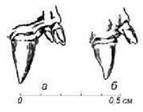
Fig. 78. Upper incisors: a — northern bat; b — parti-colored bat
Small dimensions. Head and body length 50—60 mm, tail length 39—47 mm. Condylobasal skull length in adults 14.6—15.1 mm.
Northern bat — E. nilssonii.
The outer upper incisor is very small; its tip does not reach even one-third of the inner incisor's length (Fig. 78).
Relatively small dimensions. Forearm length 41—48 mm. Unlike all representatives of the genera Eptesicus and Pipistrellus, the female has two pairs of nipples. The epiblema is narrow but possesses a transverse cross-bar. Dorsal coloration is two-toned: chestnut-brown with silver frosting, and yellowish-gray on the belly. Head and body length 54—64 mm, tail length 35—47 mm. Condylobasal skull length in adults 13.9—16.4 mm.
Parti-colored bat — V. murinus (L.).
Large bats. Forearm length 48.5—55.5 mm. On the calcar, instead of an epiblema, there is only a thickened, roll-like formation. The tragus reaches its maximum width in the middle section. Dorsal coloration is uniform, brownish-chestnut without silver frosting, with a lighter belly. Head and body length 64—75 mm, tail length 44—54 mm. Condylobasal skull length in adults 19—21 mm.
Serotine bat — E. serotinus
Order Carnivora — Identification table for Families
Both hind and fore limbs possess five digits. The bony palate of the skull extends well beyond the posterior molars.
Hind limbs possess only four digits. The bony palate of the skull does not extend beyond the posterior molars.
Animals of very large size: head and body length in adults is 1.5–2 m, total skull length in adults exceeds 250 mm. The tail is very short, almost indistinguishable in the fur.
Family Ursidae — Bears.
The fauna of Ukraine is represented by a single species — Brown bear — Ursus arctos (L.).
Animals of medium or small size: head and body length up to 1 m, total skull length in adults less than 200 mm. The tail is long and always clearly visible against the fur.
Family Mustelidae — Mustelids.
Animals with a noticeably elongated head. The hair covering the tail is shorter at the base than along the rest of the tail. Claws are blunt and non-retractile. In the upper jaw, on each side behind the carnassial tooth, there are two true molars. In the lower jaw, on each side, there are 7 molars and premolars.
Family Canidae — Canids.
A typical representative of the fauna of Ukraine is the Red fox — Vulpes vulpes (L.).
Animals have a shortened, rounded head. The hair on the tail is of uniform length throughout. Claws are very sharp and retractile. In the upper jaw, on each side behind the carnassial tooth, there are no true molars. In the lower jaw, on each side, there are three molars and premolars.
Family Felidae — Cats.
A typical representative of the fauna of Ukraine is the Wildcat — Felis silvestris (Schreb.).
Family Mustelidae — Identification Table for Genera and Species
Animals of considerable size: head and body length in adults exceeds 600 mm.
Animals of smaller size: adult head and body length is about 600 mm. Total skull length is less than 90 mm.
The digits of the fore and hind limbs are connected by webbed skin extending almost to the claws. The soles are bare underneath. Ear openings are equipped with Valves. The tail is flat, wider at the base. The broad skull is sharply flattened. The nasal region of the skull is shortened, its length being less than the skull width between the outer edges of the canine alveoli. The anterior upper premolar is set far inward into the jaw and is located on the inner side of the canine (Fig. 79).
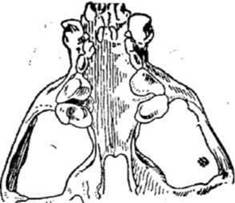
Fig. 79. Upper teeth of an otter
Dental formula: i — 3/3; c — 1/1; p — 4/3; m — 1/2 — total 36 teeth. Condylobasal skull length in males is 110–124 mm, in females 100–113 mm.
Genus Lutra — Otters.
The fauna of Ukraine is represented by a single species — Otter — L. lutra (L.).
There are no skin webs between the digits. Ear openings lack valves. The tail is round, not thickened at the base, and its length is about 1/4 of the head and body length. Limbs are plantigrade, equipped with large non-retractile claws. Soles are bare underneath. Black stripes run along the sides of the head from the tip of the Nose through the eye to the ear. The upper part of the skull is noticeably convex. The nasal region is elongated, its length being almost twice the skull width between the outer edges of the canine alveoli. Dental formula: i — 3/3; c — 1/1; p — 4/4; m — 1/2 — total 38 teeth. Condylobasal skull length in adult males is 125–140 mm, in females 123–133 mm.
Genus Meles — Badgers.
The fauna of Ukraine is represented by only one species — the European Badger — M. meles (L.).
The body is elongated, slender, and very flexible. The limbs are digitigrade. The soles of the feet are covered with hair on the underside.
Small-sized animals; the head and body length of adults is less than 400 mm.
Medium-sized animals: the head and body length in adults exceeds 400 mm. A distinct light patch is clearly visible on the throat and chest. The upper jaw has 5 molars and premolars on each side, and the lower jaw has 6. The auditory bullae possess well-defined external auditory tubes. Dental formula: i — 3/3; c — 1/1; p — 4/4; m — 1/2 — total 38 teeth.
Genus Marten — Martes.
The light patch on the throat and chest is pure white. Extending backward, it usually branches into two extensions, which sometimes reach the forelimbs. The pads of the toes are naked, although the soles of the feet are covered with short hair on the underside. The upperparts of the body are grayish-brown, and the underparts are dirty gray. The limbs and tail are dark brown. Head and body length 400–700 mm, tail length 230–260 mm, hind foot length 80–85 mm. Condylobasal skull length of adults 78–84 mm.
Beech Marten — M. foina (Erxleben).
The light patch on the throat and chest is variable, ranging from pale yellow to orange. Extending backward, it typically has only a single extension that stretches between the forelimbs. The toe pads are almost hidden within the dense fur of the soles. The upperparts of the body and the bushy tail are dark brown with yellowish tinges on the flanks and belly. The limbs are dark brownish-black. Head and body length 360–480 mm, tail
205–225 mm, hind foot length 90–95 mm. Condylobasal skull length of adults 71–86.6 mm.
Pine Marten — M. martes (L.).
The coloration of the throat and chest is identical to that of the lower part
of the body. The upper jaw has 4 molars and premolars on each side, and the lower jaw has 5. The auditory bullae lack prominently defined auditory tubes.
The coloration of the upperparts is highly mottled with distinct, irregularly shaped light patches and stripes. The inner side of the lower carnassial tooth features an additional cusp (Fig. 80).
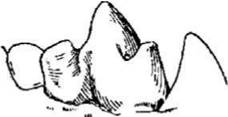
Fig. 80. Lower carnassial tooth of the marbled polecat
Dental formula: i — 3/3; c — 1/1; p — 3/3; m — 1/2 — total 34 teeth. Condylobasal skull length of adults 50–59 mm.
Genus Marbled Polecat — Vormela.
The fauna of Ukraine includes only a single species — the Marbled Polecat — V. peregusna (Guld.).
The upperparts are uniformly colored, lacking sharply defined patches and stripes. The inner side of the lower carnassial tooth lacks an additional cusp. Dental formula: i — 3/3; c — 1/1; p — 3/3; m — 1/2 — total 34 teeth.
Genus Ferret / Polecat — Mustela
The coloration of the underparts is white, sharply demarcated from the uniform brown color of the back. In winter, these animals become entirely covered with a pure white coat.
The fur of the underparts is dark; if the belly coloration is light, it gradually transitions into the dark color of the upperparts. Neither in winter nor in summer does the fur become entirely white.
The coloration of the entire body and head is uniform, dark brown or brownish-brown. The underfur of the upperparts is also dark. The upper and lower Lips are completely white. The skull is noticeably elongated, its width across the auditory bullae being approximately equal to half of the condylobasal skull length. The auditory bullae are elongated in shape. The frontal region of the skull between the postorbital processes is flattened. Head and body length 340–405 mm. Condylobasal skull length of adults 57–69.7 mm.
European Mink — M. lutreola (L.).
The fur of the body and head is not uniformly colored, as the pale buff underfur of the upperparts visibly shows through the black guard hairs. The skull is broad and short, its width across the auditory bullae significantly exceeding half of the condylobasal skull length. The auditory bullae are triangular in shape. The frontal region of the skull between the postorbital processes is convex.
The tail is almost entirely black. The upperparts of the animal's body are predominantly black. The light fawn underfur is largely obscured by guard hairs with wide black tips. The underparts are dark. Starting from the postorbital processes, the interorbital region of the skull does not narrow noticeably (Fig. 81).
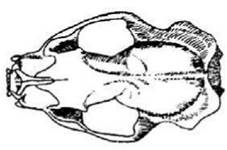
Fig. 81. Skull of the European polecat
Head and body length 295–450 mm. Condylobasal skull length of adults 51–70 mm.
European polecat — Mustela putorius (L.).
The tail is yellowish-red at the base, with only the terminal half being black. The upperparts of the animal's body are dominated by yellowish-red tones. Long dark-brown guard hairs poorly conceal the light fawn underfur. The underparts are light, yellowish-gray. Starting from the postorbital processes, the interorbital region of the skull narrows sharply in the posterior section (Fig. 82). Head and body length 350–460 mm. Condylobasal skull length of adults 56–75.2 mm.
Steppe polecat — Mustela eversmanni (Lesson).
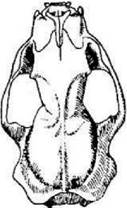
Fig. 82. Skull of the steppe polecat
Tail length (including terminal hairs) is less than half of the head and body length.
Tail coloration is usually uniform: brownish in summer and completely white in winter, with only slight darkening at the very tip.
Head and body length 150–230 mm.
Condylobasal skull length of adult males 32–44 mm, females 30–36 mm.
Least weasel — Mustela nivalis (L.).
Tail length (including terminal hairs) is either equal to or exceeds half of the head and body length. The tail features a distinct two-tone coloration. The main part (at least two-thirds) is brown in summer and white in winter, whereas the terminal part is always black. Head and body length 200–310 mm. Condylobasal skull length of adult males 45–52.2 mm, females 38.5–44.5 mm.
Stoat — Mustela erminea (L.).
Order Rodents — Rodentia
Key to families
Animals ranging from very small to considerable size. Head and body length
ranges from 5 cm to 1 m. Enamel covers only the anterior surface of the incisors.
There are only 3 molar and premolar teeth in both the upper and lower jaws.
There are more than three molar and premolar teeth in the upper jaw.
Eyes are absent—concealed beneath the skin. Pinnae do not protrude from the fur. Incisors are exceptionally well-developed and visibly protrude from the Mouth. The surface of the well-developed Occipital bone slopes forward, and its apex extends past the glenoid fossa of the Temporal bone (Fig. 83). Tail is absent.
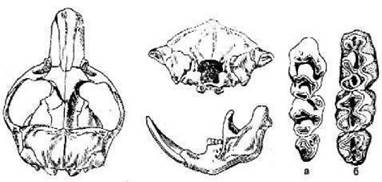
Fig. 83.
Skull of the greater blind mole-rat; diagram of the molar structure:
a — mice, b — hamsters
Family Spalacidae — Spalacidae.
A typical representative of the fauna of Ukraine is the greater blind mole-rat — Spalax microphthalmus (Guld.).
The eyes are always clearly visible. The pinnae project from the fur. The surface of the occipital bone is small, positioned vertically or with only a slight forward slant, and its apex noticeably fails to reach the articular fossa of the temporal bone. A tail is always present.
The tail length is at least 2/3 of the combined length of the head and body. The chewing surfaces of the First and Second upper molars always feature cusps arranged in three rows, which, upon wear, form trilobed enamel loops (Fig. 84).
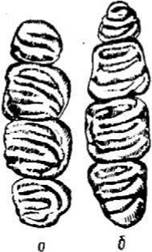
Fig. 84. Molars of the edible dormouse:
a — upper jaw; b — lower jaw
Family Muridae — Muridae.
The tail length is less than 2/3 of the combined length of the head and body. The chewing surfaces of the first and second upper molars do not always bear cusps.
Family Cricetidae — Cricetidae.
There are 4 molar and premolar teeth in the upper jaw.
There are 5 molar and premolar teeth in the upper jaw. Medium-sized animals: the combined length of the head and body does not exceed 700 mm. In arboreal species, the tail is long, flattened, and covered with long hair; in terrestrial species, it is short, measuring less than half the body length. The skull features well-developed supraorbital processes.
Family Sciuridae — Sciuridae.
There are only 3 molar and premolar teeth in the lower jaw.
There are 4 molar and premolar teeth in the lower jaw.
The hind limbs are approximately four times longer than the heavily shortened forelimbs. The tail is well-developed, ending in a lanceolate tuft. Its length always exceeds the combined length of the head and body. The long ears resemble those of a small hare.
Family Allactagidae — Allactagidae.
The hind limbs are no more than twice as long as the forelimbs. Small mouse-like mammals. The tail is longer than the combined length of the head and body, without a terminal tuft. The ears are short, up to 15 mm.
Family Sicistinae — Sicistinae.
Large animals: the combined length of the head and body in adults exceeds 400 mm. The toes of the hind feet are connected by a bare swimming web.
Small-sized animals: the combined length of the head and body is up to 170 mm.
The toes of the hind feet are not connected by a swimming web.
The very wide, flattened tail is covered with large horny scales.
Family Castoridae — Beavers.
The fauna of Ukraine is represented by a single species — the Eurasian beaver — Castor fiber (L.).
Tail rounded, covered with scales.
Family Myocastoridae — Nutrias.
Attempts have been made to acclimate only a single species in the fauna of Ukraine — the nutria — Myocastor coypus (Moll.).
The tail lacks scales and is densely covered with long hair. Transverse ridges are clearly visible on the grinding surface of the molar teeth (Fig. 84).
Family Myoxidae — Dormice.
Family Sciuridae — Squirrels. Key for the identification of genera and species.
Tail long and bushy; its length is nearly equal to the body length.
The hairs on the tail are long (40–50 mm). Pinnae are well developed, often tipped with tufts of hair. The first upper premolar is slender and Column-like or entirely absent. Sharp, curved claws are adapted for arboreal locomotion. Dental formula: i—1/1; c—0/0; p—2/1; m—3/3, total 22 teeth.
Genus Sciurus — Tree Squirrels.
The fauna of Ukraine includes only one species — the red squirrel — S. vulgaris (L.).
Tail short, its length not exceeding half of the body length.
Undeveloped pinnae are reduced to skin folds behind the auditory meatus. The first upper premolar is only half the size of the second premolar.
Small-sized rodents: head and body length does not exceed 230 mm. The dorsal coloration shows varying degrees of mottling. Cheek pouches are present. Dental formula: i—1/1; c—0/0; p—2/1; m—3/3, total 22 teeth.
Genus Citellus — Ground Squirrels
Large-sized rodents: head and body length is at least 400 mm.
Dorsal coloration is uniform. Cheek pouches are present but undifferentiated. The dental formula is identical to that of the entire squirrel family: i — 1/1; c — 0/0; p — 2/1; m — 3/3, total 22 teeth.
Genus Marmota — Marmots.
The fauna of Ukraine is represented by a single species — the bobak marmot — M. bobak (Mull.).
The tail length (excluding terminal hairs) equals or exceeds 1/4 of the head and body length. Dorsal coloration is brownish-fawn with distinct yet soft, blurred whitish spots. The venter is noticeably lighter. The soles of the hind feet are covered with hair right up to the digital pads. Head and body length 195–220 mm, tail 60–73 mm, hind foot 34–38 mm. Condylobasal skull length in adults 40–45 mm.
European ground squirrel — C. citellus (L.).
Tail length (excluding terminal hairs) is less than 1/4 of the head and body length. Dorsal coloration is brownish-brown with numerous prominent, contrasting white spots (2–3 mm). The ventral side is grayish with rusty tinges. The soles of the hind feet are covered with hairs right up to the digital pads. Head and body length 180–220 mm, tail 32–50 mm, hind
foot 30–34 mm. Condylobasal skull length in adults 39–43.5 mm.
Spotted ground squirrel — C. suslicus (Guld.).
The soles of the hind feet are almost naked, with hair present only on the sides and near the heel. The dorsal coloration is uniform, brownish-gray with indistinct, sometimes subtle light spots. Head and body length is 180–220 mm, tail length 32–50 mm, and hind foot length 33–37 mm. The condylobasal skull length of adults is 38–43.4 mm.
Little ground squirrel — S. pygmaeus (Раll.).
Family Dormice — Myoxidae
Key to genera and species
A distinct black stripe runs along the sides of the muzzle through the eye to the ear.
The bushy tail is evenly covered with hair. Head and body length in adults is less than 120 mm. Dental formula: i — 1/1; c — 0/0; p — 1/1; m — 3/3 — total 20 teeth.
Genus Forest dormouse — Dyromys.
The fauna of Ukraine includes only one species — Forest dormouse — D. nitedula (Раll.).
There is no black stripe along the sides of the muzzle through the eye to the ear.
The bushy tail is covered with long hairs parted to the sides. Head and body length in adults exceeds 125 mm. Dental formula: i — 1/1; c — 0/0; p — 1/1; m — 3/3 — total 20 teeth.
Genus Edible dormouse — Myoxus.
The fauna of Ukraine includes only one species — Edible dormouse — M. glis (L.).
The bushy tail of the animals is covered with relatively short hair that is not parted to the sides. Head and body length in adults is about 95 mm. Dental formula: i — 1/1; c — 0/0; p — 1/1; m — 3/3 — total 20 teeth.
Genus Hazel dormouse — Muscardinus.
The fauna of Ukraine includes only one species — Hazel dormouse — М. avellanarius (L.).
Family Birch mice and jerboas — Allactagidae Key to genera and species
Medium-sized rodents with a body length of over 8 cm. At the tip of the long tail, the hairs are elongated and form a distinctive tuft. The narrowest part of the wide interorbital region is located at the anterior edge of the frontal bones.
The hind limbs are five-toed, with shortened digits only. A prominent lancet-shaped tuft at the end of the tail features a dark base and a white tip. In the upper jaw, in addition to the molars, there is one premolar. The upper incisors project noticeably forward. Dental formula: i — 1/1; c — 0/0; p — 1/0; m — 3/3 — total 18 teeth.
Genus Jerboa — Allactaga.
The fauna of Ukraine includes only one species — Greater jerboa — Allactaga major (Kerr.).
The hind limbs are three-toed, with reduced lateral digits. The tail tuft is poorly defined; the hair covering the tail becomes progressively longer starting from its middle section. There are only 3 molars in the upper jaw. The upper incisors point straight downward. Dental formula: i — 1/1; c — 0/0; p — 0/0; m — 3/3 — total 16 teeth
Genus Thick-tailed three-toed jerboa — Stylodipus.
The fauna of Ukraine includes only one species — Strictly three-toed jerboa — S. telum.
Family Sminthidae Key to species
A black stripe runs along the spine down the back. The coloration of the dorsal region on the sides of this stripe is uniform—yellowish-chestnut with a dingy gray tinge. The tail length exceeds the head and body length by more than a third. Head and body length is 60–82 mm, tail length 90–106 mm; hind foot length 15.8–18.5 mm.
Northern birch mouse — Sicista betulina (Pall.).
Along the narrow black stripe on the back, there is an additional dark stripe on each side. The tail length is approximately one-third greater than the head and body length together. The coloration of the upper body is pale grayish with an ochreous tinge. Head and body length is 57–71 mm, tail length 70–80 mm, hind foot length 14–16 mm.
Southern birch mouse — Sicista subtilis (Pall.).
Family Muridae — Key for the identification of genera and species.
Small rodents: head and body length does not exceed 135 mm.
Large rodents: head and body length exceeds 150 mm, and the condylobasal skull length exceeds 30 mm.
Genus Rattus — Rats.
The tail is shorter than the head and body length combined, and the number of scale rings on it does not exceed 200. The ear, when folded forward, does not reach the eye.
The lateral crests of the parietal bones form almost parallel lines (Fig. 85).
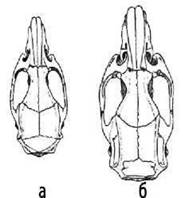
Fig. 85. Skull of rats: a — black rat; b — brown rat
Condylobasal skull length in adults is 45–50 mm.
Brown rat — R. norvegicus (Berk.).
The tail exceeds the head and body length combined, and the number of scale rings on it is over 200. The ear, when folded forward, reaches the eye. The lateral crests of the parietal bones curve outward in an arc (Fig. 86). Condylobasal skull length in adults is 38–45 mm. Black rat — R. rattus (L.).
On the inner side of the upper incisors, There is a clearly visible notch (Fig. 86).
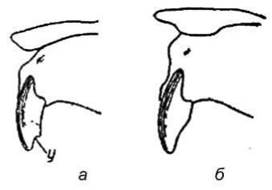
Fig. 86. Upper incisors of mice: a — house mouse; b — wood mouse; c — notch on the posterior surface of the house mouse incisor
Genus Mus — House mice.
A typical representative of the fauna of Ukraine is the house mouse — M. musculus (L.).
There is no notch on the inner side of the upper incisors (Fig. 87).
Medium-sized: head and body length exceeds 75 mm. Condylobasal skull length exceeds 20 mm.
Genera Apodemus, Sylvaemus — Wood and field mice.
Very small-sized: head and body length is less than 75 mm. Condylobasal skull length is up to 20 mm.
Genus Micromys — Harvest mice.
The fauna of Ukraine is represented by only one species — the harvest mouse — M. minutus (Pall.).
A distinctly visible black stripe runs down the back along the spine. The frontal bones have sharp, ridge-like borders along the edges of the interorbital space. The coloration of the dorsal part of the body is a dingy reddish. The underparts are clear white or whitish-gray.
Striped field mouse — A. agrarius (Pall.).
There is no black stripe along the back and spine. The frontal bones lack sharp, ridge-like borders along the edges of the interorbital space.
Hind foot length is at least 24 mm. A bright reddish patch is present on the chest between the front limbs. The upper body coloration is grayish-red with an intense rusty hue. The underparts are bright white.
Yellow-necked mouse — S. flavicollis.
Hind foot length is less than 24 mm. The dorsal coloration is dark grayish-red. The belly is clear white, mostly lacking a reddish patch on the chest.
Wood mouse — S. silvaticus (L.).
Family Hamsters — Cricetinae
Identification Key to Genera and Species
The chewing surfaces of the molars are flat. Tail length does not exceed half the length of the head and body.
The chewing surfaces of the first and second upper molars have cusps arranged in two rows. Tail length does not exceed 1/3 of the length of the head and body.
Medium-sized rodents: head and body length in adults exceeds 230 mm. The fur on the animal's underparts is black.
Genus Hamster — Cricetus.
The fauna of Ukraine includes only one species — Common hamster — C. cricetus (L.).
Small-sized rodents; head and body length is less than 120 mm. The fur on the underparts is pure white or has a grayish tint.
Genus Dwarf hamster — Cricetulus.
The fauna of Ukraine includes only one species — Gray dwarf hamster — C. migratorius (Pall.).
Large-sized rodents, significantly (1.5–2 times) larger than a rat. The tail is long, scaly, and laterally compressed like a paddle (its height exceeds 15 mm).
Genus Muskrat — Ondatra.
The fauna of Ukraine is represented by only one acclimatized species — Muskrat — O. zibetica (L.).
Smaller rodents, no larger than the brown rat. The tail is rounded and covered with short hairs.
The large upper incisors protrude prominently forward. The anterior surface of the incisors is white. Pinnae are absent. On the outer surface of the articular process of the Mandible, a distinctly visible tubercle (alveolar process) is present, which houses the root of the lower incisor (Fig. 87).
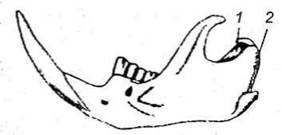
Fig. 87. Lower jaw of a mole-rat: 1 — articular process; 2 — alveolar process
Enamel loops on the chewing surface of the molars are not shaped like closed triangles.
Genus Mole Vole — Ellobius.
The fauna of Ukraine is represented by only one species — the Northern Mole Vole — E. talpinus (Pall.).
The upper incisors are of typical murine size and do not protrude forward. The anterior surface of the incisors is yellow. The pinnae of the ears noticeably protrude from the fur. The enamel loops on the chewing surface of the molars form closed triangles.
A black stripe runs along the spine from the nose to the base of the tail.
The soles of the hind feet are densely covered with hair. The skull features clearly visible supraorbital processes.
Genus Steppe Lemming — Lagurus.
The fauna of Ukraine includes only a single species — the Steppe Lemming — L. lagurus (Pall.).
There is no black stripe along the spine.
Large rodents: the head and body length exceeds 135 mm.
The interorbital crest on the frontal bones forks into two ridges before reaching the anterior margin of the parietal bones. The molars are rootless.
Genus Water Vole — Arvicola.
The fauna of Ukraine is represented by a single species — the European Water Vole — A. terrestris (L.).
Smaller rodents: the head and body length does not exceed 135 mm.
The posterior margin of the bony palate almost reaches the anterior edge of the third molar. The fur coloration is rufous or brownish-rufous. The molars in adults are rooted.
Genus Bank Vole — Clethrionomys.
Within Ukraine, this genus is represented by only one species — the Bank Vole — C. glareolus (Schreb.).
The posterior margin of the bony palate extends only to the middle of the third molar. The molars never develop roots.
Genus Vole — Microtus.
In adults, the tail length exceeds the head and body length. The chewing surface of the first lower molar bears 7 more or less closed dentine islands. The outer side of this tooth features 4 angular projections (Fig. 88).
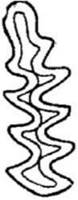
Fig. 88. First lower molar of the common vole
The upper body coloration is dingy grey, occasionally with a buffy tinge. The underparts are light grey.
Common Vole — M. arvalis (Pall.).
The tail length is approximately one-quarter of the head and body length. The second upper molar has 5 closed loops, as the posterior end of the tooth bears a small additional triangle on the inner edge. The upper parts are yellowish-grey, and the underside is whitish-grey. The tail is dark and nearly unicoloured.
Field Vole — M. agrestis (L.).
The tail length is approximately equal to half the combined length of the head and body. The first lower molar has only three outer angles. The dorsal coloration is dark dirty-gray with an ash-tinged hue, while the ventral side is whitish-gray. The tail is bicolored: black above and whitish below.
Root Vole — M. oeconomus (Pall.).
Order Artiodactyla — Key to Genera
The facial region of the skull is greatly elongated. The eye orbits are open: the frontal and jugal bones do not meet. The upper canines and incisors are well developed. The molar teeth are tuberculate.
Family Suidae — True Pigs.
The fauna of Ukraine is represented by a single species — Wild Boar — Sus scrofa (L.).
The facial region of the skull is not wedge-shaped. The eye orbits are closed: the frontal and jugal bones meet. There are no upper incisors, and if canines are present, they are very poorly developed.
Family Cervidae — Deer.
Key to Genera and Species
Large to medium-sized animals. The upper and lower jaws bear no more than six molar and premolar teeth on each side. Males possess bony, branched antlers that are shed annually. Females lack antlers.
Smaller animals. The length of the Lacrimal bone is less than the anteroposterior diameter of the eye Orbit. The anterior margin of the hard palate extends beyond the first molar. The antlers lack supraorbital tines.
Genus Capreolus — Roe Deer.
The fauna of Ukraine is represented by a single species — Roe Deer — С. capreolus (L.).
The base of the antlers expands into a large palmation with multiple tines. The nasal bones are greatly shortened: their length is shorter than the upper molar and premolar tooth row.
Genus Alces — Moose.
The fauna of Ukraine is represented by a single species — Moose — А. alces (L.).
The antlers are large with numerous tines. The nasal bones are quite long; their length equals or exceeds that of the upper molar and premolar tooth row. The length of the lacrimal bone is not less than the anteroposterior diameter of the eye orbit. The anterior margin of the bony palate does not extend past the first molar. The antlers possess supraorbital tines.
Genus Cervus — True Deer.
The typical species in the fauna of Ukraine is the Red Deer — С. elaphus (L.).
Order Cetacea — Key to Genera and Species
The lower jaw does not project far forward. Numerous teeth are present in both the upper and lower jaws.
The rostrum is short, equal to or shorter than the length of the skull measured from the anterior edge of the zygomatic arch to the posterior edge of the occipital condyle. Dental Morphology is characterized by a distinct constriction (neck) between the crown and the root. The total number of teeth ranges from 80 to 108, most commonly up to 100.
Genus Phocoena — Porpoises.
Represented in the Black and Azov Seas by a single species only — Harbour Porpoise — Ph. phocaena relicta (Abel.).
The rostrum is significantly longer than the cranium proper, measured from the anterior edge of the zygomatic arch to the posterior edge of the occipital condyle.
The width of the rostrum at the base goes into its length approximately two times. The teeth have blunt tips. The total number of teeth ranges from 72 to 96, more often up to 88.
Genus Bottlenose Dolphin — Tursiops.
In the Black Sea, there is only one species — the Black Sea bottlenose dolphin — T. truncatus ponticus (Barab.).
The width of the rostrum at the base goes into its length significantly more than twice. The teeth are small and sharp-tipped. The total number of teeth ranges from 150 to 220.
Genus Common Dolphin — Delphinus.
In the Black Sea, there is only one species — the Black Sea common dolphin — D. delphis ponticus (Barab.-Nikif.).
Last update: 13/08/2026
Editorial and Educational Adaptation: This material has been compiled based on the primary/original source text. The project team performed an editorial review, corrected technical inaccuracies, structured sections, and adapted the content for an educational format.
What was processed:
- elimination of formatting defects (OCR errors, structural breaks, corrupted characters);
- editorial organization of content;
- standardization of terminology in accordance with academic sources;
- verification of factual statements against the original source text.
All mentions of the author, publication year, and origin of the primary text have been preserved in accordance with the source.