FISHES OF THE FAMILY CYPRINIDAE IN THE WATER BODIES OF UKRAINE - V. V. Zamorov - 2015
GENUS ROACH - RUTILUS RAFINESQUE
Identification key for species of the genus Rutilus
1 (2). Lateral line with fewer than 50 scales. Body relatively short, high,
laterally compressed. Common roach - R. rutilus
2 (1). Lateral line with more than 53 scales. Body relatively long, low, almost not compressed laterally
3 (4). Maximum body depth noticeably greater than HEAD length.
Anal fin base length shorter than its height. Lateral line mostly with 60-67 (53-69) scales. Black Sea roach - R. frisii
4 (3). Maximum body depth less than or equal to head length.
Anal fin base length greater than its height. Lateral line mostly with 55-58 (53-62) scales. Caspian kutum - R. kutum
Roach - Rutilus rutilus (Linnaeus)
Morphological features: D (II) III 9-11; A III (8-9) 10-11 (12); P I (13) 14-17 (18-19); V II (7) 8 (9); C I (15-16) 17 (18) I; l. l. (39) 40-44 (45-46); Squ1 (7) 7.5-8.5 (9-9.5); Squ2 (3) 3.5-4.5 (5); sp. br. (9) 10-14 (15); vert. (38-39) 40-43; d. f. 6-5 (66.8%), 5-5 (24.2%), 5-6 (4.1%), 5-4 (2.1%), 6-4 (1.4%), 4-5 and 6-6 (0.7% each). Maximum length 35 cm, body weight up to 1000 g, lifespan up to 10 years (Fig. 48).
Body moderately elongated, laterally compressed, fairly deep; maximum depth in adult fish averages 28-33 (24-36)% of body length and is nearly twice the minimum body depth. Dorsal profile convex, transitioning into an almost horizontal line behind the dorsal fin; ventral profile smoothly convex, straight at the level from the pectoral to the anal fin. Back in front of the dorsal fin laterally compressed, forming a small ridge near the apex, rounded behind the dorsal fin. Belly flat from the throat to the end of the pelvic fin base, laterally compressed behind the pelvic fins with a scale-covered keel. Caudal peduncle relatively short, averaging 16-21 (15-24)% of body length.
Class="center">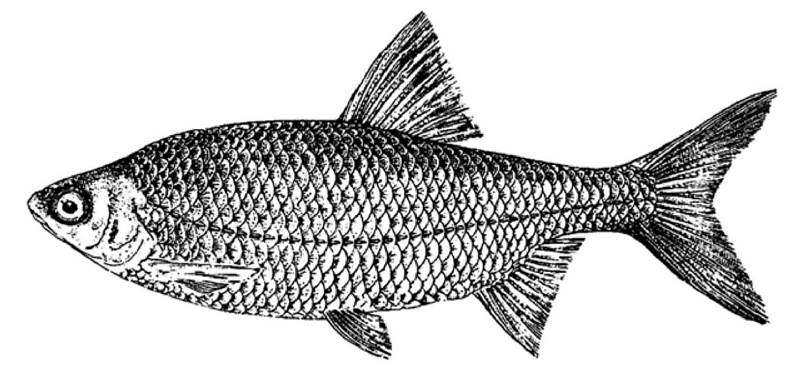
Fig. 48. Roach Rutilus rutilus
Dorsal fin relatively small, truncate, with a slight notch. Anal fin small, with a well-defined notch. Paired fins slightly rounded, pointed or blunt at the tip. Caudal fin with a distinct, deep notch; its middle rays are more than 2.5 times, sometimes 3 times, shorter than the longest outer rays. Both lobes of the caudal fin are equal in length, or either the lower or upper lobe is longer. Dorsal fin origin located slightly behind the vertical line of the pelvic fin origin; anal fin origin noticeably behind the vertical line of the posterior margin of the dorsal fin base. Pectoral fins quite long, reaching half or more of the pectroventral distance. At the Base of the pelvic fins on the outer side, there is an elongated scale with an acute tip. Scales rather large, densely covering the body. Lateral line complete, curving in a gentle arc toward the belly, transitioning from the trunk to the head in the anterior part. Head relatively small, in length almost equal to the caudal fin.
Snout relatively short, quite blunt, slightly rounded at the tip. Mouth small, semi-lunate, obliquely cut, subinferior in adults. Its apex is located at the level of the lower margin of the eye, sometimes slightly higher. Eyes large, their diameter on average slightly exceeds the upper jaw length. Forehead wide, slightly convex. Upper jaw always shorter than the lower jaw and does not reach the anterior margin of the eye. Lower jaw connects to the cranium at the vertical of the anterior margin of the eye. Gill rakers short, sparsely spaced. Pharyngeal Teeth fairly robust, with a small hook at the apex, sometimes weakly folded, arranged in a single row. Abdominal cavity usually light, reddish.
In Ukraine, it occurs in all river basins, lakes, reservoirs, etc., as well as in the brackish waters of estuaries in the northwestern Regions of the Black Sea and the northern part of the Sea of Azov; it has been acclimatized in the reservoirs and rivers of Crimea.
Black Sea roach - Rutilus frisii (Nordmann)
Morphological features: D (II) III - IV (8) 9-10; A III (IV) (9) 10-11 (12); P I 16-18; V III 8-9 (10); l. l. (53-59) 60-67 (68-69); Squ1 (9) 9.5-11 (11.5); Squ2 (4.5) 5-5.5 (6-6.5); vert. 42-44; sp. br. (7) 8-11 (12); d. f. 6-5 (90.2%), 5-5 (8.1%), 6-6 (1.7%). Maximum length 71 cm, body weight up to 8 kg, lifespan over 10 years (Fig. 49).
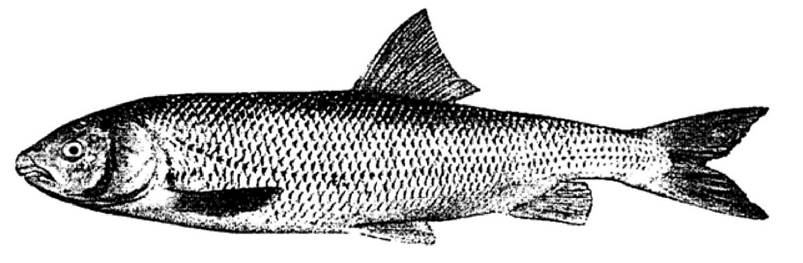
Fig. 49. Black Sea roach Rutilus frisii
Lateral line with 53-69 scales. Swim bladder ending in a sharp appendage at the posterior end. Belly behind the pelvic fins rounded laterally, flat (no scale-covered keel).
Body elongated, somewhat laterally compressed, thickset, relatively low. Its maximum depth in adult fish is less than 1/3 of the body length. Dorsal profile weakly convex, ventral profile smoothly convex, almost straight from the Water/144.html">Origin of the pectoral fins to the anal fin. Back in front of the dorsal fin slightly compressed laterally; belly behind the pelvic fins rounded or flat, without a keel. Caudal peduncle short, 15-24% of body length. Dorsal fin squarely truncate, sometimes slightly rounded at the apex, with an inconspicuous notch at the lower part. Anal fin squarely truncate, with an indistinct notch in the middle. Paired fins rounded, pointed at the tip. Caudal fin with a well-defined deep notch, both lobes generally equal in length. Dorsal fin begins slightly ahead of the vertical of the pelvic fin origin.
At the base of the pelvic fins on the outer side, There is a fairly wide, elongated scale. Scales of medium size, densely covering the body. Lateral line complete, curving in a gentle arc toward the belly in the area from the upper margin of the operculum to the vertical of the pectoral fin tips, and thereafter running in a straight (sometimes faintly wavy) line. The lateral line passes from the trunk to the head, where it is arranged in several rows. Head small, its length almost half the post-dorsal distance. Snout fairly long, blunt, thickened and high at the tip, protruding slightly over the upper jaw. Mouth relatively small, inferior, somewhat obliquely cut. Its apex is located below or at the level of the lower margin of the eye. Eyes fairly large, their diameter half the snout length, sometimes slightly more. Forehead wide, slightly convex, almost flat, its width more than twice the head height. Jaws approximately equal in size. Upper jaw noticeably failing to reach the anterior margin of the eye; lower jaw connects to the cranium at the level of the vertical from the anterior margin of the eye or slightly behind it. Gill rakers short, rather massive, sparsely spaced. Pharyngeal teeth robust, arranged in a single row, massive, expanded and thickened at the apex, smooth (not serrated or folded), some occasionally hooked at the end. Abdominal cavity light (yellowish).
Previously in Ukraine, it was found in the estuaries of the northwestern Black Sea region and in the Sea of Azov, entering the Dniester, Southern Bug, Dnieper, Seversky Donets, Obitichna, Berda, and possibly the lower Danube. Currently, a very sparse population survives in the upper Dniester, and single specimens are occasionally found in the tributaries of the Seversky Donets and possibly in the Sea of Azov. It is a rather rare, low-Abundance fish, listed in the Red Data Book of Ukraine.
Caspian kutum (kutum) - Rutilus kutum (Kamensky)
Morphological features: D III 9; A III 10; l. l 53-62 (64); Squ1 9,5-10, Squ2 4,5-5, d. f. 6-5, maximum body length up to 67 cm, typically 40-50 cm, weight up to 4 kg, typically 0,5-2.5 kg, lifespan up to 11 years (Fig. 50).
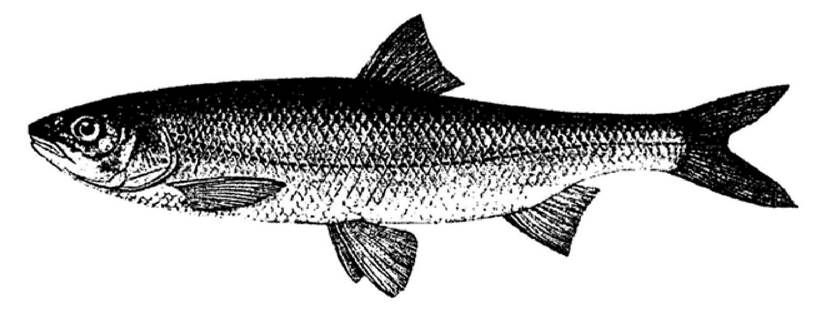
Fig. 50. Caspian kutum Rutilus kutum
In Ukrainian waters, its morphological and biological features remain virtually unstudied. The body is elongated, low, and cylindrical. The mouth is small and inferior. In external Structure and coloration, it closely resembles the Black Sea roach (viderezub).
A semi-anadromous schooling bottom-dwelling fish that feeds in brackish waters and ascends rivers to spawn. Sexual
maturity is reached at the age of 4-5, occasionally 3 years, with a body length exceeding 40 cm.
A valuable commercial fish that was rarely encountered as solitary individuals in Ukrainian waters.
Range: Caspian Sea basin. Previously considered a subspecies of R. frisii kutum. The species status of this fish requires confirmation.
The native habitat of the kutum is the Caspian Sea, from where it was introduced into the Sea of Azov, where it successfully naturalized and became part of the local ichthyofauna. However, over the past 25-30 years, it has practically disappeared from catches, indicating its likely extinction in our waters.
In Ukraine, it was previously recorded near the northern shores of the Sea of Azov (acclimatization efforts began in 1957-1958), specifically in the Molochnyi Liman as well.
Last update: 07/08/2026
Editorial and Educational Adaptation: This material has been compiled based on the primary/original source text. The project team performed an editorial review, corrected technical inaccuracies, structured sections, and adapted the content for an educational format.
What was processed:
- elimination of formatting defects (OCR errors, structural breaks, corrupted characters);
- editorial organization of content;
- standardization of terminology in accordance with academic sources;
- verification of factual statements against the original source text.
All mentions of the author, publication year, and origin of the primary text have been preserved in accordance with the source.