FISHES OF THE FAMILY CYPRINIDAE IN UKRAINIAN WATERBODIES - V. V. Zamorov - 2015
GENUS CRUCIAN CARP (KARAS) CARASSIUS JAROCKI
Key to species of the genus Carassius
1 (2). Serrations on the last unbranched ray of the dorsal and
anal fins are fine and numerous (up to 30 elements). The upper margin of the dorsal fin is convex-rounded. The first gill arch bears no more than 35 gill rakers. The Abdominal cavity is light ( yellowish). Crucian carp (Prussian/Goldfish) - C. carassius
2 (1). Serrations on the last unbranched ray of the dorsal and anal fins are coarse and few in number (up to 10-15 elements). The upper margin of the dorsal fin is straightly truncated, often with a slight notch. The first gill arch bears at least 38 gill rakers. The abdominal cavity is dark (black).
3 (4). Gill rakers 38-45. Lateral line with (26) 28-30 (31) scales, scales above the lateral line typically exceeding 7 (up to 8 and more) Goldfish - C. auratus
4 (3). Gill rakers 43-53. Lateral line with 28-32 (33) scales, scales above the lateral line usually not exceeding 7
Prussian carp - C. gibelio Crucian carp (goldfish) - Carassius carassius (Linnaeus) Morphological features: D III-IV 14-20; A III 5-7; P I 12-16; V II 6-8; C n I17 I n, total 25-30; l. l. 29-34; vert. 30-34; sp .br. 24-32; d. f 4-4. Maximum body length of the largest specimen 36 cm, mass 1500 g, lifespan up to 10-15 years (Fig. 2).
Class="center">
Fig. 2. Crucian carp Carassius carassius
Body short, deep, laterally compressed. In crucian carp from the Lower Danube, which represents the nominotypical form of this species, the following plastic characters were recorded: maximum body height is close to half of body length l and exceeds maximum body thickness by 2.4 times. The dorsal and ventral margins are rounded. The lateral body profiles form rounded curves. The dorsal profile rises steeply behind the HEAD and extends in a fairly uniform arc to the end of the dorsal fin base, which is relatively long. The ventral profile is less convex, extending in a gentle arc from the pelvic fin bases to the anal fin base. The caudal peduncle is short, laterally compressed, and uniformly moderately high; its average length is 16.5% of l, almost equalling its height and matching the height of A. The base of V originates slightly posterior to the vertical through the middle of l, while the base of D is slightly further removed from the tip of the snout. The base length (34.7% of l) and height (19.1% of l) of D are large. The base of A is short (12.3% of l). The length of P is slightly smaller, the length of V slightly exceeds 1/5 of l, and the length of each lobe of C is nearly equal to 1/5 of l. Fin tips are faintly rounded, without incisions. The caudal fin notch is small. The last unbranched ray of D and A is slightly thickened, with moderate serration along the posterior margin. The body is covered with moderately sized scales with weak sculpturing. The lateral line runs along the middle of the body and is well-defined. Head of medium size, length less than 1/3 of l, high. Head height averaged 92.4% of head length. Snout short, slightly exceeding 1/3 of head length. Eyes of medium size. Eye diameter exceeds 1/5 of head length; it is positioned very close to the dorsal margin of the head and significantly closer to the snout tip than to the posterior margin of the head (postorbital distance is 1/2 shorter than head length and 1.4 times greater than snout length). Forehead relatively wide (41.4% of c). Mouth small, terminal, obliquely directed, protrusible, its apex lying on the level of the lower margin of the eye. Jaws of moderate length, the upper (27.8% of c) significantly shorter than the lower (36.8% of c). According to literature data, the gut length in crucian carp is 3-3.5 times greater than body length l.
In Ukraine, it is widely distributed primarily in enclosed natural and artificial waterbodies within the basins of all major rivers, less common in the rivers themselves, and has been acclimatized in Crimean waterbodies. A fairly rare, low-Abundance fish. The species is listed in the Red Data Book of Ukraine.
Goldfish (Chinese crucian carp) - Carassius auratus (Linnaeus)
Morphological features: D III 15-19; A III 5-6; P I 16; V II 8; C n I 17 I n; І. І. 26-31; Squ1 5-8, Squ2 6-8; vert. 26-31; sp. br. (n = 42) 3845, d. f. 4-4. Maximum body length of the largest specimen 18.6 cm, mass 37.2 g, lifespan up to 10-15 years (Fig. 3).
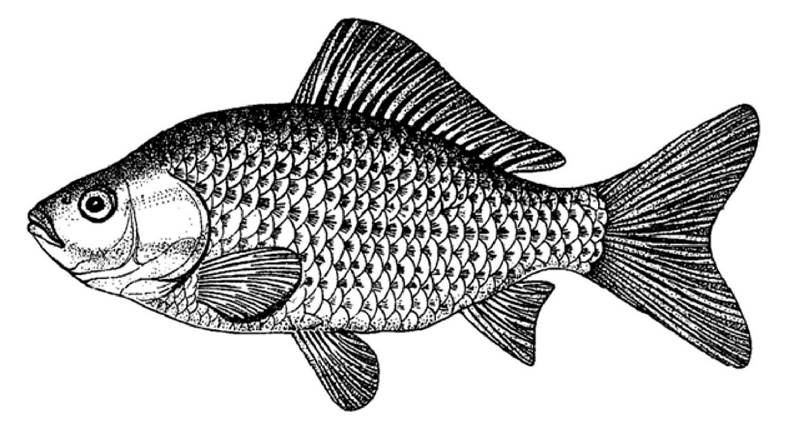
Fig. 3. Goldfish Carassius auratus
Body short, deep, moderately compressed laterally. Maximum body height ranges from 33.8 to 43.4% (averaging 38.8-39.5%) of body length l, exceeding maximum body thickness by 1.3 times and minimum body height by 2.2-2.6 times. The back and belly margins are rounded. The dorsal profile is moderately convex, rising in a gentle arc to the Water/144.html">Origin of the dorsal fin base, and descending almost in a straight line past the end of the D base to THE ORIGIN OF the caudal peduncle. The ventral profile is nearly straight from the vertical of the pectoral fin base origin to the anus, rising rather steeply forward to the snout and backward to the caudal peduncle origin. The caudal peduncle is short, uniformly high, with a length of 13.7-20.3% (averaging 16.7-16.9%) of l, slightly exceeding the minimum body height. The dorsal and especially pelvic fins originate slightly anterior to the vertical through the midpoint of body length; the pectoral fin originates at half the anteventral distance and reaches the pelvic fin base origin; the anal fin originates at the vertical of the last third of body length and terminates posterior to the vertical through the dorsal fin base end. The margins of all fins are slightly rounded, except for the anal fin, which is angular.
Fins are unincised, with only the caudal fin bearing a noticeable notch; its lobes are equal and of moderate width. The last unbranched ray of the dorsal and anal fins is massive, with serrations along the posterior margin. Scales are medium-sized, quite thick, firmly attached, densely covering the entire trunk in rather irregular rows. The lateral line is continuous, running along the middle of the body, curving slightly upward toward the upper margin of the gill slit only anteriorly. Head of medium size, of typical crucian carp shape, with length almost equal to the ordinary caudal fin lobe. Snout short, intermediate in shape between blunt and pointed, its length being one-third of the head height. Mouth small, terminal, obliquely directed, its apex level with the lower margin of the eye. Eyes relatively large, their diameter being only half the forehead width.
Introduced to Europe in the 16th century, from where it reached Ukraine. Occasionally cultivated in park ponds, more frequently in aquaria.
Prussian carp (silver crucian carp) - Carassius gibelio (Bloch)
Morphological features: D III-IV 15-19; A II-III 5-6; P I 13-17; V II 6-9; l. l. 28-33, vert. 29-33, sp. br. 43-53, d. f. 4-4. Maximum body length of the largest specimen 20 cm, mass 285 g, lifespan up to 10-11 years (Fig. 4).
Body relatively short, deep, moderately compressed laterally. In Prussian carp specimens from Lower Danube waterbodies, the modal values are as follows: maximum body height accounts for 42.5% of body length l and exceeds body thickness by 2.3 times. Dorsal and ventral margins are rounded. The dorsal profile exhibits a slight break behind the occiput, rising rather steeply in an arc to the dorsal fin base origin and sloping down toward the caudal region along the base itself. The ventral profile is slightly convex, rising upward with a distinct break behind the anus at the anal fin base and continuing into the horizontal lower line of the caudal peduncle. The latter is short and uniformly high. Its length is 16.9% of l, slightly exceeding its height (15.9%) and the height of A (16.7%).
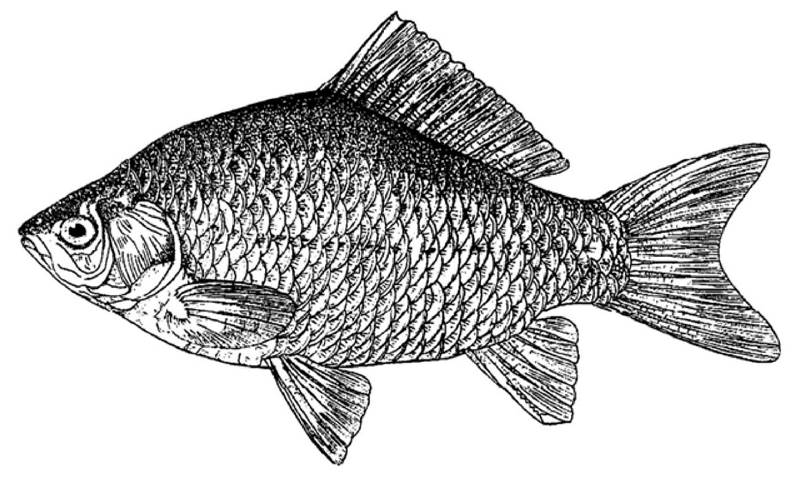
Fig. 4. Prussian carp Carassius gibelio
The Base of the dorsal fin (D) originates slightly behind the vertical line passing through the midpoint of the standard length ($l$), while the base of the ventral fin (V) originates just ahead of it. Both the length (37.8%) and height (18.5%) of the D base are relatively large. The length of the pectoral fin (P) is slightly less, and the V fin slightly greater, than 1/5 of $l$, with both caudal lobes being slightly shorter than 1/4 of $l$. The fin tips are somewhat angular. The fins are indistinct, except for the clearly notched caudal fin with equal and moderately broad lobes. The first three unbranched rays of D and A are closely appressed.
The last unbranched ray of D and A is robust, bearing distinct serrations along its posterior margin. The body is covered with moderately sized, somewhat sculptured scales. The lateral line runs along the middle of the body and is well-defined. The head is moderately elongated (its length being 28.99% of $l$) and deep. Expressed as a percentage of head length ($c$), head depth is 86.6%. The snout is short, measuring one-third of the head length. The eyes are of medium size; the eye diameter is 1/5 of the head length, positioned close to the dorsal profile and significantly closer to the anterior margin of the head than to the posterior. Postorbital distance is 51.8% of $c$. The interorbital space is broad, accounting for 41.7% of $c$. The mouth is small, terminal, oblique, and protrusible, with its upper edge aligned with the lower margin of the eye. Gill rakers are closely spaced and comparatively long.
There are two prevailing viewpoints regarding the native distribution range of this fish. According to one, its ancestral homeland includes the water bodies of China and Japan. It was introduced to Europe in the early 20th century, from where it found its way into ponds in the Lviv and Vinnytsia regions. Later, it was repeatedly imported into Ukraine from Russia and other neighboring countries. Today, it inhabits the basins of virtually all major rivers, large lakes, and reservoirs. It is most abundant in the lower reaches of the Danube, Dniester, Dnieper, and Southern Bug rivers, and has been acclimatized in the reservoirs and ponds of Crimea. The alternative perspective posits that the species is indigenous.
Last update: 07/08/2026
Editorial and Educational Adaptation: This material has been compiled based on the primary/original source text. The project team performed an editorial review, corrected technical inaccuracies, structured sections, and adapted the content for an educational format.
What was processed:
- elimination of formatting defects (OCR errors, structural breaks, corrupted characters);
- editorial organization of content;
- standardization of terminology in accordance with academic sources;
- verification of factual statements against the original source text.
All mentions of the author, publication year, and origin of the primary text have been preserved in accordance with the source.