FISH OF THE FAMILY CYPRINIDAE IN WATER BODIES OF UKRAINE - V. V. Zamorov - 2015
THE GENUS CARP (SAZAN) CYPRINUS LINNAEUS
The body is elongated, moderately deep, and slightly compressed laterally. In lateral profile, the transition from the HEAD to the back is smooth, without a distinct hump. The dorsal fin has a very long base and is slightly emarginate along the edge, D III-IV 11-22; the anal fin has a short base, A III (4) 5; in both fins, the last unbranched ray is serrated and robust. The scales are large, thickened, cycloid, and arranged in regular rows. The lateral line runs along the middle of the body and is moderately distinct (26-45 scales). The supraorbital sensory canal connects with the postorbital canal in the pterotic region. The bones of The Skull and operculum are sculpted. The first three vertebrae in the spine are fused. The Mouth is terminal to slightly subterminal and protrudable. There are two pairs of barbels at the corners of the mouth. The pharyngeal Teeth are molariform, triserial, 1.1.3-3.1.1 (occasionally 1.2.3-3.2.1), with a flat, grooved crown. The gill rakers are relatively short, distributed singly, and resemble those of the barbel. The intestine length is 2.5-3 times the body length l. The Abdominal cavity is silvery-white.
Southeast Asia is considered the center of origin for this genus. Three or four species are known in Southeast Asia and Europe. Among them, Cyprinus carpio Linnaeus is widespread in Europe and the Amur River basin, with D III-IV 17-22, l. l. 35-41. In addition, species have been described in China from the Yunnan rivers: C. micristius Regan, 1906, which has D IV 11, and from the Yangtze River: C. rabaudi Tchang, 1930, which has l. l. 45.
Common carp (sazan) - Cyprinus carpio (Linnaeus)
Morphological features: D III-IV 17-22; A III 5; P I 13-16; V II 7-8; C I 16-18 I; l. l. (35) 36-40; Squ1 6-7, Squ2 5-7; vert. 35-39; sp. br.1 22-29, sp. br.2 29-34; d. f. 1.1.3-3.1.1. The body length of the largest specimen is 100 cm, weight up to 20 kg, and lifespan exceeds 20 years (Fig. 5).
Class="center">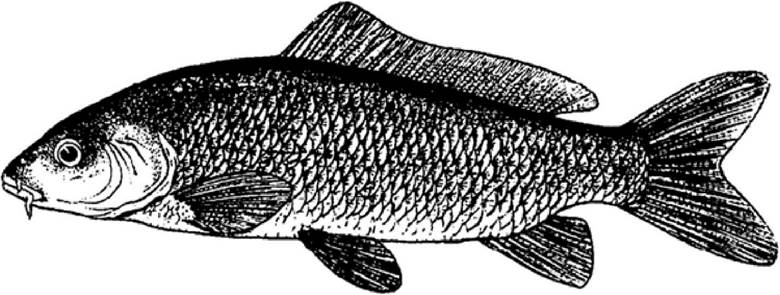
Fig. 5. Common carp Cyprinus carpio
The body is moderately elongated, somewhat deep, and thickened. On average, the maximum body depth ranges from 30.2 to 36.2% of l and is 1.6-2 times greater than the body width. The dorsal profile of the body transitions smoothly from the head to the back. The back just behind the nape is slightly compressed laterally. The belly is slightly convex and rounded along the margin. The caudal peduncle is somewhat elongated (its length is less than 1/5 of l), relatively deep (up to 13% of l), and laterally compressed. The dorsal and ventral fins begin at almost the same distance from the tip of the snout: the predorsal and preventral distances are close to 1/2 of l. The Base of the dorsal fin is only slightly shorter (about 40% of l), and its upper margin is noticeably emarginate. The anal fin has a shorter base. The heights of these fins are similar, or slightly greater in the latter. The lengths of the caudal lobes are almost equal and close to 1/5 of l. The head length is 1/4 of l or slightly more.
The head depth relative to its length averages 73.9-81.1%. The eyes are small, with the eye diameter fitting into the head length about seven times. The eye is positioned closer to the anterior margin of the head (snout length is 37-38% of c) than to its posterior margin (the postorbital distance is slightly greater than half the head length). The barbels are short; the length of the anterior ones is one and a half to two times less than the eye diameter, while that of the posterior ones is slightly greater than or equal to it.
According to literature data, the sazan (common carp) exhibits clinal variation across its Eurasian range in certain morphological traits. Specifically, with a regional shift eastward, the species shows a decrease in the number of rays in the dorsal fin, the number of vertebrae, and the number of gill rakers, as well as in the V-A distance, the length of the caudal peduncle, the base length and height of the dorsal fin, and the height of the anal fin, alongside an increase in the predorsal distance.
The modern range of the sazan lies approximately between 35-50° N and 30-135° E, spanning temperate, subtropical, and tropical climates. The native range of the species consists of two parts: 1) the Water bodies of the Ponto-Caspian-Aral region and parts of Western Europe, and 2) the river systems of the Far East and Southeast Asia, from the Amur River in the north to Yunnan and Burma in the south. It is absent from the southern part of Asia Minor, Iran (excluding the Caspian basin), the Tigris and Euphrates rivers, Turkmenistan, the inland water bodies of Central Asia, the Baikal basin, India, and the Indo-Malayan archipelago, excluding areas of artificial stocking and acclimatization.
The disjunction of the species' range into western and eastern parts is believed to have occurred in the late Tertiary or early Quaternary period As a result of climate cooling, during which thermophilic fish in Siberia became extinct.
Last update: 07/08/2026
Editorial and Educational Adaptation: This material has been compiled based on the primary/original source text. The project team performed an editorial review, corrected technical inaccuracies, structured sections, and adapted the content for an educational format.
What was processed:
- elimination of formatting defects (OCR errors, structural breaks, corrupted characters);
- editorial organization of content;
- standardization of terminology in accordance with academic sources;
- verification of factual statements against the original source text.
All mentions of the author, publication year, and origin of the primary text have been preserved in accordance with the source.