FISH OF THE FAMILY CYPRINIDAE IN THE WATER BODIES OF UKRAINE - V. V. Zamorov - 2015
GENUS TENCH - TINCA CUVIER
Pharyngeal Teeth uniserial, with crowns slightly thickened and curved into a weak hook. Scales small, numbering 70-120 in the lateral line. Lateral line
complete. Belly fully scaled right up to the interbranchial space. All fins rounded, lacking spiny rays. In D (II) III- IV (V) 7-9, in A III-IV 6-8 rays. Caudal fin very slightly emarginate. Mouth terminal, with a short barbel at each corner. Belly not compressed anterior to the anus. Gill rakers moderately long, 10-16 on the first gill arch. Articulation of the lower jaw with the cranium situated below the vertical of the anterior margin of the eye. Gut short. One species distributed in Europe, Asia Minor, the Caucasus, and Siberia eastwards to the Yenisei River basin.
Tench (lin) - Tinca tinca (Linnaeus)
Morphological features: D (II)III-IV(V) (7)8-9; A III-IV (5)7; P I 14-17 (18), VI (8) 9-10; Squ (70, 76, 85) 86-112 (114, 115, 119); l. l. (70, 78, 80) 84-109 (112, 115, 116); Squ1 (25, 26) 27-34 (35, 36); Squ2 (16, 17) 18-26 (27); vert. (35, 38) 39-43 (44); sp. br. (10) 11-15 (16); d. f 4-5 (37.5%), 5-4 (31.9%), 4-4 (27.5%), 5-5 (3.1%). Maximum dimensions: body length 70 cm, mass 860 g, lifespan about 9-10 years (Fig. 6).
Class="center">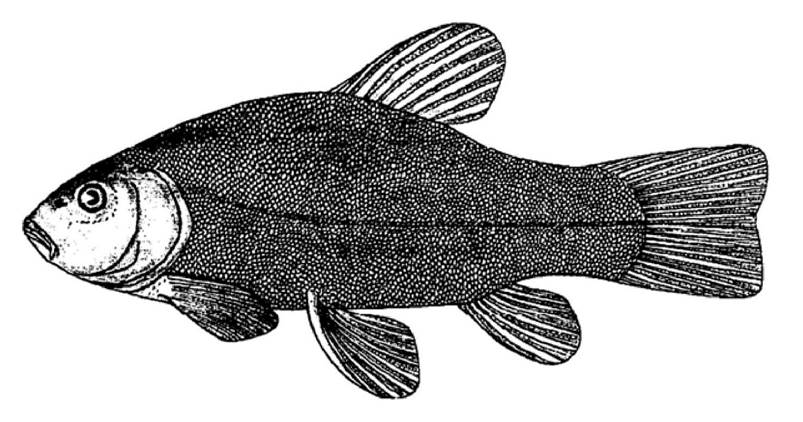
Fig. 6. Tench Tinca tinca
Body relatively short, slightly laterally compressed, quite thick and deep. Its maximum body depth averages 30.6-34.6% (27.5-39.2) of the total body length. Dorsal and ventral profiles smoothly convex, though a distinct hump usually forms behind the nape. Back slightly compressed laterally in front of the dorsal fin, belly rounded. Caudal peduncle fairly deep and short, its length averaging 19.1-19.7% (16.5-23.8) of body length. All fins, including the caudal, are rounded. The caudal fin is straight-edged with a barely perceptible notch; its lobes are usually of equal length, though sometimes the lower lobe is slightly longer than the upper. The dorsal fin originates slightly behind the vertical of the posterior margin of the pelvic fin base or directly above it. Pectoral fins long. In females, they span more than half the P-V distance; in males (depending on age), they fall just short of the pelvic fin base, reach it, or even extend beyond it. In younger specimens and males, the pelvic fins are usually noticeably longer than the pectorals, occasionally equal in length, and shorter than the pectorals in females. Furthermore, in males, particularly mature ones, the second unbranched ray of the pelvic fins is greatly thickened and broad. Typically, the pelvic fins do not reach the anus in females, whereas in males they reach as far as the anal fin. Scales are very minute, tightly overlapping, and firmly embedded in the Skin due to their elongated shape, with more than two-thirds immersed in skin covered by a thick layer of mucus. The lateral line is usually complete, occasionally interrupted by gaps of two to five scales.
In the posterior part of the body, it falls short of the scale cover's edge by two to three scales. It appears as a straight line running along the middle of the flanks, rising towards the upper margin of the operculum and extending onto the HEAD only at the vertical of the midpoint of the pectoral fins or near their tips. Lateral line canals on the head form several rows. Above and below the lateral line, there may occasionally be a few additional short rows. Head of moderate size, usually slightly smaller than the maximum body depth. Snout fairly long, blunt, fitting 2.3-2.4 times into the head height at the nape. Anterior nostrils feature a well-defined flap.
Mouth small, terminal, directed upwards, its apex positioned at the level of the lower margin of the eye or slightly higher; each corner bears a small flattened barbel, the length of which is typically equal to half (or less) of the eye diameter. Eyes small, their diameter fitting more than twice into the snout length. Forehead broad, flat, sometimes slightly convex, half the height of the head at the nape. Gill rakers not very long, quite thick, sparsely spaced. Pharyngeal teeth strong, uniserial, usually slightly compressed laterally. Tooth crowns noticeably broadened, divided medially by a longitudinal groove, and terminating in a small hook at the tip. Occasionally, alongside the main pharyngeal teeth, one to three fully formed additional teeth are present on the outer side.
In Ukraine, it occurs in almost all river basins, mainly in their secondary systems and lakes, and has been introduced into several reservoirs in Crimea.
Last update: 07/08/2026
Editorial and Educational Adaptation: This material has been compiled based on the primary/original source text. The project team performed an editorial review, corrected technical inaccuracies, structured sections, and adapted the content for an educational format.
What was processed:
- elimination of formatting defects (OCR errors, structural breaks, corrupted characters);
- editorial organization of content;
- standardization of terminology in accordance with academic sources;
- verification of factual statements against the original source text.
All mentions of the author, publication year, and origin of the primary text have been preserved in accordance with the source.