MICROBIOLOGY Study Guide - 2012
CHAPTER 7. THE IMPACT OF ENVIRONMENTAL FACTORS ON MICROORGANISMS
In their natural habitat, microorganisms are exposed to a variety of environmental factors. These factors can either stimulate microbial development, inhibit growth and METABOLISM, or lead to Cell death. The action of Mutagenic Factors results in altered hereditary traits in microorganisms. Broadly speaking, environmental factors can be divided into physical, chemical, and biological.
In the food industry, preservation Methods based on suppressing microbial activity using physical or Chemical factors are widely applied to keep food products safe and fresh.
7.1. PHYSICAL FACTORS
The most significant physical factors include humidity, Temperature, radiant energy, ultrasound, and ultra-high frequency (UHF) currents.
Temperature. Ambient temperature dictates not only the rate at which microorganisms multiply, but also their very survival. Every Organism operates within specific temperature boundaries. This temperature dependence is defined by three cardinal points.
Minimum temperature is the lowest temperature at which a particular species of microorganism can still grow, below which reproduction ceases entirely.
Optimum temperature is the temperature at which microorganisms multiply at their maximum rate, with the lag phase reduced to a minimum.
Maximum temperature is the upper temperature limit, above which cellular damage occurs, ultimately leading to cell death.
Based on their temperature requirements, microorganisms are conventionally grouped into three categories: psychrophiles, or cold-loving organisms (from the Greek psychria — cold, phileo — to love); mesophiles (from the Greek mesos — middle); and thermophiles (from the Greek therme — heat, warmth).
Psychrophiles thrive at relatively low temperatures, with an optimum growth temperature around 10–15 °C (Table 4). The temperature range capable of supporting psychrophilic growth spans from —10 to +20 °C. These organisms inhabit cold springs, northern seas and oceans, and deep lakes. Most luminous Bacteria (genus Photobacterium) are psychrophiles. Their cultures emit a white, greenish-lunar, or blue glow. The ability of psychrophiles to grow at low temperatures is attributed to the unique structural properties of their enzyme Proteins and Membrane Lipids. The latter contain a high proportion of Unsaturated Fatty acids, allowing the membranes to remain in an active liquid-crystalline state even at low temperatures.
Microbial die-off at low temperatures can result from Aging or starvation during prolonged periods of anabiosis. At temperatures below 0 °C, ice crystals inflict mechanical damage on The Cell, compounded by the elevated osmotic pressure generated inside The Cell as Water freezes.
Mesophiles have a temperature optimum of 30–40 °C. This group includes the majority of saprophytic and pathogenic bacteria. For instance, the bacterium Escherichia coli is a typical mesophile, with an optimal growth temperature of 37 °C, a lower limit of +10 °C, and an upper limit of +49 °C.
Thermophiles comprise a remarkably broad and diverse group of microorganisms that thrive at relatively high temperatures. Their temperature optimum lies within the 50–65 °C range. Thermophiles are widespread in nature, found in hot springs, peat, manure, and biological wastewater Treatment plants. More recently, extreme thermophiles with temperature optima exceeding 70 °C have been discovered. Isolated from silts and hot spring waters, they are classified under the genera Thermus, Thermobacterium, and others.
Class="center">Table 4. Temperature ranges for Microbial growth
Temperature, °С |
Psychrophiles |
Mesophiles |
Thermophiles |
Minimum |
(—10) -(+5) |
10 |
20-30 |
Optimum |
10-15 |
30-40 |
45-60 |
Maximum |
20 |
45-50 |
70-90 |
Cooling and freezing are widespread methods used to protect food products from microbial spoilage. Foods are generally chilled and stored at temperatures between (10...—2) °C, or frozen down to —12 to —30 °C. While chilling helps preserve the natural properties of food, it does not stop microbial proliferation—it merely slows it down. Consequently, the shelf life of chilled foods is limited. It depends heavily on storage temperature and the initial microbial load of psychrotrophic and psychrophilic microorganisms. For example, Micrococcus cryophilus has an optimum reproduction temperature of 10 °C and can grow even at —4 °C; Pseudomonas putida can grow at —2 °C, and Pseudomonas fluorescens at +5 °C. Mold Fungi of the genera Mucor, Thamnidium, Cladosporium, and Alternaria exhibit high cold tolerance, capable of multiplying on foodstuffs at temperatures ranging from 0 to —5 °C.
Milk and dairy products, meat, fish, poultry, vegetables, and fruits are among the items commonly chilled. To extend the shelf life of refrigerated foods, supplementary antimicrobial treatments are often employed, such as ultraviolet irradiation (e.g., prior to packaging semi-finished meat products), vacuum packaging, ozonation, and modified atmosphere packaging.
During freezing, ice crystals form inside microbial Cells, causing mechanical disruption to cell membranes and subsequent cell death. As a result, a portion of the microorganisms perish during the freezing process itself, with a slow freezing rate yielding a significantly higher percentage of cell mortality than a rapid freezing rate. Nevertheless, a fraction of the microbial population survives by entering a state of anabiosis.
During frozen storage, most of the microorganisms present on the product gradually die off; notably, the lower the storage temperature, the slower this mortality rate.
Meat, fish, poultry, cottage cheese, fruits, berries, vegetables, dough, and various semi-finished culinary products are commonly preserved by freezing. When thawing foods, It is important to remember that certain microorganisms in anabiosis will resume reproduction once defrosted; therefore, thawed foods should be cooked promptly or consumed immediately.
At temperatures exceeding the maximum threshold, enzymatic activity drops, metabolic processes within the cell are disrupted, and microbial growth rates plummet sharply. A further rise in temperature triggers irreversible changes, such as the Denaturation of cytoplasmic proteins and the inactivation of Enzymes, ultimately resulting in cell death.
To safeguard food products against microbial spoilage, the food industry relies primarily on two heat treatment methods: pasteurization and sterilization.
Pasteurization refers to heating a product within a temperature range of (65—95) °C. The duration of pasteurization depends on the product type, its mass, heat capacity, and temperature, lasting anywhere from a few seconds to 10–30 minutes. As a rule, liquid products such as beer, wine, milk, and cream are subjected to pasteurization. This process does not eliminate all microorganisms; the residual microflora in pasteurized goods typically consists of heat-resistant bacteria and bacterial spores.
Sterilization refers to the complete elimination of living microorganisms and their dormant forms from food products. Food sterilization is typically carried out under pressure using moist heat in autoclaves.
Traditionally, thermal food Processing involves heating to a specified temperature, holding the product at that temperature for a designated time, and cooling it to a certain level. Saturated steam under pressure exhibits the highest bactericidal effect. During steam sterilization, the thermal death time for the most heat-resistant thermophiles at 121 °C is 4 min, whereas dry heat requires 60 min at 1600С and 10 min at 180 °C. The destruction of microorganisms under high temperatures occurs as a result of protein coagulation. The water content within the cell plays a crucial role here: the higher the water content, the lower the temperature required for protein coagulation. This explains the high sterilizing efficacy of saturated steam, which not only heats the cells but also additionally moisturizes them, thereby increasing their heat sensitivity.
Humidity. Microorganisms can only proliferate in substrates that contain free water at or above a certain threshold. In a moisture-free environment, Microbial Nutrition ceases, as nutrients can only be transported into the cell in a dissolved state. The water requirements of microorganisms can be quantified in terms of water activity (aw).
Water activity is determined by The ratio of the vapor pressure of the solution to the vapor pressure of distilled water:
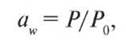
where P is the water vapor pressure of the solution, and P0 is the vapor pressure of pure water.
For distilled water, aw = 1.
The proliferation of many microorganisms is observed when substrate aw ranges from 0.99 to 0.65. The majority of bacteria multiply at a substrate water activity of no less than 0.95–0.90; for Yeasts, the limiting value of aw is 0.88–0.80; Molds can multiply, albeit slowly, at a substrate aw of 0.75–0.65. Consequently, products with a water activity below 0.7 can be preserved for a certain period without microbial spoilage (Table 5).
Table 5. Water activity and microbial growth in food products (Fennema, 1985)
aw range |
Microorganisms inhibited at aw values lower than this range |
Food products typical of this aw range |
1.00-0.95 |
Pseudomonas, Escherichia, Proteus, Shigella, Klebsiella, Clostridium perfringens, certain yeasts |
Fruits, vegetables, meat, fish, homemade sausage, and bread; products with sugar (~40 %) and sodium chloride (~7 %) content |
0.95-0.91 |
Salmonella, Vibrio parahaemoliticus, C. botulinum, Serratia, Lactobacillus, Pediococcus, certain fungi, yeasts (Rhodotorula, Pichia) |
Certain cheeses, canned ham, fruit juice concentrates, products with sugar (~55 %) and sodium chloride (~12 %) content |
0.91-0.87 |
Many yeasts (Candida, Torulopsis, Hansenula), Representatives of the genus Micrococcus |
Fermented salami-type sausages, hard cheeses, margarine, porous biscuits, products with sugar (65 %) and sodium chloride (15 %) content |
0.87-0.80 |
Many fungi (mycotoxigenic penicilla), bacteria of the species Staphylococcus aureus, yeasts of the genera Saccharomyces, Debaromyces |
Most fruit juice concentrates, sweetened condensed milk, chocolate, syrup, flour, rice, whipped products with a moisture content of 15–17 % |
0.80-0.75 |
Most halophilic bacteria, mycotoxigenic aspergilli |
Jam, marmalade, frozen fruits |
0.75-0.65 |
Xerophilic micromycete species (Asp. chevalieri, Asp. candidus, Wallemia sebi), Saccharomyces bisporus |
Molasses, dried fruits, nuts |
0.65-0.60 |
Osmophilic yeasts (Saccharomyces rouxii), certain molds (Asp. echinulatus, Monascus bisporus) |
Dried fruits containing 15–20 % moisture, caramel, honey |
0.5 |
None |
Dough with 12 % moisture, spices with 10 % moisture |
0.4 |
None |
Dried egg powder with 5% moisture |
0.3 |
None |
Cookies, crackers, rusks with 3–5 % moisture |
0.2 |
None |
Dry milk with 2–3 % moisture, dried vegetables with 5 % moisture, crackers |
A decrease in substrate aw can be achieved either by partially removing water from it or by adding soluble substances.
Based on their relationship to substrate moisture, microorganisms are conventionally categorized into hydrophites ("moisture-loving" — growing at high substrate moisture levels and poorly tolerating desiccation), mesophiles (capable of growing at moderate substrate moisture levels), and xerophiles ("dry-loving" — capable of growing at low substrate moisture levels and well-tolerant of desiccation).
During the microbial desiccation process, water moves from the center of the cell toward its periphery. Water-soluble substances move along with the water and, owing to the permeability of The Cell wall, exit the cell. Concurrently, the peripheral Regions of the cell adjacent to the cytoplasmic membrane become saturated with intracellular water-soluble substances: CARBOHYDRATES, Amino Acids, and Vitamins. An increase in the concentration of these substances can lead to protein coagulation or even denaturation and the inactivation of certain enzymes. Enzyme inactivation and the loss of cell viability during drying may also occur as a result of Maillard (sugar-amine) reactions taking place between the carbonyl group of glucose and the free amino groups of cellular proteins.
The desiccation of bacteria leads to the dehydration of the Cell Cytoplasm, the nearly complete cessation of metabolic processes, and ultimately the transition of the microbial cell into a state of cryptobiosis (anabiosis). In this state, the metabolism of microorganisms is practically reduced to a minimum. Microorganisms can maintain their viability in a dried state for quite prolonged periods. Resistance to drying varies among different microbes. For instance, gonococci and Vibrio cholerae tolerate desiccation for up to 2 days, the tubercle bacillus for up to 90 days, while many staphylococci and micrococci can survive in a dry state for several weeks or months; dried lactic acid bacteria and numerous yeasts retain viability for several months or even years. DORMANT FORMS OF microorganisms—such as bacterial spores and cysts—are particularly resistant to drying, maintaining viability for decades, centuries, or even millennia.
To preserve production and museum cultures of microorganisms, freeze-drying (lyophilization: freezing and drying under vacuum conditions) is employed.
Drying. To protect food products from microbial spoilage, an ancient and widely used preservation method involving drying is utilized, which is based on the ability of microorganisms to proliferate at a specific environmental moisture level (typically no less than 10 %). Grain, flour, pasta, bakery products, milk and dairy products, vegetables, fruits, mushrooms, meat, fish, and other goods are stored in a dried form.
Relative air humidity is of great importance for preserving dried products without spoilage. Due to their hygroscopic nature, dry products can either release or absorb moisture. Consequently, an equilibrium state is established between the humidity of the air and that of the product. The moisture content of a product in equilibrium with 70% relative air humidity represents the lower "critical" limit down to which microbial growth is possible. Bacteria are capable of multiplying in substrates with a moisture content in equilibrium with 95–90% relative air humidity. For yeasts, this value is 90–85%, for molds 75–80%, and for certain desiccation-resistant microbial species, 75–65%.
Thus, the potential for microbial development in products depends on both substrate moisture and relative air humidity. The storage and transportation of dried products must be carried out under conditions that prevent changes in their moisture content.
Concentration of dissolved substances. The vital activity of microorganisms largely depends on the Osmotic Pressure of the environment, which is determined by the concentration of substances dissolved within it. Under natural conditions, microorganisms have adapted to exist in environments with specific osmotic pressures; consequently, the intracellular pressure in many microorganisms fluctuates across a wide range—from a few tenths of a megapascal to several tens of MPa. Water activity and its entry into the cell depend on the magnitude of the osmotic pressure. The higher the osmotic pressure, the lower the water activity (aw) and the less accessible it is to the cell.
The osmotic pressure inside the cells of many bacteria corresponds to the pressure of a 10–20% sucrose solution. High intracellular osmotic pressure promotes a constant influx of water, causing colloids to swell and the cytoplasm to press tightly against the cell wall. This state of the cytoplasm is referred to as turgor. If bacteria are placed in a solution with a higher osmotic pressure, water flows out of the cell and the cytoplasmic volume decreases, accompanied by membrane damage and cell death. This phenomenon is termed plasmolysis. In Gram-positive bacteria, the membrane detaches from the cell wall. In Gram-negative bacteria, the cell wall detaches from the cellular contents along with the membrane, which also causes membrane damage and the loss of cell viability. In cases where the solution has a lower pressure, water will enter the cell, and its death will result from the rupture of the cell wall—plasmoptysis.
Owing to the presence of a rigid cell wall, most bacteria are relatively insensitive to salt concentration changes within the 0.5–3.0% range; however, raising their content in the medium above 4% leads to the inhibition of putrefactive, lactic acid, propionic acid, and certain other bacteria.
The preservative effect of elevated osmotic pressure achieved by adding sugar or sodium chloride is widely utilized in the food industry for The production of condensed milk, preserves, jams, various fruit syrups, as well as in the curing of meat, fish, vegetables, and mushrooms.
Along with microbes sensitive to changes in osmotic pressure, A number of microorganisms are known to proliferate normally under high osmotic pressure. Such microorganisms are termed osmophilic. For instance, certain yeasts multiply in honey, and micrococci in condensed milk.
Osmophilic microorganisms that reproduce normally in solutions with a high concentration of sodium chloride are called halophilic (salt-loving). These microorganisms inhabit saline seas, lakes, and mineral springs. Halophilic microorganisms—bacteria of the genera Halobacterium, Sarcina, Micrococcus—are causative agents of spoilage in salted products (fish, salted meats, bacon).
Despite the fact that increasing the osmotic pressure of the medium through The addition of sodium chloride or sugar protects products from microbial spoilage, many microorganisms present within them—including agents of various food poisonings and diseases—do not perish; only their vital activity is suspended. For example, salt-tolerant staphylococci as well as the botulinum bacillus (causative agents of toxicoses) may be present in stored salted fish. The proliferation of osmophilic yeasts and molds leads to the spoilage (molding, Fermentation) of preserves, jams, fruit butters, and fruit syrups. Osmotolerant microorganisms are capable of multiplying in environments with widely fluctuating osmotic pressures. This trait in bacteria is explained by the fact that the intracellular osmotic pressure in each instance exceeds the environmental osmotic pressure. The accumulation of potassium ions (K+) inside the cell plays the primary role in this regulation. It has been demonstrated that many bacteria concentrate K+ to a much greater extent than Na+. Thus, a clear correlation exists between the osmotolerance of bacteria and their K+ content.
Radiant energy propagates through space as electromagnetic waves of varying lengths. Light energy and ionizing radiation exert the most profound effects on microorganisms.
Sunlight is essential exclusively for the vital activity of photosynthetic microorganisms—green, blue-green, and purple bacteria, whose cells contain pigments. All other prokaryotes prefer to multiply in the dark. However, The Development of many mycelial fungi in the dark proceeds abnormally: in the constant absence of light, only the mycelium multiplies well, while sporulation is inhibited.
Ultraviolet irradiation can cause microbial cell death or Mutations. Ultraviolet rays with a wavelength of 100—400 nm possess the highest photochemical activity. UV rays with a wavelength of 250—260 nm exhibit a strong mutagenic and bactericidal effect. Their absorption is accompanied by The formation of thymine dimers in the DNA molecule, which in turn suppresses DNA Replication and leads to the cessation of microbial Cell Division. The damaging effect of UV irradiation is partially reversed when cultures are exposed to visible light. This phenomenon is known as photoreactivation. Apparently, photoreactivation is driven by enzymes that cleave abnormal thymine dimers.
Among non-spore-forming bacteria, pigmented cocci in which the pigment is located in the cytoplasm (sarcinae, staphylococci) are the most resistant to UV irradiation; pigmented bacteria that secrete pigment into the external environment are the least resistant.
Currently, UV rays are widely used in practice for the sterilization of air in operating rooms and maternity wards, starter-culture rooms, and cold storage chambers. The sterilization of food products using UV rays is complicated by their low penetrating power. The action of these rays manifests only On the surface or within an extremely thin layer. UV irradiation of chilled products (e.g., meat semi-finished products) prior to aseptic packaging extends their shelf life.
X-rays with a wavelength of less than 10 nm possess the highest penetrating power. Nuclear decay products—α-particles, β-particles, and γ-rays (short-wave X-rays)—vary in their penetrating power. Gamma rays exhibit the lowest activity yet the greatest penetrating power. The lethal effect of ionizing radiation on microorganisms is explained by The ionization of intracellular structures. The Effect of ionizing radiation depends on its dose and duration of exposure. The resulting photochemical changes are accompanied by cell mutation or death. However, among prokaryotes, certain species of bacteria are known to possess high resistance to X-rays. These include thionic bacteria as well as Micrococcus radiodurans, isolated from nuclear Reactor water.
In the food industry, ionizing radiation is used to sterilize polystyrene packaging material.
Ultrasound refers to high-frequency acoustic oscillations with a frequency exceeding 20 kHz, which is imperceptible to the human ear. Ultrasonic waves can cause ruptures in cells and cellular structures, as well as morphological, functional, and physicochemical colloidal changes. Under The Influence of ultrasound, a hollow space—a cavitation bubble filled with liquid vapor—is formed in the cytoplasm of microbial cells. High pressure, reaching tens or hundreds of megapascals, arises within the bubble, leading to the destruction (disintegration) of the cytoplasmic structures of the cell or the rupture of the cell itself. Furthermore, the development of cavitation is accompanied by the generation of a high-voltage electric field. Freely moving electric charges cause the ionization of molecules, resulting in the appearance of unsaturated, reactive water Cleavage products that exert a lethal effect on the cell or alter its functional properties.
The bactericidal action of ultrasound depends on its intensity and the duration of exposure. The RESISTANCE OF MICROORGANISMS to ultrasound depends on their size, shape, and ability to form endospores: the smaller the cell size, the higher its resistance to ultrasound; rod-shaped forms perish faster than spherical ones; spores are more resistant than vegetative cells.
Microwave currents. Microwave electromagnetic radiation exerts a thermomechanical effect on microbial cells, causing their death. This is due to the selective release of heat directly within the microbial cell. Microbial death is also facilitated by the fact that maximum field intensity is generated at the boundary between the cell and the surrounding environment.
The heating rate significantly affects the bactericidal efficacy of microwave currents. An increase in the heating rate leads to a decrease in the bactericidal action of microwaves. For example, at a microwave heating rate of 0.5 and 1.0 °C/s, Escherichia coli dies at 65 °C, whereas upon heating at a rate of 4.0 and 6.0 °C/s, cells of this species perish only at 70 °C.
Unlike conventional thermal processing methods, microwave heating of food products does not elicit the heat-protective Properties of Proteins, fats, and other substances, because electromagnetic energy is accumulated directly by the microbial cell. Therefore, during microwave heating, the inactivation of microorganisms occurs faster and at lower temperatures, which makes it possible to reduce the thermal processing temperature and improve food quality. Microwave currents are used for thermal processing only in Glass containers, as they do not penetrate through metal.
Last update: 13/08/2026
Editorial and Educational Adaptation: This material has been compiled based on the primary/original source text. The project team performed an editorial review, corrected technical inaccuracies, structured sections, and adapted the content for an educational format.
What was processed:
- elimination of formatting defects (OCR errors, structural breaks, corrupted characters);
- editorial organization of content;
- standardization of terminology in accordance with academic sources;
- verification of factual statements against the original source text.
All mentions of the author, publication year, and origin of the primary text have been preserved in accordance with the source.