GENERAL MICROBIOLOGY - T.P. Pyroh - 2004
6. MICROBIAL GROWTH
6.1. EFFECT OF EXTERNAL FACTORS ON MICROORGANISMS
6.1.1. Physical factors
Temperature. Microbial life is possible only within specific temperature limits. When studying the Effect of temperature on Microbial growth, three key reference points can be identified: the minimum, optimum, and maximum temperature (Fig. 6.1). The minimum temperature (point A) is the temperature below which a microorganism cannot grow; the optimum (point B) Supports the most intensive and rapid growth; and the maximum (point C) is the temperature above which growth is no longer possible. Characteristically, the optimum temperature is always closer to the maximum than to the minimum.
The range between the minimum and maximum temperature points varies among different microorganisms. For instance, in Bacillus subtilis, it is quite broad—ranging from 3 to 62 C; for gonococci and meningococci, it is 36-38 C, spanning only 1-2 C; and for Viruses, it is even narrower. Microorganisms with wide temperature limits are termed eurythermal. As a rule, they inhabit environments subject to significant temperature fluctuations (soil, Water, and the atmosphere).
Class="center">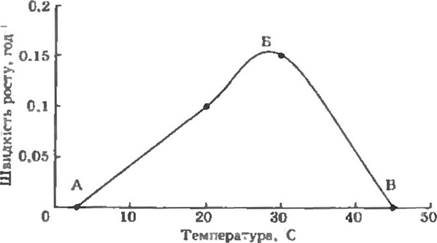
Fig. 6.1. Effect of temperature on the microbial growth rate
Microorganisms of the second group—stenothermal—have narrow temperature limits and inhabit zones with relatively constant temperatures (hot springs, glaciers).
Depending on their temperature requirements, microorganisms are classified into psychrophiles, mesophiles, and thermophiles (Fig. 6.2).
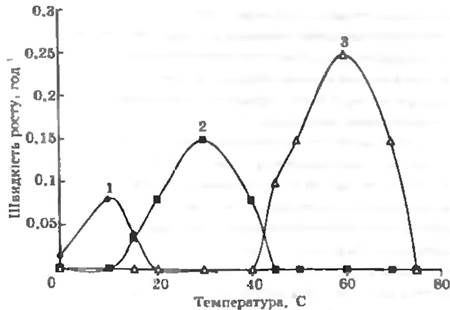
Fig. 6.2. Relationship between the growth temperature of psychrophiles (1), mesophiles (2), and thermophiles (3)
For psychrophiles, the optimum temperature is 5-12 C. This group includes inhabitants of cold seas, oceans, deep lakes, glaciers, and soils of the Far North. Despite the ability of some microorganisms to grow at low temperatures, There is a threshold below which reproduction ceases. Cell growth stops at -30 C, although enzymatic reactions may still proceed (usually very slowly) at this temperature. The lower limit for biochemical reactions in aqueous systems is considered to be -140 C. Consequently, freezing does not kill microorganisms; rather, it merely inhibits their GROWTH AND REPRODUCTION. Freezing is widely used in laboratory practice for preserving microbial cultures.
Mesophilic microorganisms are those with an optimal growth temperature of 25-37 C (some literature sources cite the growth range of mesophiles as 20-42 C). This largest group of microorganisms encompasses saprophytic and parasitic forms, as well as inhabitants of soil, water, air, and the bodies of animals and humans.
The thermophile group comprises microorganisms with a temperature optimum of 40-65 C. These are inhabitants of hot mineral springs, silage pits, and manure piles. Extreme thermophiles are microorganisms with a temperature optimum reaching 65 C (Sulfolobus, Thermus aquaticus). Some of them are capable of growing even at temperatures above 70 C, and occasionally up to 105 C (Pyrodictium occultum, an obligate anaerobe that reduces sulfur). Notably, Bacteria are the most heat-resistant organisms among all living creatures on Earth.
Upper temperature limits C for various groups of microorganisms
Protozoa 45-50
Photosynthetic prokaryotes (bacteria and cyanobacteria) 70-78 Non-photosynthetic prokaryotes (bacteria) Above 90
Moisture and osmotic pressure. Water is essential for microbial life, serving simultaneously as a medium and a direct participant in numerous biochemical reactions within The Cell. Microorganisms require water to dissolve nutrients (mineral salts and organic substances). Water also plays a crucial role in Respiration. The water present in the external environment may be either available or unavailable to a microorganism. The degree of water availability for Chemical Reactions and microorganisms is determined by the water activity index aw, which characterizes the degree of binding of its molecules. The water activity of pure free water is equal to one. When water interacts with surfaces, anions and cations, or any hydrophilic groups, its water activity decreases below one. Microorganisms can grow in media with aw values of 0.99-0.60. Sometimes, relative humidity (expressed as a percentage) is used to define the degree of water availability. Both parameters refer to the vapor phase in equilibrium with a solid material or solution. Water activity (relative humidity) is The ratio of the water vapor concentration in the air space above a given material to the water concentration in the air above pure water at a specific temperature.
The water activity of a solution can change through two mechanisms: matric and osmotic. Osmotic changes in aw occur As a result of the interaction between water molecules and dissolved solutes. Matric changes in aw are caused by the adsorption of water molecules onto solid substrate surfaces. It is often believed that The Effect of solution concentration on microbial growth is mediated by osmotic pressure. In reality, this effect is manifested through changes in water activity as a measure of water available to the Organism.
Microorganisms that grow in media with high solute concentrations are called osmotolerant. These include certain species of Yeasts that multiply in jam and honey, as well as bacteria found in salted fish. Some microorganisms are osmophilic; they not only withstand high-solute environments but actually prefer them. There is also a group of microorganisms that require a high concentration of sodium chloride for growth—the so-called halophiles. For example, Halobacterium grows best in media containing 20-30% sodium chloride. Halophiles inhabit the saltiest seas and lakes (such as the Dead Sea and the Caspian Sea).
Hydrostatic pressure. In the deep sea, microorganisms withstand hydrostatic pressures caused by the weight of the water
Column. This pressure can reach substantial values, increasing by 1 MPa for every 100 m of depth. The deepest Zones of the Pacific Ocean (down to 11 km) feature hydrostatic pressures of up to 110 MPa. Microorganisms that live at great depths and have adapted to high hydrostatic pressure are called barotolerant. Conversely, most bacteria isolated from soils and shallow waters grow best at atmospheric pressure and perish at hydrostatic pressures of 20-60 MPa.
Radiant energy. Energy propagating through space in the form of electromagnetic waves is called radiant energy. Different spectra of radiant energy have varying wavelengths that determine the CHARACTERISTICS OF THE electromagnetic wave. Electromagnetic waves include radio waves, light rays (infrared, visible, and ultraviolet), and ionizing radiation.
Radio waves have the longest wavelength (exceeding 1500 nm). Infrared rays have a wavelength of up to 760 nm, visible light ranges from 760 to 380 nm, and ultraviolet rays span 380 to 200 nm. Ionizing radiation features the shortest wavelengths.
Various spectra of radiant energy affect microorganisms differently. Radio waves have no biological effect, whereas the adsorption of infrared rays by an organism causes it to heat up. Part of the infrared spectrum with wavelengths under 1000 nm and visible light favorably affect phototrophic microorganisms, as they serve as the primary source of light. Non-phototrophs develop better in the dark. Even diffuse light inhibits bacterial growth, and high-intensity visible light can cause cellular damage or even death. Pigments protect microorganisms from the lethal effects of visible light.
Ultraviolet irradiation is the most detrimental to microorganisms, exerting either a lethal or mutagenic effect depending on the dose and The Nature of the microorganism.
Ionizing radiation affects microorganisms less specifically than UV irradiation, though it also impacts DNA and causes either a bactericidal or mutagenic effect. Studies involving γ-irradiation across a broad spectrum of microorganisms have shown that LD values (in kGy) are as follows: for Escherichia coli (and other Gram-negative bacteria) — 0.03–0.04, for staphylococci — 0.17–0.19, Gram-positive rods — 0.4, yeasts — 0.39–0.15, and Sarcina species — up to 0.5. LD represents the radiation dose that allows 10% of the Cells to survive. The sublethal dose (resulting in less than 1% survival) for Bacillus subtilis spores is 8–10 kGy. Among bacteria, there are sensitive strains to ionizing radiation (Pseudomonas fluorescens), resistant ones (Micrococcus, Streptococcus), and highly resistant (radioresistant) forms.
Radioresistant bacteria (red-pigmented cocci of the species Micrococcus radiodurans) were first isolated in 1956 from canned meat sterilized with X-rays. Later, such bacteria were isolated from natural environments with elevated Background radiation, as well as from pre-irradiated samples. All of these radioresistant bacteria proved similar in their properties and were assigned to the genus Deinococcus. These are Gram-positive, non-motile, aerobic cocci with a DNA G+C content ranging from 62 to 70%, forming pink-pigmented colonies (containing carotenoids). Their sublethal dose is approximately 15 kGy. In 1981, radioresistant bacteria were separated from the genus Micrococcus, and Micrococcus radiodurans was renamed Deinococcus radiodurans. In the 1980s, the genus Deinococcus was officially established, along with the species D. radiodurans, D. radiophilus, D. proteolyticus, and others.
Recently, heightened interest in radioresistant bacteria has been driven by the Chornobyl disaster. A MICROBIOLOGICAL ANALYSIS OF soils in the 10-kilometer zone of the Chornobyl Nuclear Power Plant, conducted between 1993 and 1996, revealed that their quantitative and qualitative bacterial composition was poorer than that of comparable control soils. Typical representatives of radiation-contaminated soils were pink-pigmented facultative methylotrophs of the genus Methylobacterium, as well as spore-forming bacteria Bacillus subtilis and Bacillus cereus. The sublethal dose for certain bacteria of the genus Methylobacterium was 9–10 kGy.
Of particular interest are studies on the species composition of micromycetes in the indoor environments of the "Shelter" object (the 4th power unit of the Chornobyl NPP). Specifically, the fungal species composition comprises 48 species across 24 genera. Over 80% of these fungi are pigmented (with melanin-containing fungi accounting for about 40%). Fungi isolated from sites with high radionuclide contamination demonstrated an ability to assimilate radiocarbon from Reactor graphite. Cladosporium cladosporioides assimilates radiocarbon most intensively. Furthermore, The phenomenon of positive radiotropism was discovered in many micromycetes isolated from the Chornobyl zone.
Electricity. The short-term passage of direct or alternating current through a microbial suspension produces only a mild effect. However, the prolonged passage of high-voltage current can cause electrolysis of certain medium components, leading to The formation of compounds that are detrimental to microorganisms. Additionally, current flow is accompanied by heat generation, which can also affect microorganisms.
When suspended In aqueous solutions, microorganisms carry an electrical charge on their surface. Consequently, when a current passes through such a suspension, negatively charged particles migrate toward the anode (the positive electrode), while positively charged particles move toward the cathode (the negative electrode). This movement of particles in an electric field is known as Electrophoresis. This phenomenon forms The basis of numerous Analytical Methods that enable the Separation of substances from a mixture. In microbiology, this method is used to analyze microbial metabolic products.
Ultrasound. Because bacteria possess a relatively small mass and a rigid Cell wall, low-frequency oscillations (in the sonic range of 100–10,000 Hz) have little effect on them. However, if bacteria are submerged in a liquid through which high-frequency oscillations (ultrasound, US) propagate, the cells are disrupted and destroyed. It is believed that cell destruction under METABOLISM/18.html">The Influence of ultrasound is caused by the formation inside the cell of microbubbles consisting of gases dissolved in the protoplasm or present in the liquid on the cell surface.
The bactericidal effect of ultrasound diminishes when cavitation (the rupture of liquid) is suppressed. This occurs during degassing or when an object is immersed in a gel or another viscous medium. Conversely, the bactericidal effect of ultrasound is enhanced by saturating the sonicated suspension with nitrogen, air, or oxygen, as this intensifies cavitation.
The action of ultrasound causes not only mechanical cell damage. It also induces biochemical and functional changes that do not necessarily lead to cell death (such as the release of BIOLOGICALLY ACTIVE SUBSTANCES like Vitamins, Enzymes, etc.). Therefore, ultrasound is utilized to obtain specific cell fractions and to sterilize substrates that would otherwise be damaged by thermal Processing. All microorganisms, including spore-formers, are sensitive to ultrasound, though they vary in their degree of susceptibility.
Last update: 13/08/2026
Editorial and Educational Adaptation: This material has been compiled based on the primary/original source text. The project team performed an editorial review, corrected technical inaccuracies, structured sections, and adapted the content for an educational format.
What was processed:
- elimination of formatting defects (OCR errors, structural breaks, corrupted characters);
- editorial organization of content;
- standardization of terminology in accordance with academic sources;
- verification of factual statements against the original source text.
All mentions of the author, publication year, and origin of the primary text have been preserved in accordance with the source.