PLANT SYSTEMATICS - Yu. I. Korniievskyi - 2017
Lecture Notes
Lecture No. 2. Introduction to Plant Systematics. Fundamentals of Botanical Classification. The Magnoliophyte System. Families: Ranunculaceae, Papaveraceae, Polygonaceae
Lecture Outline
1. Plant Systematics
2. Branches of Systematics
3. Basic Concepts of Systematics
4. The Magnoliophyte System. Families Papaveraceae, Polygonaceae
Systematics is the science that studies The Diversity of all existing and extinct organisms. It is estimated that there are currently about 500,000 plant species and about 2 million species of living organisms on Earth.
The task of systematics is the identification, description, and Classification of organisms into a system.
Branches of systematics include Taxonomy, nomenclature, and phylogenetics.
Taxonomy is the theory and practice of Organism classification, that is, the arrangement of all currently known organisms into a specific system of subordinate categories based on their Similarities and differences. Similarities and differences are established using various Methods and evaluated according to specially developed criteria.
Nomenclature is the set of all existing taxon names.
Phylogenetics studies the historical Development of the living world (phylogeny) and the evolutionary relationships among organisms.
Basic concepts of systematics are taxa and taxonomic categories. Taxonomic categories are specific levels in a hierarchical classification.
Taxa are specific groups of organisms, either currently existing or extinct.
The fundamental taxon uniting individuals most closely related to one another is the species (species). Plants utilized by humans must be identified at the species level. To date, there is no single universally accepted definition of a species that applies equally well to sexually reproducing plants as well as asexually or vegetatively reproducing ones.
Species is a group of individuals similar in morphological, physiological, biochemical, and other characteristics, capable of freely interbreeding, producing fertile offspring, and inhabiting a specific geographic area (range).
Within a species, there may be varieties and subspecies, which can evolve into new species over time. No matter how large the intraspecific Variability may be, a continuous series of forms still exists within a species, whereas between even closely related species, there is typically discontinuity with a lack of transitional forms. Species differ not only in external traits but also in their ecological habitats.
Species are grouped into genera. A genus (genus) is a higher taxonomic category uniting a group of related species. All taxa starting from the genus have scientific names consisting of a single Latin word (uninominal). For species, binominal names consisting of two Latin words are adopted: the first word is the name of the genus to which the given species belongs, and the second is the specific epithet, e.g., Plantago major, Urtica dioica. This binomial nomenclature was introduced by Carl Linnaeus in 1753, who considered species to be fixed and immutable.
Higher-ranking taxonomic categories include the family (familia), which comprises one or more genera. The family name is formed from the generic name with the suffix -aceae, e.g., Convallaria - Convallariaceae.
An order (ordo) is a taxonomic category comprising several families. It is named with the suffix -ales.
A Class (classis) is a significantly higher taxonomic category. The number of classes is relatively small. Angiosperms have two classes—Monocots and Dicots. The standard suffix for classes is -psida, though long-established traditional names without this suffix are also accepted. Dicots may be called Magnoliopsida or Dicotyledones.
The largest taxonomic unit in the plant kingdom is the division (divisio). Divisions are named with the suffix -phyta and are distinguished by fundamental characteristics. They are arranged in order of evolutionary advancement.
Any system consists of taxonomic units arranged hierarchically. When we refer to the levels of this hierarchy, we are talking about taxonomic categories. When we refer to the specific content of the delineated groups, we are talking about taxa. The first systems appeared in pre-Christian times, but to this day, a universally accepted system containing the maximum possible amount of biological information has not been established. There are artificial, natural, and phylogenetic plant systems.
Artificial systems are based on one or more selected characteristics. The best known of these is the Linnaean system. The plant kingdom was divided into 24 classes based on the number of stamens and the Features of the staminal complex. The advantages of this system include its practical applicability for identifying plants in nature. Carl Linnaeus was the first to establish The concepts of genus and species, introduce binomial nomenclature, and describe about 10,000 species, grouping them into 1,000 genera. His research has not lost its significance to this day. However, the Linnaean system was artificial because it placed unrelated plants into the same class—for example, rice and cabbage—simply because they both have 6 stamens.
Unlike artificial systems, natural systems classify organisms by considering similarities and differences across multiple characters simultaneously. The first such system was created by Antoine de Jussieu in the late 18th century (1789), in which he distinguished natural groups of dicots, monocots, conifers, Fungi, Algae, mosses, and ferns.
The de Candolle system was the first to incorporate the Water/140.html">Anatomical Structure of plants into classification (1824–1874). The system of J. Hooker and G. Bentham (1883) is a logical development of de Candolle's system, but it covers a larger number of plants and differs in interpreting naked flowers as reduced and secondary rather than primary.
The idea of development from simple to complex—that is, the embryos of evolutionary theory—formed The basis of some pre-Darwinian systems. This includes Lamarck's system, as well as the system of botanist P.F. Goryainov (1834), who believed that related taxa share a common origin. Goryainov's system begins with fungi and, quite accurately from a modern perspective, arranges the divisions of higher plants in the order of their emergence and development.
All natural systems are based on METABOLISM/2.html">THE CONCEPT OF the immutability of species. In the late 19th century, following the Introduction of Darwin's evolutionary theory, genealogical systems emerged. They are constructed on a phylogenetic basis.
In the late 19th century, evolutionary or phylogenetic systems emerged, taking into account plant origins and the phylogenetic relationships of taxa, along with comparative data from molecular biology, Morphology, anatomy, Embryology, karyology, biochemistry, plant geography, and ecology (A. Engler, A.A. Grossheim, A.L. Takhtajan). A new field, chemosystematics, is successfully developing, based on the comparative analysis of The chemical composition of plants from various taxonomic groups.
The contemporary period of botany's development is associated with the advent of new Research Methods: Electron Cell/15.html">Microscopy, the tracer atom method, and cell, tissue, and organ culture. These techniques enable The Study of the ultrastructure of tissue Cells and the specifics of metabolic processes at various levels of plant Organization.
In Ukraine, The Development of plant systematics, phylogenetics, and floristics is associated with the names of world-renowned scientists such as L.S. Tsenkovsky, I.I. Mechnikov, O.O. Kovalevsky, A.N. Severtsov, I.I. Schmalhausen, D.K. Zerov, O.P. Markevych, O.V. Topachevsky, and A.M. Oksner.
General characteristics of the buttercup family - Ranunculaceae
· Underground Organs are diverse: taproot or fibrous ROOT systems, stolons (meadow-rue), root tubers (lesser celandine), tubers (gymnospermium), and rhizomes (pheasant's eye, hellebore).
· Leaves are alternate, opposite, or in a basal rosette, simple, without stipules, entire or dissected, sessile or petiolate, often with a sheath; characteristic water Stomata—hydathodes—are present.
· Flowers are solitary or arranged in inflorescences such as monochasia, racemes, or panicles.
· The receptacle is convex, and the arrangement of floral parts is spiral or hemicyclic.
· Flowers are regular or irregular, bisexual, and occasionally unisexual. The perianth is simple, usually corolla-like (PСо4,5,6), or double (Са3,5,6,∞ Со5-7).
· Sepals are caducous (buttercup, pheasant's eye) or persistent in fruit (hellebore). Sometimes sepals are petaloid (hellebore), occasionally forming a spur (larkspur, consolida) or a hood (monkshood).
· Petals are yellow in most cases. Specific nectaries are characteristic, taking the form of a spur (larkspur, consolida), a funnel (hellebore), horns (black cumin), or a nectar pit either covered (buttercup) or uncovered (lesser celandine) by a scale.
· Stamens are free, numerous, arranged in a spiral (hemicyclic flowers), and can be fertile, sterile, or nectar-bearing.
· The gynoecium is apocarpous, with monocarpous as an exception (consolida); sometimes carpels are partially fused (black cumin, hellebore).
· Fruits are aggregate follicles or achenes, with single follicles (consolida) or berries (baneberry) as exceptions. Fruits and seeds often feature various adaptations for dispersal.
❖ Spring pheasant's eye - Adonis vernalis
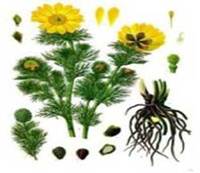
· The plant is poisonous! In terms of ecomorphology, spring pheasant's eye is classified as a xerophyte and an early-blooming rhizomatous geophyte/ephemeroid.
· Requires conservation protection.
· Perennial plant with a thickened, multi-headed, dark brown rhizome.
· Stem leaves are alternate, semi-amplexicaul, and ternately palmatifid to pinnatipartite into narrow-linear, pointed segments.
· Lower leaves membranous, brown.
· Flowers solitary, terminal, large. Perianth double: calyx of 5 free, pubescent, deciduous sepals; corolla of 6-20 free, oblong, slightly dentate, golden-yellow petals without a nectary pit. All flower parts are arranged in a spiral.
· Gynoecium apocarpous.
· Fruit an aggregate of achenes (polyachene), the achenes featuring a hooked beak.
· Action: cardiotonic, diuretic.
❖ Tall Larkspur - Delphinium elatum
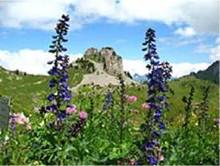
· Poisonous plant!
· Leaves alternate, dissected.
· Inflorescence a raceme. Flowers zygomorphic with a double perianth. In the cymose inflorescence of *Consolida regalis*, the lateral axes are oriented in one direction (cincinnus).
· Calyx of 5 colored sepals, the upper one bearing a spur.
· Corolla of two lateral petaloid staminodes and a spurred nectary extending into the calyx spur.
· Action: ganglionic blocking, hypotensive.
❖ Karakol Wolfsbane - Aconitum karakolicum
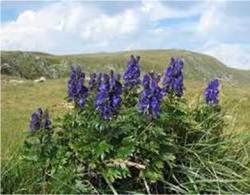
· Deadly poisonous plant! Contains the alkaloid aconitine.
· Perennial herbaceous plant. Underground organs are tuberous roots.
· Leaves alternate, petiolate, palmately divided into narrow segments.
· Inflorescence a terminal panicle.
· Flowers large, purple, zygomorphic, with subulate bracts.
· Calyx of 5 petaloid sepals: the upper one shaped like a hood (helmet), and 4 lateral ones in pairs.
· Petals modified into 2 nectaries enclosed within the helmet-shaped sepal. They feature an expanded lip and a curved nectar-bearing spur.
· Fruit a 3-7-follicle.
· Action: analgesic, antitumor.
❖ Field Larkspur - Consolida regalis
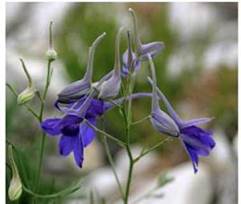
· Poisonous annual plant!
· Root system is taproot.
· Stem is branched and pubescent.
· Leaves are repeatedly dissected into narrow linear segments.
· Bracts are subulate, small, and bluish-purple.
· Inflorescence is a spreading panicle.
· Flowers and follicules are covered with sparse appressed hairs.
· Seeds are oblong-triangular and transversely furrowed.
· Action: herb is diuretic, flowers are anti-inflammatory.
Poppy family - Papaveraceae
Diagnostic features of the family.
· Most species feature laticifers with poisonous milky juice containing Alkaloids (a diagnostic feature of the family).
· Leaves are alternate, exstipulate, simple, usually deeply divided, rarely entire.
· Flowers are solitary or arranged in inflorescences such as a raceme, panicle, or false umbel (pleiochasium).
· Calyx consists of two early deciduous sepals.
· Petals are arranged in two whorls. Sometimes flowers are double.
· Stamens are usually numerous, free, arranged in whorls.
· Gynoecium is formed by two or many fused carpels.
· Stigma is sessile, Ovary is superior.
· Floral formula: * Са2 СО2+2,3+3,4+4,6+6 А(3) ∞+(3) G(2),∞.
· Fruit is a capsule of rounded (poppy) or pod-like (celandine, horned poppy) shape (a diagnostic feature of the family).
· Seeds with oily endosperm.
❖ Opium poppy - Papaver somniferum
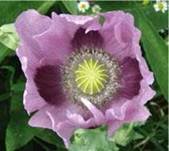
· The plant is poisonous!
· The plant contains white milky sap (opium).
· Apples, leaves, and sepals are sparsely pubescent with long bristly emergences.
· Middle leaves clasp the stem, lanceolate, pinnately lobed, or coarsely dentate.
· Flowers are solitary, petals are arranged in two whorls, with 2 sepals that fall off as the flower opens.
· Fruit is a coenocarp - a globose greyish-brown multi-locular capsule from which seeds shed through pores beneath the sessile stigma; gynoecium is syncarpous (paracarpous), unilocular, formed by the fusion of carpel margins with parietal placentation of ovules.
· Action: narcotic, analgesic, antispasmodic, antitussive, hypotensive.
❖ Yellow horned poppy — Glaucium flavum
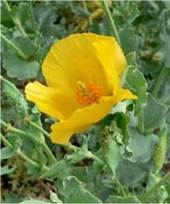
· Milky sap is absent.
· Polycarpic perennial or monocarpic annual.
· Stem leaves are alternate, stem-clasping, glaucous, divided or dissected, upper ones pinnately lobed.
· Flowers are large, terminal, or axillary.
· Corolla is actinomorphic, cruciform; there are 2 green sepals that are caducous.
· Fruit is a coenocarp — a siliquiform, unilocular, bivalved capsule.
· Action: analgesic, antispasmodic, antitussive, hypotensive.
❖ Greater celandine — Chelidonium majus
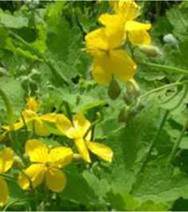
· Perennial poisonous plant. Contains orange-colored milky sap.
· Shoots are erect, stems branched, ribbed, sparsely pubescent.
· Leaves are pinnately and lyrate-dissected.
· Perianth is double, sepals are caducous.
· Flowers are gathered in groups of 4-5 into false umbels (pleiochasium), petals are yellow, arranged crosswise.
· Fruit is a coenocarp — a siliquiform capsule.
· Seeds are black, glossy, with a crested aril.
· Action: choleretic, fungistatic, antibacterial.
Buckwheat family — Polygonaceae
Diagnostic features of the family.
· Class — dicotyledonous plants. The family includes about 750 species distributed worldwide.
· Mostly herbaceous plants with alternate leaves, whose stipules fuse to form a thin membrane — the ochrea, which clasps the jointed stem and serves as a key diagnostic feature.
· Flowers are usually bisexual, actinomorphic, consisting of a simple petaloid or sepaloid perianth with 5–6 lobes.
· Stamens range from three to nine. The pistil is single with a superior, unilocular ovary and 2–3 styles bearing capitate or stigma-like stigmas.
· Fruit — a biconvex or triquetrous nutlet or achene; seeds with mealy endosperm.
❖ Common bistort - Polygonum bistorta
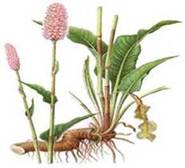
· Perennial plant with a thick, snake-like curved rhizome and a dark red surface.
· Stem erect, up to 1 m tall.
· Basal rosette leaves large, with long winged petioles, oblong-ovate, with an acute apex and a decurrent base.
· Cauline leaves alternate, sessile, with wavy margins and a cuneate base, grayish and short-pubescent beneath, glabrous above.
· Ochreae oblique, open.
· Inflorescences spicate, terminal, dense, cylindrical, pink in color.
· Fruit — a nutlet.
· Action: astringent, anti-inflammatory, hemostatic.
❖ Pale persicaria - Polygonum persicaria
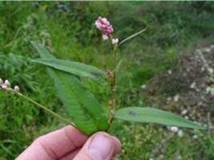
· Stem ascending, ribbed, dichotomously branched with strongly swollen anthocyanin-colored nodes.
· Leaves oblong-lanceolate, with a cuneate base, sparsely pubescent with bristly hairs in clusters.
· A horseshoe-shaped brown spot is visible in the middle on the upper surface of the leaf.
· Ochreae red, narrow, tightly clasping the stem.
· Leaves lack a pungent taste (unlike water pepper).
· Spike-like racemes are terminal and erect.
· Perianth is pale pink, greenish at the base, and glandless.
· Fruit is an achene, compressed-cordate or triquetrous, glossy, and black.
· Action: astringent, anti-inflammatory, hemostatic.
❖ Water pepper - Polygonum hydropiper
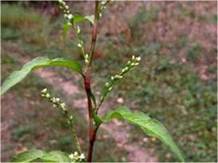
· Shoots are ascending, branched, with the prostrate portion rooting at the nodes. Nodes are thickened and reddish.
· Leaves are oblong with a narrow wedge-shaped base, rough along the margins due to Hair tufts. Rounded glands are translucent on the blade.
· Epidermis features anisocytic stomata.
· Leaves and stems have an acrid-pungent taste.
· Ochreae are cylindrical, membranous, and reddish.
· Spike-like racemes are terminal, loose, with a drooping apex.
· Perianth is pale green with golden glands.
· Action: astringent, anti-inflammatory, hemostatic.
❖ Common knotgrass - Polygonum aviculare
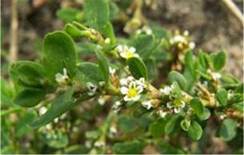
· Shoots are horizontal, prostrate on the ground but not rooting — procumbent or trailing, branched from the base.
· Ochreae are oblong-acuminate, translucent-silvery almost to the base.
· Leaves range from elliptic to linear-lanceolate.
· Flowers are clustered 2-5 in the leaf axils.
· Perianth is deeply 5-parted, green in the lower part and white or pink in the upper part.
· Achenes are triquetrous and black.
· Action: diuretic, litholytic, astringent
❖ Common buckwheat - Fagopyrum sagittatum
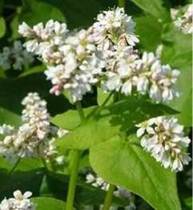
· Stem reddish.
· Leaves triangular-cordate or sagittate.
· Inflorescence is a corymbose panicle. Flowers pink, dimorphic.
· Simple petaloid perianth, pistil composed of three carpels.
· Heterostyly phenomenon.
· Nuts sharply trigonous, brown.
· Action: tonic, cholagogue, vitamin.
❖ Medicinal rhubarb - Rheumpalmatum (tanguticum)
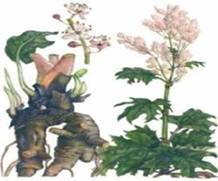
· Rhizome strong, roots large, fusiform, bright yellow when broken.
· Stems erect, branched.
· Basal leaves petiolate, very large, 5-7-palmatipartite, setose.
· Perianth simple, in 2-3-merous whorls.
· Flowers yellowish-white, gathered in panicles.
· Fruits are red nuts broadly winged along the edges.
· Action: laxative, astringent, vitamin, cholagogue.
❖ Water dock - Rumex confertus
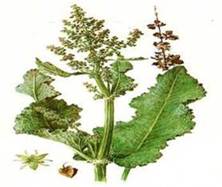
· Stem erect, sulcate, branched above.
· Leaves alternate, upper ones small, ovate-lanceolate, lower ones petiolate, oblong-triangular-ovate. Cordate at the base, slightly wavy along the margin. Petioles grooved above.
· Pedicels articulated in the middle or slightly below.
· Flowers bisexual and pistillate, gathered in whorls.
· Inflorescence is a narrow-paniculate thyrse.
· Fruit is a trigonous nut.
· Action: laxative, astringent.
❖ Garden sorrel - Rumex acetosa
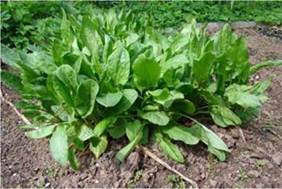
· Leaves are sour to the taste, basal ones long-petioled with a sagittate base.
· Inner perianth segments enlarge in fruit.
· Flowers are unisexual, pink or reddish, arranged in cylindrical panicles.
· Fruit is a 4-angled nutlet, smooth and glossy.
· Action: astringent, anti-inflammatory, digestive.
Last update: 07/08/2026
Editorial and Educational Adaptation: This material has been compiled based on the primary/original source text. The project team performed an editorial review, corrected technical inaccuracies, structured sections, and adapted the content for an educational format.
What was processed:
- elimination of formatting defects (OCR errors, structural breaks, corrupted characters);
- editorial organization of content;
- standardization of terminology in accordance with academic sources;
- verification of factual statements against the original source text.
All mentions of the author, publication year, and origin of the primary text have been preserved in accordance with the source.