PLANT SYSTEMATICS - Yu. I. Kornievsky - 2017
Lecture Notes
Lecture No. 3. Characteristics of Plant Families: Ericaceae, Brassicaceae, Rosaceae, Fabaceae, Apiaceae
Lecture Objective: To provide a general Description of the families, genera, and species used in pharmacy and medicine.
Lecture Outline:
1. General characteristics of the main diagnostic Features of the Ericaceae family. Representatives: bilberry (European blueberry), lingonberry, bog cranberry, marsh Labrador tea, bearberry.
2. General CHARACTERISTICS OF THE main diagnostic features of the Brassicaceae family. Representatives: Sarepta mustard, black mustard, white mustard, shepherd's purse, spreading treacle-mustard (grey wallflower), garden cabbage.
3. General characteristics of the main diagnostic features of the Rosaceae family.
3.1. Subfamily Rosoideae: red raspberry, tormentil (septfoil), great burnet, woodland strawberry, dog rose, cinnamon rose.
3.2. Subfamily Maloideae: black chokeberry (blackaronia), Blood-hawthorn, rowan (mountain ash), common pear, domestic apple.
3.3. Subfamily Prunoideae: common apricot, sour cherry, common almond, common peach, domestic plum, blackthorn, bird cherry.
4. General characteristics of the main diagnostic features of the Fabaceae family. Representatives: peanut, woollypod milkvetch, yellow sweet clover, restharrow, garden pea, common bean, black locust, licorice, Japanese pagoda tree, soybean.
5. General characteristics of the main diagnostic features of the Apiaceae family. Representatives: anise, poison hemlock, caraway, coriander, dill, garden carrot, garden parsley, celery, fennel, Water hemlock.
Ericaceae Family - Ericaceae
· Trees, shrubs, or subshrubs, typically with alternate, simple leaves, lacking stipules.
· Roots with mycorrhiza.
· Leaves leathery, needle-like, or scaly; if the leaf blade is flat, it features downward-rolled margins or is longitudinally rolled and pubescent. Leaves are evergreen or deciduous, adapted to moisture conservation.
· Flowers regular (actinomorphic) or nearly regular, solitary or arranged in racemes, umbels, or panicles. Calyx five-lobed or entire, mostly persistent in fruit. Corolla sympetalous, incised into five, less commonly four, lobes or Teeth, occasionally polypetalous. Stamens typically twice as numerous as petals, rarely equal in number. Filaments free, anthers bilocular, sometimes with two awl-shaped appendages. Style filiform, stigma truncate, capitate, or slightly four- to five-lobed.
· Fruits: multi-seeded capsules opening by Valves, coenocarpic berry-like drupes, or berries.
· Flowers solitary, anthers with awl-shaped appendages, dehiscing by pores.
❖ Bilberry - Vaccinium myrtillus
Class="center">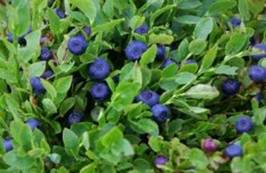
· Deciduous subshrub. Honey plant.
· ROOT system mixed.
· Stems branched, erect, cylindrical, ridged, grey at the base.
· Leaves are short-petioled, alternate, ovate or elliptic with a finely serrate margin, light green, smooth, and thin.
· Flowers are solitary at the base of young branchlets, pendulous.
· Corolla is campanulate, 4-5-toothed.
· Fruits are black berries with a bluish bloom, globose, flattened at the apex, featuring a ring of sepals and a central depression; used for gastrointestinal disorders and to improve Vision.
· Action: vitamin, antidiabetic, astringent.
❖ Lingonberry - Vaccinium vitis-idaea
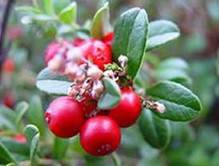
· Evergreen dwarf shrubs with a slender creeping rhizome and upright stem.
· Leaves are leathery, with revolute margins, elliptic; dark green above, pale green with dark glands below.
· Calyx with 4 short triangular teeth, persistent in fruit. Corolla pale pink, bell-shaped, 4-toothed.
· Inflorescence is a drooping panicle.
· Fruits are red berries, globose, shiny, with persistent dry sepals at the apex.
· Action: vitamin, diuretic and choleretic, hypoglycemic, astringent.
❖ Bog cranberry - Oxycoccus palustris
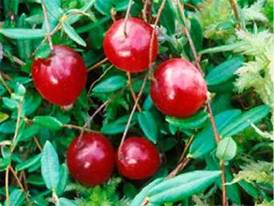
· Evergreen dwarf shrub with creeping stems and filiform flowering shoots.
· Leaves are short-petioled, oblong-ovate, acute, with revolute margins, scabrous, leathery, dark green and shiny above, whitish beneath due to a waxy bloom.
· Calyx is toothed, fused with the Ovary. Petals fused at the base, light purple or pink, with recurved teeth.
· Staminal filaments are purple, anthers yellow.
· Fruits are dark red berries, flattened or pyriform, sour-tasting.
· Action: vitamin, diuretic, antipyretic.
❖ Marsh Labrador tea - Ledum palustre
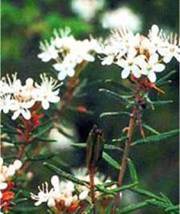
· Evergreen dwarf shrub or shrub with a strong specific odor. Poisonous plant!
· Young shoots are densely covered with essential-oil glands and brown simple hairs.
· Leaves short-petiolate, linear, with revolute margins, leathery; upper surface glossy, dark brownish-green, lower surface rusty-tomentose.
· Sepals brownish-pubescent, glutinous.
· Nectary disc surrounding the ovary.
· Inflorescence—terminal compound corymbs with reddish-brown bracts persisting in fruit.
· Fruit—oblong-oval, nodding, dark, glandular-pubescent capsule, opening by valves.
· N.B! Raw Materials should be harvested with care.
· Action: antitussive, expectorant, disinfectant.
❖ Bearberry - Arctostaphylos uva-ursi
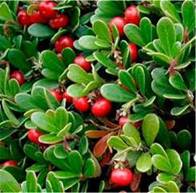
· Grows in pine forests, on dry sandy soils of the Ukrainian Polissya.
· Evergreen, prostrate subshrub, forming mats.
· Leaves oblong-ovate, dark green and glossy above, with a network of impressed Veins. Margin entire.
· Flowers arranged in terminal nodding racemes.
· Fruit—coenocarpic berry-like drupe with three to five pyrenes.
· Contains phenolic Glycosides—arbutin, methylarbutin, hydroquinones.
· Astringent, diuretic, anti-inflammatory agent.
Family Brassicaceae - Cabbage family
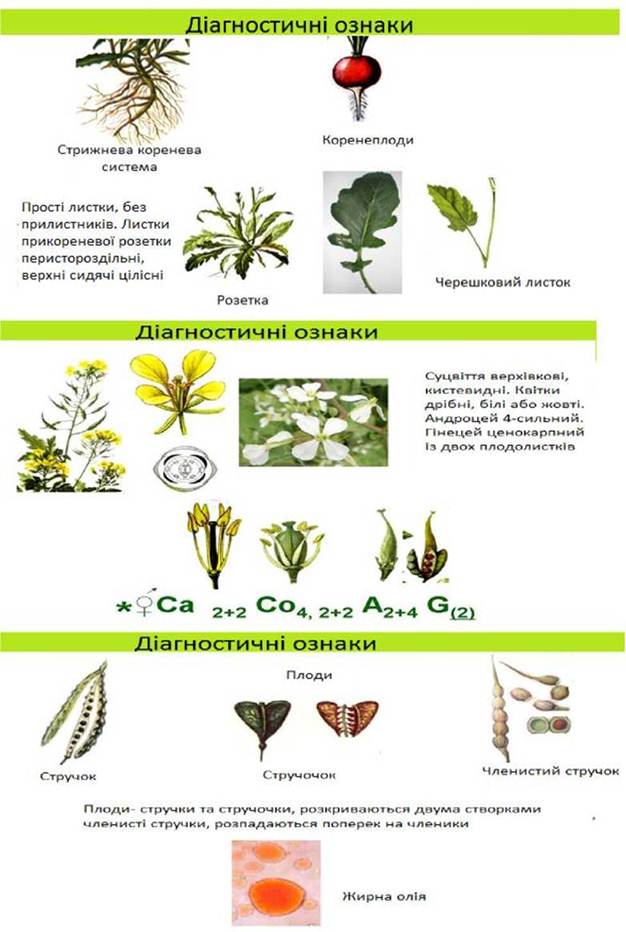
· The family includes herbaceous plants with alternate leaves, lacking stipules; heterophylly is a characteristic feature.
· Taproot system, with root crops developing in biennials.
· Flowers in racemes, actinomorphic, choripetalous. Four sepals alternate with four petals arranged in a cross. Six stamens, of which four are longer and two outer ones are shorter (tetradynamous).
· Single pistil with a bilocular ovary divided by a false septum. Nectaries are present at the Base of the pistil.
· Nectaries at the base of the staminal filaments.
· Flowers small, white or yellow.
· Inflorescences—leafless, terminal, racemose panicles.
· Fruit—silique or silicle, multi-seeded, dehiscing by two valves or breaking apart into individual segments.
· The silique is formed by two carpels with a superior ovary, whose fused margins create a frame with a false membranous septum bearing seeds on both sides in single or multiple rows.
· Articulate siliques break apart transversely into individual segments (e.g., wild radish).
· Silicle — a short silique in which length and width are approximately equal (e.g., field pennycress, shepherd's purse).
· Seeds lack endosperm, contain a curved embryo, and are rich in oil.
· Kohlrabi is characterized by an above-ground SHOOT modification known as a turnip-like stem (stem tuber).
❖ Shepherd's purse - Capsella bursa-pastoris
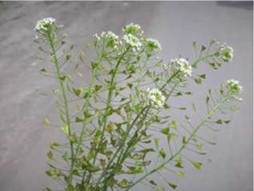
· Annual or biennial herbaceous plant.
· Stem erect, branched, pubescent in the lower part with simple, branched, spreading hairs.
· Basal rosette leaves overwintering, petiolate, pinnatifid (pinnatisect), with acute, triangular, entire or dentate-sinuate lobes.
· Stem leaves alternate, sessile, oblong-lanceolate, entire or sinuate-dentate, with a sagittate, stem-clasping base.
· Racemes terminal, corymbose.
· Fruit — a silicle, obversely triangular-cordate.
· Properties: hemostatic, vitamin-rich, hypotensive.
❖ Spread-leaved wallflower - Erysimum diffusum
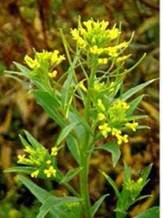
· Annual or biennial plant, grayish due to appressed, 2-4-partite hairs. Poisonous!
· Stem branched.
· Leaves of vegetative shoots of the first year simple, exstipulate, oblong-lanceolate, sinuate-dentate, tapering into a petiole at the base.
· Leaves of flowering shoots short-petiolate, linear-lanceolate; upper leaves sessile.
· Inflorescence — terminal racemes.
· Fruits — siliques.
· Properties: cardiotonic, diuretic.
❖ Wild cabbage - Brassica oleracea
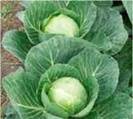
· Biennial vegetable crop.
· In the first year of life, it forms a basal rosette of leaves and a HEAD (cabbage head) – a vegetative bud modified into a shortened fleshy stem bearing large, enveloping, succulent leaves, initially green and later pale green.
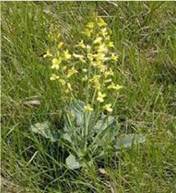
· In the second year, an erect stem with racemes of pale yellow flowers is formed. The stem leaves are semi-amplexicaul and greyish-green.
· Fruit is a silique.
· Contains Vitamin U, an anti-ulcer factor used in the complex Treatment of gastric and duodenal ulcers.
· Effects: vitamin, anti-ulcer, antitussive.
❖ Black mustard - Brassica nigra syn. Sinapis nigra
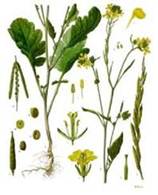
• Corolla is cruciform, yellow.
• Inflorescence is a raceme.
• Fruits are siliques pressed against the stem, quadrangular, 1–2 cm long, with a short beak.
• Contains the thioglycoside sinigrin and mustard essential oil.
• Effects: counter-irritant, appetite-stimulating, digestive, irritant.
❖ Sarepta mustard - Brassica juncea syn. Sinapis juncea
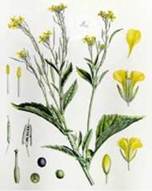
· Corolla is cruciform, yellow.
· Inflorescence is a raceme.
· Fruits are siliques directed obliquely upward at a 45° angle to the stem, cylindrical, 3–5 cm long (twice as long as the pedicel), torulose, with an awl-shaped beak.
· Effects: counter-irritant, appetite-stimulating, digestive, irritant.
❖ White mustard - Sinapis alba
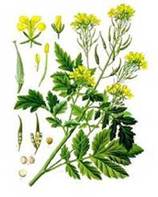
· Corolla is cruciform, yellow.
· Inflorescence is a raceme.
· Fruits are cylindrical pods, 2-4 cm long, on elongated, slender pedicels deflected at a 90° angle from the stem. The pod beak is long and flattened-ensiform, with rigidly hairy, bumpy valves bearing 3-5 prominent veins.
· Contains the thioglycoside sinigrin and mustard essential oil.
· Seeds extracted from the pods exhibit irritating and antiseptic properties.
· Action: aperient, digestive, irritant, counter-irritant.
Family Rosaceae - Rosaceae
· Class — Dicotyledons. The rose family is subdivided into the following subfamilies: Spiraeoideae, Rosoideae, Prunoideae (Amygdaloideae), Maloideae.
· The rose family includes herbs, shrubs, and trees with alternate simple or compound leaves bearing stipules.
· Flowers are actinomorphic; the calyx is gamosepalous, frequently double, consisting of the calyx proper and an epicalyx. The corolla consists of five or four free petals. Numerous stamens and the corolla are attached to the margins of either a convex or concave receptacle. Such a receptacle in rosaceous plants is termed a hypanthium.
· Fruits are apocarpous, varying According to the subfamily.
Subfamily Rosoideae (Rose subfamily) — Rosoideae
❖ Cinnamon rose - Rosa majalis
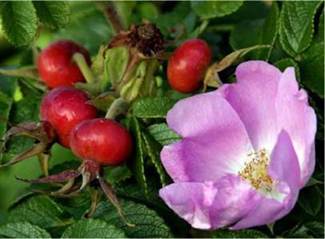
· Shrub. The lower portion of the stems and vegetative shoots are covered with paired, closely spaced, sometimes falcate prickles and setaceous acicles. Flowering shoots are glabrous.
· Leaves are imparipinnately compound with 5-7 leaflets and stipules fused with the petiole. Leaves are glaucous-green, pubescent beneath.
· Flowers are borne in groups of 2-5 on short glabrous pedicels, ranging in color from pale to dark red.
· The urceolate hypanthium becomes fleshy and red upon fruit maturation, featuring a rounded opening at the apex and persistent free calyx lobes directed upwards until the hypanthium turns completely red.
· Fruit — a cynarhodium consisting of a fleshy, orange-red hypanthium with remnants of the calyx at the apex and true achenes situated on the inner, setose-pubescent surface of the hypanthium.
· Action: vitamin, cholagogue, diuretic, radioprotective.
❖ Dog rose - Rosa canina
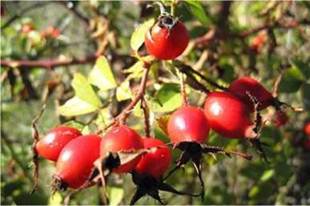
· Free PARTS OF THE calyx are pinnatifid, reflexed downward after flowering.
· Shrub. Prickles on the branches are solitary, large, hook-shaped, and directed downwards.
· Leaflets of the compound leaf are glandular along the veins and doubly serrate-dentate along the margin; the rachis bears sparse prickles and glands.
· Fruit — a cynarhodium, globose or oval, lacking sepals, with a 5-angular area at the apex.
· Action: vitamin, cholagogue, diuretic, radioprotective.
❖ Red raspberry — Rubus idaeus
· A semi-shrub with biennial aerial shoots.
· First-year shoots are vegetative, herbaceous, upright, bearing sharp, needle-like, reddish-brown prickles and hairs.
· Second-year shoots become woody.
· Leaves are compound, imparipinnate with 3–5 leaflets, green on the upper surface and grayish-white beneath due to dense pubescence.
· Flowers are white, solitary, or arranged in raceme-like inflorescences.
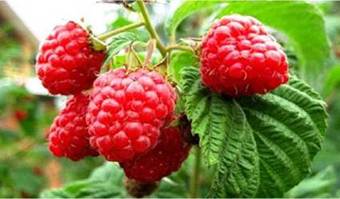
· Fruits are aggregate drupes, raspberry-red or yellow—a collection of single-seeded fruitlets seated on a convex receptacle, separating more or less freely upon ripening.
· Effects: diaphoretic, vitamin-rich, hypotensive, tonic.
❖ Woodland strawberry - Fragaria vesca
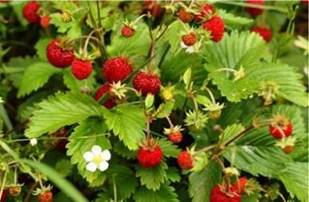
· A perennial herbaceous rhizomatous plant with a basal rosette of trifoliate, long-petioled leaves and aerial creeping shoots (runners) that root at the nodes.
· Inflorescence is a few-flowered corymb.
· Fruit is an etaerio of achenes (or fragara), consisting of an enlarged, conical, fleshy red hypanthium and true fruitlets—small nut-like achenes embedded in the pulp.
· Effects: vitamin-rich, hypotensive, tonic, anti-inflammatory.
❖ Tormentil (common tormentil, septfoil) — Potentilla erecta
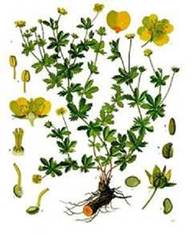
· A perennial herb with a multi-headed, horizontal, thickened rhizome.
· Stem is pseudo-dichotomously branched.
· Basal leaves are petiolate, trifoliate to palmately divided, withering before flowering.
· Stem leaves are sessile, trifid, with large stipules.
· Flowers are borne on long pedicels.
· Fruit is an aggregate of achenes (polyachene).
· Effects: astringent, hemostatic.
❖ Great burnet - Sanguisorba officinalis
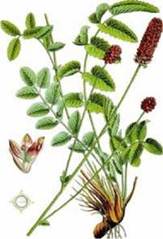
· Perennial herb with a thick, vertical rhizome and adventitious roots.
· Basal leaves long-petiolate, imparipinnate, with 7–17 serrate-dentate elliptic stalked segments, dark green and glossy above, dull underneath. Stipules falcate, dentate.
· Inflorescences: terminal, cylindrical, oval, or ovoid dense heads.
· Fruit: a nutlet.
· Effects: astringent, hemostatic.
Subfamily Maloideae - Maloideae
❖ Blood-red hawthorn - Crataegussanguinea
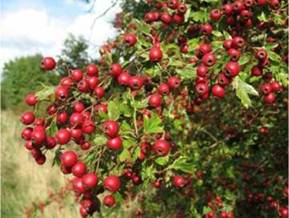
· Tree or shrub up to 5 m tall.
· Shoots of two types: elongated and shortened, modified into thorns.
· Leaves simple; small and obovate on short shoots, larger and pinnately cleft on elongated shoots. Stipules falcate.
· Flowers in compound corymbs, white or pale pink.
· Fruits: drupaceous pomes.
· Effects: cardiotonic, hypotensive, sedative, hypnotic, diuretic.
❖ Black chokeberry - Aronia melanocarpa
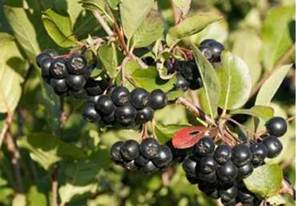
· Tree or shrub up to 3 m tall.
· Leaves simple, elliptic or obovate, with double-crenate-serrate margins.
· Inflorescences: compound, corymbose.
· Fruits: berry-like pomes.
· Effects: hypotensive, anti-inflammatory, anti-sclerotic, antidiabetic.
❖ Rowan (mountain ash) - Sorbus aucuparia
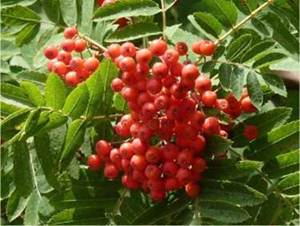
· Tree. A good honey plant. Branching sympodial.
· Leaves are odd-pinnately compound, consisting of 9-13 oblong, serrate leaflets.
· Flowers are small, yellowish, with a specific scent, gathered in drooping, dense corymbose panicles.
· Fruits are berry-like, globose pomes, orange-red and glossy.
· Action: multivitamin, astringent, choleretic, diuretic, and anti-sclerotic.
❖ Common pear - Pyrus communis
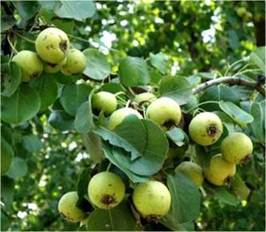
· Tree with a spreading crown; shoots feature terminal thorns.
· Leaves are petiolate, rounded or oblong-ovate, and finely serrate.
· Flowers are white, clustered in corymbs.
· Fruit is a pyriform pome. The flesh contains stone Cells (sclereids).
· Action: astringent, vitamin-rich, antipyretic, choleretic, and diuretic.
Subfamily Plum subfamily - Prunoideae
❖ Apricot — Armeniacavulgaris
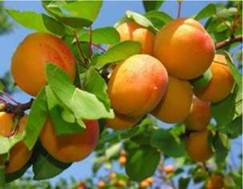
· Tree up to 4 m in height.
· Leaves are ovate-rounded or cordate.
· Flowers are solitary, sessile, and pale pink.
· Fruit is a succulent drupe.
· Action: vitamin-rich, appetite-stimulating, anti-sclerotic, and cardiotonic.
❖ Sour cherry - Cerasusvulgaris
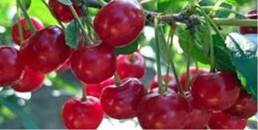
· Tree up to 8 m in height.
· Leaves are short-petioled, elliptic, and glabrous.
· The fertile parts of sour and sweet cherry flowers are surrounded by white and green floral leaves of various SHAPES AND SIZES, which collectively form the perianth.
· Inflorescence is a few-flowered umbel.
· Fruits are single-seeded drupes on long pedicels.
· Effects: expectorant, general tonic, antiseptic, sedative.
❖ Common Almond - Amygdalus communis
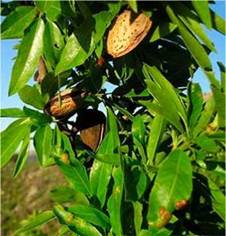
· A branching tree up to 8 m tall.
· Leaves are lanceolate.
· Flowers are large, pink, and sessile.
· Fruits are dry drupes containing the cyanogenic glycoside amygdalin, which, under the action of Hydrochloric acid in The Stomach and the enzyme emulsin, decomposes into glucose, benzaldehyde, and highly toxic hydrocyanic acid.
· Effects: anti-inflammatory, laxative, emollient, sedative, hematopoietic.
❖ Common Peach - Persica vulgaris
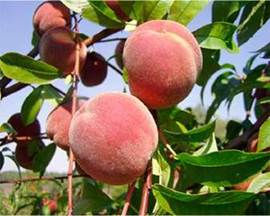
· A tree up to 6 m tall.
· Leaves are alternate, short-petioled, lanceolate, and sharply serrate.
· Flowers are pink. Blooms before the leaves fully unfold.
· Fruit is a drupe.
· Effects: cardiotonic, antiarrhythmic, hematopoietic, diuretic.
❖ Common Plum - Prunus domestica
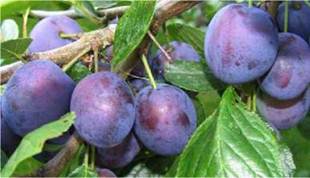
· A tree up to 10 m tall.
· Leaves are elliptic, pubescent along the veins on the underside, and serrate or crenate at the margins.
· Flowers are pedicellate, clustered in groups of 2–4.
· Fruit is a flattened, pitted drupe.
· Effects: multivitamin, astringent, anti-sclerotic, choleretic, and diuretic.
❖ Blackthorn - Prunus spinosa
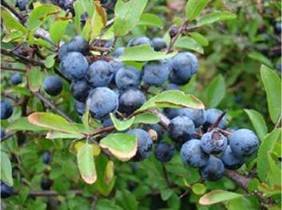
· Spiny, spreading shrub up to 1.5 m in height.
· Leaves elliptic, oblong-ovate or broad-lanceolate, glabrous.
· Flowers white, clustered by 2-3 on short pedicels.
· Fruit is a globose, dark blue drupe.
· Action: astringent, vitamin-rich, antipyretic, cholagogue, diuretic, hypotensive.
❖ Bird cherry - Padusavium (P. racemosa)
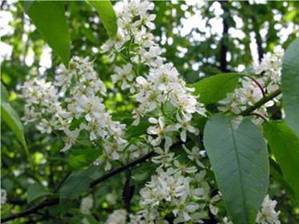
· Tree up to 10 m in height with a dense crown.
· Leaves elliptic, finely serrate.
· Flowers fragrant, gathered in drooping racemes.
· Fruits are small, black, shiny, tart-tasting drupes.
· Action: phytoncide, astringent, diaphoretic, diuretic, anti-inflammatory, antitussive.
Family Fabaceae - Fabaceae
· Legumes (Fabaceae or Leguminosae) are a family of dicotyledonous, polypetalous plants. It comprises over 500 genera and about 13,000 species distributed worldwide.
· Fabaceae are divided into 3 subfamilies: Mimosoideae, Caesalpinioideae, and Papilionoideae.
· Fabaceae exhibit diverse life forms — annual and perennial herbaceous plants, subshrubs, shrubs, trees, and lianas.
· Root system is taproot-type, with nodules of nitrogen-fixing Bacteria; bacteriorrhiza of the family species represents a Symbiosis between plant roots and nitrogen-fixing bacteria.
· Fabaceae increase soil fertility because nodule bacteria that assimilate atmospheric nitrogen settle on their roots. In fields, legumes are used as green manure.
· Leaves are alternate (occasionally opposite), mostly with stipules, pinnately or palmately compound, rarely simple; sometimes leaf blades are poorly developed or reduced, and their function is performed by leaf-like petioles (phyllodes in Australian acacia), or modified into tendrils (pea) or spines (acacia).
· Flowers are bisexual, mostly zygomorphic, with a double perianth, solitary or in inflorescences (raceme, head).
· Calyx is five-sepaled (synsepalous), bell-shaped or two-lipped, persistent in fruit.
· Corolla is papilionaceous, consisting of five petals: an odd, largest standard or banner, two lateral wings or alae, and two petals fused at the apex or along one side to form a keel.
· Pistil consists of a single carpel, with a superior unilocular ovary (monocarpous gynoecium).
· Androecium consists of 10 stamens. They are free or monadelphous — fused into a tube open at the top, or diadelphous, where one stamen is free and 9 are fused for about half their length into an obliquely or straightly truncated tube.
· Fruit is a legume (pod), mostly many-seeded, dehiscent, rarely one-seeded, indehiscent.
❖ Yellow sweet clover - Melilotus officinalis
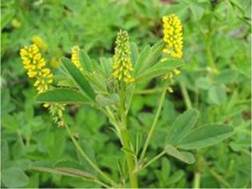
· Raw material: herb.
· Stems are branched.
· Leaves are trifoliate, the terminal leaflet has a petiole, lateral leaflets are nearly sessile.
· Flowers are gathered into axillary racemes.
· Androecium is monadelphous.
· Fruits are small, pendulous, indehiscent legumes.
· Effects: expectorant, emollient, analgesic, anticonvulsant, anti-inflammatory.
❖ Field restharrow - Ononis arvensis
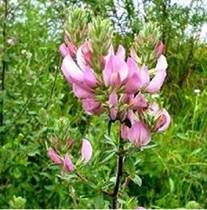
· Raw material: roots.
· Stems are ascending, branched, glandular-pubescent. Leaves are sticky, upper ones simple, the rest trifoliate, sharply serrate-dentate with large stipules.
· Flowers are gathered into racemose inflorescences.
· Perianth consists of a deeply divided calyx and a papilionaceous corolla.
· Fruits are indehiscent legumes containing 1-3 seeds.
· Used for the treatment of hemorrhoidal bleeding.
· Effects: hemostatic, diuretic, laxative, anti-inflammatory, hypotensive, cardiotonic.
❖ Garden pea - Pisum sativum
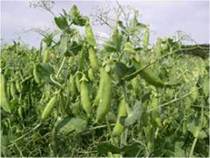
· Raw material: herb, seeds.
· Upper leaflets of the compound leaf are modified into tendrils.
· Effects: herb – hepatoprotective, diuretic; seeds – hypoglycemic, hypoazotemic, antioxidant.
❖ Common bean - Phaseolus vulgaris
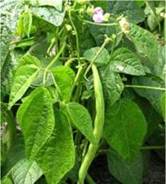
· Raw material: herb, seeds, pericarp (husks).
· Effects: herb and husks have hypoglycemic, diuretic, and anti-inflammatory properties; seeds are a source of protein.
❖ Black locust (false acacia) - Robiniapseudoacacia
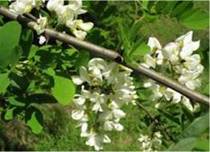
· Raw material: flowers, bark.
· Leaves are odd-pinnately compound with oval leaflets, acute at the apex, and grayish-green on the underside.
· Stipules are modified into thorns.
· Flowers are arranged in drooping axillary racemes.
· Androecium is diadelphous.
· Fruit is a dry legume formed by a single carpel, dehiscing along both the ventral and dorsal sutures into two valves, with seeds attached along the ventral suture.
· Effects: flowers are diuretic, hypoazotemic, antipyretic, anti-inflammatory, and antispasmodic; bark is anti-inflammatory and laxative.
❖ Licorice - Glycyrrhiza glabra
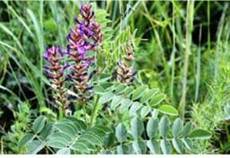
· Raw material: rhizomes with roots.
· Rhizome is short, thick, multi-headed, with deep-penetrating roots and a network of vertical and horizontal stolons. Roots have a sweet taste.
· Leaves are odd-pinnately compound, with 5-7 pairs of ovate, glandular-pubescent leaflets.
· Inflorescence is a loose axillary raceme.
· Flowers are pale violet.
· Fruits are indehiscent legumes.
· Effects: expectorant, demulcent, antispasmodic, anti-inflammatory, diuretic, and antiallergic.
❖ Soybean - Glycinehispida (G.max)
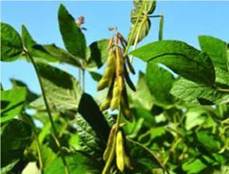
· Raw material: seeds.
· Effects: seeds possess hepatoprotective, venotonic, and anti-atherosclerotic properties; fatty oil is hypocholesterolemic. Used in vegetarian diets.
❖ Peanut (groundnut) - Arachishypogaea
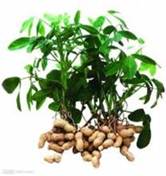
· Raw material: seeds, fatty oil.
· Leaves are imparipinnate with long petioles.
· Flowers are yellow, axillary on pedicels; terminal flowers are sterile, while lower ones are fertile. Blooms for one day.
· Fruit develops underground (geochory).
· Fruit is an indehiscent one- to two-seeded pod resembling a constricted cocoon.
· Action: seeds are metabolic; fatty oil is hypocholesterolemic, anti-atherosclerotic, and hypoglycemic.
❖ Japanese pagoda tree - Sophora japonica
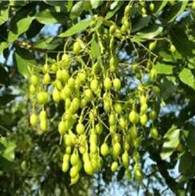
· Deciduous tree.
· Leaves are alternate and imparipinnate.
· Corolla is papilionaceous, pale yellow.
· Flowers are bisexual, gathered in terminal panicles.
.· Fruits are greenish or yellowish-brown, fleshy, flattened-cylindrical succulent jointed pods.
· Japanese pagoda tree is a source of rutin and quercetin.
· Action: capillary-strengthening.
❖ Woollypod milkvetch - Astragalus dasyanthus
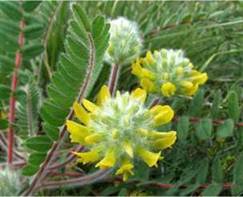
· Perennial, protected as a rare plant.
· Stems are ascending, branched, and reddish due to woolly pubescence.
· Leaves are imparipinnately compound, with 13–17 pairs of oblong-lanceolate pubescent leaflets.
· Flowers sit on a shortened and thickened main axis, forming a simple monopodial inflorescence – a head.
· Androecium is monadelphous.
· Pod is hairy, oval, with a false septum, indehiscent.
· Action: sedative, hypotensive, cardiotonic, diuretic.
Family Celery - Apiaceae (Umbelliferae)
· Biennials are characterized by root crops.
· Stems are ribbed and hollow.
· Leaves are exstipulate, with a broad membranous sheath and a pinnately dissected blade of varying degrees.
· Lower leaves form a basal rosette.
· Inflorescence is a compound umbel, with involucres and involucels.
· Gynoecium is coenocarpous, consisting of 2 carpels.
· Schizocarpic fruit is a cremocarp (diachenium). The fruit surface features 5 longitudinal primary Ribs containing vascular bundles; schizogenous essential oil tubes are located in the furrows between the ribs, and the pericarp is fused with the seed. Upon ripening, the cremocarps hang on thin, thread-like stalks (carpophores). Seeds contain endosperm.
❖ Anise - Anisum vulgare
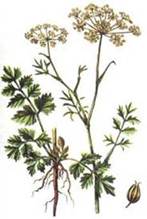
· Lower stem leaves are long-petiolate, entire, rounded-reniform, and incised-dentate; middle stem leaves are ternate-pinnatisect with wedge-shaped segments; upper leaves are sessile, 5-fid or entire.
· Compound umbels have 7-15 pubescent rays, lacking involucres and involucels.
· Fruits are greenish or yellowish-gray, brownish, do not split into mericarps, and have a characteristic anise scent and sweet taste.
· Action: expectorant, anti-inflammatory, antiseptic, diaphoretic, diuretic, bactericidal, laxative.
❖ Poison hemlock - Conium maculatum
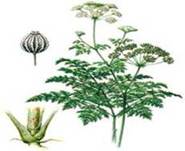
· A highly poisonous plant!
· The specific epithet of poison hemlock reflects the presence of red-purple spots on the stem and petioles.
· Has a characteristic mousy odor.
· Zygomorphic white flowers form compound umbel inflorescences.
· Fruits are round-ovoid, splitting, with 5 convex ribs (cremocarp).
· Action: hypotensive, antitumor, analgesic, anticonvulsant, hemostatic.
❖ Caraway - Carum carvi
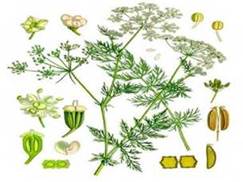
· Leaves are bi- or tripinnatisect into ovate-acuminate, lanceolate, and linear segments. Lower leaves have long petioles, while upper leaves have short ones that transition into a sheath.
· Inflorescence: compound umbel.
· Fruits are dark brown with prominent, light-colored ribs. They easily break down into elongated, sickle-curved, laterally compressed mericarps.
· Effects: bactericidal, antispasmodic, expectorant, diuretic, and cholagogue.
❖ Coriander - Coriandrum sativum
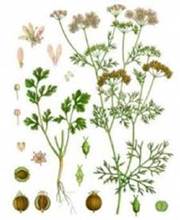
· The green parts of the plant have a sharp, specific odor and a pungent taste.
· Basal rosette leaves are long-petioled, ranging from pinnately lobed to segment-dissected, with serrated margins.
· Inflorescence: compound umbel.
· Fruits do not split or break apart under pressure; they are spherical, brownish-yellow, and ribbed, featuring 10 slightly convex, wavy ribs and 12 straight, thread-like ribs.
· The odor of immature fruits is unpleasant, reminiscent of bedbugs, while mature fruits have a strong, specific, and aromatic scent.
· Effects: anti-inflammatory, anticonvulsant, expectorant.
❖ Dill - Anethum graveolens
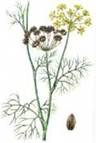
· Pinnate leaves are repeatedly dissected into linear-subulate, almost thread-like segments. Lower leaves are petioled; upper ones are sessile, with white-margined sheaths.
· Inflorescence: compound umbel.
· Fruits split apart. Mericarps are flat, ovoid, oval, or oval-elongated, with thin edges and 5 yellowish-brown ridges, of which the two lateral ones are significantly wider than the three middle ones.
· Effects: appetite-stimulating, antispasmodic, expectorant, diuretic, and cholagogue.
❖ Fennel - Foeniculum vulgare
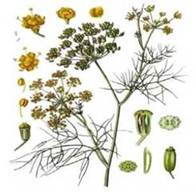
· Stems are glaucous-green, finely ribbed, and highly branched.
· Leaves are petioled, large, grayish-green, dissected into narrow linear and thread-like segments.
· Inflorescence: compound umbel.
· Fruits are fragrant, sweetish, breaking down into two grayish-green, five-ribbed, elongated, and arch-curved mericarps with carminative properties. Dill water is produced from their essential oil.
· Effects: appetite-stimulating, antispasmodic, expectorant, diuretic, and carminative.
❖ Parsley - Petroselinum sativum
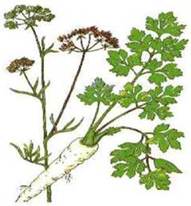
· Basal and lower stem leaves are long-petiolate, pinnatifid, and form a rosette. Upper leaves are ternate-divided or dissected.
· Inflorescence is a compound umbel.
· Fruits are grayish-brown, schizocarps: mericarps are irregularly ovoid with a beak and 5 ribs, of which the marginal ones are lighter in color.
· The taproot is modified into a root crop, with nutrients accumulating in the phloem.
· Properties: bactericidal, antispasmodic, appetite-stimulating, diuretic, and choleretic.
❖ Celery - Apium graveolens
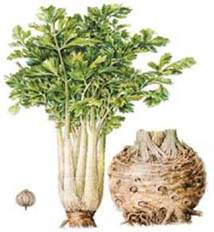
· Root is fusiform, becoming round-turnip-shaped in cultivated forms.
· The taproot is modified into a root crop, with nutrients accumulating in the phloem.
· Leaves are rough, brittle, glossy, and pinnatifid; basal leaves are long-petiolate with 5 wedge-shaped, coarsely serrate segments at the apex, while upper leaves are nearly sessile with 3 segments.
· Inflorescence is a compound umbel.
· Fruits are small, convex-ovoid, and laterally compressed.
· Properties: anti-inflammatory, antispasmodic, digestive, and regulates Water-Salt METABOLISM.
❖ Carrot - Daucus sativus
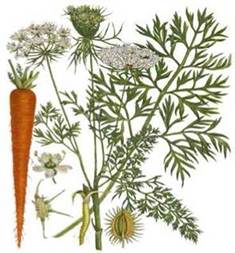
· The taproot develops into a root crop, with nutrients accumulating in the cortex and phloem.
· Inflorescence is a multi-rayed compound umbel, with zygomorphic flowers at the edge of the umbellets, possessing both an involucres and involucels; resembling a "bird's nest" during the fruiting stage.
· Fruits are schizocarps bearing bristles.
· Properties: anti-inflammatory, antispasmodic, lithotriptic, diuretic, and choleretic.
❖ Cowbane (Water Hemlock) - Cicuta virosa
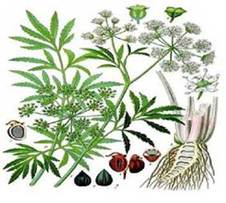
· The plant is poisonous!
· Rhizome is thick, rounded, and becomes elongated by autumn, with shortened hollow internodes. The rhizome is divided into hollow chambers by transverse partitions.
· Inflorescence is a compound umbel.
· Fruits are globose, slightly laterally compressed, with flat ribs, and schizocarpic.
· Action: hypotensive; suppresses the Central Nervous system and locomotor activity.
Last update: 07/08/2026
Editorial and Educational Adaptation: This material has been compiled based on the primary/original source text. The project team performed an editorial review, corrected technical inaccuracies, structured sections, and adapted the content for an educational format.
What was processed:
- elimination of formatting defects (OCR errors, structural breaks, corrupted characters);
- editorial organization of content;
- standardization of terminology in accordance with academic sources;
- verification of factual statements against the original source text.
All mentions of the author, publication year, and origin of the primary text have been preserved in accordance with the source.