Plant Physiology - Musiyenko, M. M. 2001
General principles of plant growth and morphogenesis regulation
Genetic regulation
Genetic regulation ensures:
·the preservation and Replication of information concerning the individual Structure of a specific Organism and The sequence of morphogenesis processes encoded in the nuclear Chromatin and circular DNAs of Plastids and Cell/35.html">Mitochondria as a triplet code;
·Regulation of the readout process (METABOLISM/31.html">Transcription) of this information, the Processing of synthesized RNAs and their transport, the preservation of mRNA in a latent form as informosomes, and their activation;
·control over the assembly of Ribosomes, polyribosomes, and the corresponding synthesis of Polypeptides (Translation).
GROWTH AND DEVELOPMENT are primarily regulated at THE CELLULAR LEVEL. The growth of an organ or organism, accordingly, consists of the growth of its Cells, while morphogenesis—that is, The formation of specific forms of Organization of an organ or organism—is the result of the developmental pathways undertaken by individual cells. The determination of each cell's developmental pathway forms The basis of developmental physiology. During determination, a cell makes a choice from a vast array of potential capabilities (genes, information), although the greater part of this information remains unused (in particular, genes that ensure basic cellular Functions such as Protein Synthesis, Glycolysis, etc.).
Embryonic meristematic cells can develop along diverse pathways. In the process, certain cell Organelles may disappear, such as the Cell Nucleus and tonoplast in sieve tube elements, or even the entire protoplasm may vanish (vessel elements). The number of mitochondria may increase (companion cells), cell walls may dissolve (xylem), and Lignin or suberin may be deposited within cell walls. Finally, proplastids can give rise to chloro-, leuko-, and chromoplasts.
The transition to a particular developmental pathway is determined by a specific set of Proteins; thus, each specialized cell synthesizes only a fraction of the genetically possible Enzymes. For example, a high concentration of amylase is observed exclusively in the aleurone layer of grains, phenol oxidases are present in the endodermis rather than the ROOT cortex, and so on.
Given that the synthesis of each protein is controlled via template DNA by a single Gene, the formation of different sets of enzymes in various cell types is likely the result of differential gene activation (the activation of one group of genes with the simultaneous inactivation of others).
During the formation of a cotyledon, for instance, while the Introduction/20.html">DNA Structure remains constant, the composition of RNA (the composition of nitrogenous bases) changes sequentially, and consequently so do the proteins (electrophoretic properties, enzymatic activity). Such biochemical differentiation is not the result, but rather the cause, of morphological differentiation. Differential gene activation occurs not only in specialized embryonic cells. For instance, light can induce the formation of trichomes or Stomata in epidermal cells—processes that likewise require differential gene activation.
Morphogenetic RNA. Messenger RNA that is formed through differential gene activation and participates in morphogenesis is termed morphogenetic RNA. The Role of this RNA can be readily traced using the example of the alga Acetabularia (Fig. 170).
Class="center">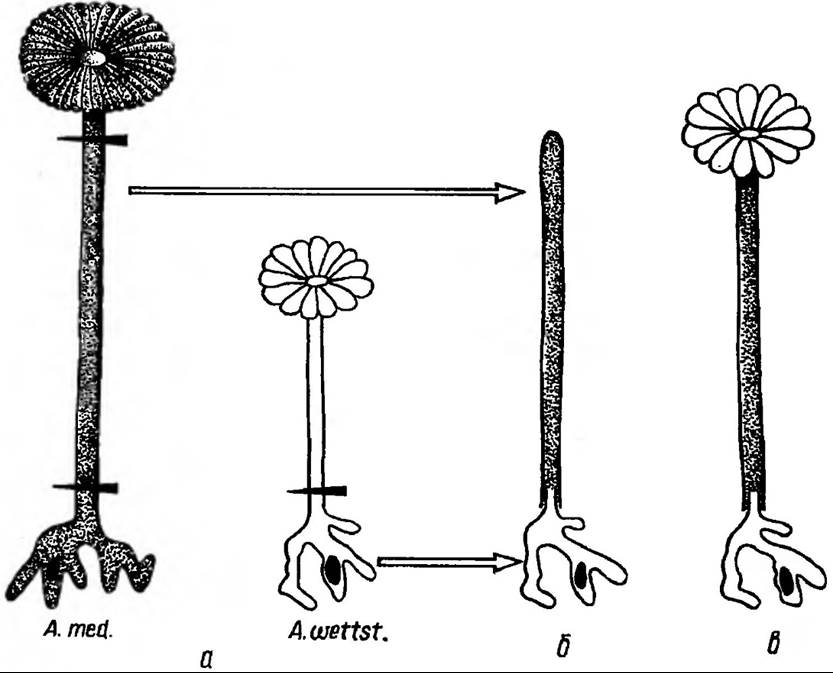
Fig. 170. Evidence for the presence of morphogenetic substances in Acetabularia: a — an enucleated stalk segment of A. mediterranea grafted onto a rhizoid (containing The Nucleus) of A.wettsteinii; b — the grafted components fuse together; c — the A. mediterranea stalk segment regenerates an A. wettsteinii cap.
These plants reach up to 5 cm in length, with nuclear sizes up to 0.1 mm. It is a unicellular alga possessing a rhizoid, a stalk, and a cap that varies in shape among different species. If nuclear transplantation is used to transfer genetic material from an Acetabularia of one species into young individuals of another species that lack a cap and whose own nucleus has been previously removed, the resulting cap shape is characteristic of the nuclear donor plant. This indicates that The Cell nucleus produces a species-specific morphogenetic messenger RNA, which accumulates apically toward the tip and directs morphogenesis of the cap formation there through the Synthesis of specific proteins. Therefore, there is no doubt that in higher plant cells as well, such morphogenetic RNA can act as a mediator between selective gene activation and cellular differentiation.
Activation of Differential Gene Activation. Factors that induce selective gene activation include phytohormones and light. Quite often, eliciting a single response requires multiple signals, such as the action of two phytohormones. Not all cells respond identically to the same signal. For example, in response to a long dark period signal, the Cells of the SHOOT apical meristem will transition to Flower Formation, which is not observed in the root apical meristem. Another example is when, under The Influence of light, only epidermal cells are capable of forming trichomes or the stomatal apparatus. This indicates that what is decisive is not so much the acting factor itself, but rather the genetic pattern of the cell receiving it—specifically, the set of regulated genes available to those cells. Recall that the cell genome at any given moment contains active, blocked, and regulated genes. Only regulated genes are switched on or off during differential activation, with some responding to factor A, others to B, C, and so on. Cases are also possible where the direct activation of pre-formed enzyme proteins occurs rather than gene activation.
Coordinated Gene Activation. The determination of embryonic cell development involves a diverse array of genes. Therefore, it is difficult to imagine that a specific factor, such as a hormone, activates each individual gene or group of genes separately, because during ordered development, genes must become active one after another. Consequently, it can be assumed that genes are organized into functional units comparable to programs embedded in a computer. The Genome contains a limited number of programs that can be triggered by appropriate factors. Just as in a computer, a program consists of subroutines, sub-subroutines, and so on.
Let us consider an example of a program: palisade mesophyll cells → chloroplast formation → chlorophyll synthesis, and so forth. Another program: flower → subroutines → stamens, pollen, etc. Some subroutines belong to only a single program (a stamen belongs to the flower), while others belong to several (xylem belongs to both the shoot and the root). Accordingly, for each such genetic program, There is a specific molecular construction.
If the genome consists of a small number of such elements, they can be interrelated due to the fact that, In addition to regular gene products (mRNA), they also produce modulator molecules whose function is to switch other genome elements on or off. Modulator molecules may also consist of RNA or represent secondary gene products—proteins. The existence of such interconnections explains the phenomena of Induction and Repression.
There is also evidence for the presence of genome elements that are formed as a single product of a modulator molecule and serve exclusively for coordinated gene activation. Such elements, composed of integrated genes, are termed integrators. THE PRINCIPLE OF their action can be visualized as follows: factors that switch on a gene may act, perhaps via an intermediary block, on modulator molecules or on special sensor genes that control the action of integrators in much the same way as an operator gene controls an Operon. These models make it possible to explain two well-known facts: first, higher plants possess numerous repeated DNA sequences—these may well be integrator genes and receptors; second, the greater part of mRNA is degraded in the nucleus—thus, this may represent RNA produced by integrator genes.
It should be remembered that during development, genes are activated one after another in a specific sequence, with determination typically restricted to the initial steps of the developmental process. Subsequent Changes in the gene pattern are coordinated by internal mechanisms.
Last update: 07/08/2026
Editorial and Educational Adaptation: This material has been compiled based on the primary/original source text. The project team performed an editorial review, corrected technical inaccuracies, structured sections, and adapted the content for an educational format.
What was processed:
- elimination of formatting defects (OCR errors, structural breaks, corrupted characters);
- editorial organization of content;
- standardization of terminology in accordance with academic sources;
- verification of factual statements against the original source text.
All mentions of the author, publication year, and origin of the primary text have been preserved in accordance with the source.