PLANT MORPHOLOGY - T. A. Sautkina - 2012
CHAPTER 9. DEVELOPMENT, STRUCTURE, AND TYPES OF SEEDS AND FRUITS
9.1. Development, Structure, and Types of Seeds
A seed is the primordial form of a new Organism, a specialized Structure that ensures the dispersal and propagation of seed plants as well as their survival through unfavorable environmental conditions. Seeds develop from ovules; consequently, many elements of the ovule expand and undergo various modifications to become the Structural components of the mature seed.
Typically, a seed consists of an embryo and nutrient reserves accumulated either in specialized trophic Tissues (endosperm, perisperm), within the embryo itself, or in the seed coat (scleroderma, testa).
The most crucial part of the seed is the embryo. It originates either via amphimixis or through apomixis. During its development (Embryogenesis), the embryo goes through a series of successive stages. As noted earlier, development begins with the mitotic division of the zygote. During the first division of the zygote Nucleus, at the end of telophase, a horizontal Cell plate is laid down, resulting in two Cells: the basal cell and the apical (terminal) cell (see Fig. 200, D). Most commonly, a series of mitotic Divisions of the basal cell gives rise to the suspensor, while the terminal cell develops into the embryo proper. However, this is not the only pattern of embryogenesis. In some plants, derivatives of the terminal cell contribute to the embryo, whereas in others they participate in The formation of the suspensor. One end (the basal end) of the suspensor contacts the nucellar tissues in the micropylar region, while its terminal end bears the proembryo (often referred to simply as the "embryo"), which is a spherical body composed of meristematic cells.
The suspensor performs a trophic function; its cells frequently form haustoria that penetrate the nucellar tissue to extract nutrients essential for the normal Development of the growing embryo. Furthermore, the suspensor gradually pushes the developing embryo into the center of the embryo sac—where the majority of endosperm nuclei are located—thereby facilitating efficient nourishment of the developing embryo (see Fig. 202).
At early Selection/3.html">Stages of development, the embryos of dicotyledonous and monocotyledonous plants exhibit striking similarities. They initially develop as radially symmetrical structures; however, during subsequent differentiation, dicot embryos become monosymmetric (possessing a single plane of Symmetry), while monocot embryos become asymmetrical (incapable of being divided into mirror-image halves). This difference is determined by THE POSITION OF the SHOOT apical meristem, which occupies a terminal (apical) position in dicots and a lateral position in monocots.
As the spherical proembryo enlarges, its differentiation begins. The first structures to arise on the spherical body of a dicot proembryo are the cotyledons, appearing as lateral protuberances of meristematic tissue. The shoot apical meristem (shoot apex) then becomes segregated between them. Following the ESTABLISHMENT OF THE shoot apex, embryonic leaves develop as lateral outgrowths on the shoot apical meristem, and the plumule is formed. Thus, cotyledons (seed leaves) and true embryonic leaves have distinct origins. In monocots, only a single cotyledon is formed during embryonic development.
Following the Differentiation of the shoot apex, at the opposite end of the proembryo adjacent to the suspensor, the ROOT apical meristem (root apex) becomes distinct. Through cellular division and apical growth, the radicle is formed. The embryonic stem (hypocotyl/epicotyl axis) differentiates between the radicle and the plumule. Thus, the rudiments of the Water/115.html">Vegetative Organs of the future plant are laid down within the seed: the radicle, the embryonic stem, and the plumule (Fig. 203).
Class="center">Fig. 203. Seed and embryo of the common bean (Phaseolus vulgaris): A—general external view of the seed; B—seed embryo: 1—seed prominence (Location OF THE radicle); 2—micropyle (former micropylar opening); 3—hilum; 4—raphe; 5—plumule; 6—embryonic stem; 7—radicle; 8—cotyledons; 9—seed coat

Normal embryo differentiation occurs only if the endosperm forms and develops properly during the Cytology/cytology/16.html">Early stages of seed development. If endosperm development is anomalous or if it degenerates prematurely, embryonic Nutrition is impaired, and differentiation into embryonic organs fails to take place. This phenomenon is observed in orchids, whose mature seeds contain an undifferentiated mass of embryonic cells known as a protocorm. If the endosperm degenerates at late stages of development, after embryo differentiation has already occurred (such as in the Fabaceae family), no anomalies in seed development are observed.
Embryos vary in shape and may occupy different positions within the seed. The straight embryo is most common, in which the shoot and root apices lie along a single axis (tobacco — Nicotiana). The embryo may also be curved (carnation — Dianthus), spirally coiled (dodder — Cuscuta), annular (corn cockle — Agrostemma), or horseshoe-shaped (shepherd's purse — Capsella) (Fig. 204).
Fig. 204. Seed types classified by shape, embryo position, and storage tissue type: A—castor bean (Ricinus communis) — seed with endosperm and a straight, centrally located embryo; B—black pepper (Piper nigrum) — seed with endosperm, perisperm, and a straight embryo; C—corn cockle (Agrostemma githago) — seed with perisperm and a curved, peripheral embryo; D—spinach (Spinacia oleracea) — seed with perisperm and an annular, peripheral embryo; E—opium poppy (Papaver somniferum) — seed with endosperm and a curved, centrally located embryo: 1—seed embryo; 2—endosperm; 3—perisperm; 4—seed coat (testa); 5—aril
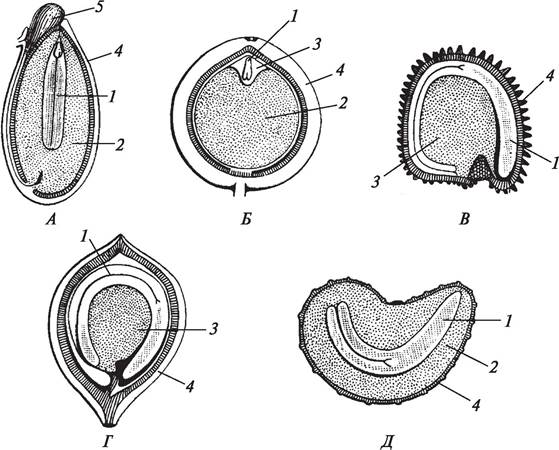
Relative to the nutritive storage tissue, the embryo within the seed may occupy a central position (spurge — Euphorbia), a peripheral position (corn cockle), or a lateral position (cereals). Regardless of how varied the position of the embryo within the seed may be, it is always optimal for utilizing the nutrients stored in the surrounding cells.
The endosperm is a polyploid nutritive storage tissue that forms exclusively As a result of the Fertilization of the polar nuclei or the central Nucleus of the embryo sac. In the early stages of development, the endosperm exhibits high PHYSIOLOGICAL AND BIOCHEMICAL activity, although the synthesis of storage nutrients does not yet take place at this stage. Gradually, as nutrient reserves accumulate, the physiological and biochemical activity of the endosperm declines. The primary storage nutrients accumulated in the endosperm are Lipids, starch, and Proteins; however, as a rule, one particular type of nutrient predominates in the endosperm of any given plant species. Starch predominates in cereals, whereas lipids predominate in sunflower (Helianthus annuus), flax (Linum usitatissimum), and peanut (Arachis hypogea). In addition to major storage nutrients, various other substances have been detected in the endosperm of different plants, including Amino Acids (corn and wheat contain up to 17 amino acids), Vitamins (A, B1, B2, B6, C, E, H, PP), and a range of Enzymes. Nevertheless, because mature seeds contain no more than 14% water, the endosperm within them Functions physiologically as a "dead tissue."
In consistency, the endosperm may be relatively liquid, semi-fluid, or hard. Hard endosperm typically has a smooth surface, but in representatives of certain families (Juglandaceae, Aristolochiaceae, Arecaceae), it forms folds that increase its contact surface area with the embryo. Such endosperm is termed ruminated. A massively developed endosperm is formed in the seeds of cereals (Gramineae), lilies (Liliaceae), nightshades (Solanaceae), and umbellifers (Umbelliferae). In the seeds of various umbellifers, the shape of the endosperm is so diverse that this feature is utilized in Taxonomy as a key diagnostic character for species identification.
In Representatives of the families Caryophyllaceae, Chenopodiaceae, and Piperaceae, the endosperm is absent in the mature seed, and the perisperm serves as the nutritive storage tissue. The perisperm develops from the nucellus and, unlike the endosperm, is a diploid tissue.
In legumes, composites, and cucurbits, the mature seed either lacks endosperm entirely or retains only a small amount in the region of the radicle. In plants of these families, nutrient reserves are deposited within the embryo itself, specifically in its heavily hypertrophied cotyledons. Endosperm is also absent in the seeds of orchids (Orchidaceae).
Quite rarely, Two Types of storage tissue—endosperm and perisperm—develop simultaneously within a seed (Nymphaeaceae family).
Thus, based on the localization of nutrient reserves in mature seeds, they are classified into five groups (see Fig. 204):
1. Seeds with massive endosperm (poppies, umbellifers, brassicas, cereals).
2. Seeds with perisperm (caryophyllaceous plants, chenopods, rubiaceous plants).
3. Seeds with equally well-developed endosperm and perisperm (Nymphaeaceae, Cannaceae, Zingiberaceae).
4. Seeds with a massive perisperm and a weakly developed endosperm (Piperaceae).
5. Seeds lacking endosperm (Fabaceae, Orchidaceae, Araceae, Alismataceae).
The seed is covered by a more or less thick seed coat (testa), which develops primarily from the ovule integuments. One or both integuments may participate in the Formation of the seed coat, and occasionally nucellar tissues are also involved.
The seed coat protects the plant embryo from adverse environmental influences. In some plants, it is covered by a cuticle or a layer of wax, which enhances its durability. The seed coat exhibits A number of structural features that are species-specific. Its structure is of great importance for plant systematics and reflects specific adaptations for seed dispersal (Fig. 205). In seeds that develop within dehiscing fruits, the seed coat often forms a protective layer of sclerenified cells known as the sclerotesta (e.g., in lupine seeds). In seeds dispersed by birds and mammals, the outer layer of the seed coat becomes juicy and fleshy, termed the sarcotesta (as in magnolia seeds). The mucilaginous epidermis of the seed coat is called the myxotesta (as in flax seeds); it facilitates moisture absorption and anchors the seeds to the soil.
Fig. 205. Diversity of seed coats: A—greater celandine (Chelidonium majus); B—California poppy (Eschscholtzia californica); C—corn poppy (Papaver rhoeas); D—field pennycress (Thlaspi arvense): 1—seed coat; 2—aril (caruncle)
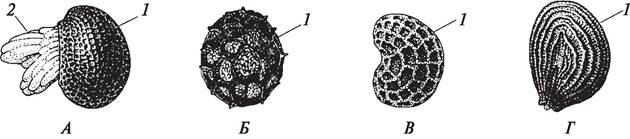
In some plants, a fleshy outgrowth known as an aril develops on the seed, partially or completely covering it. It is usually brightly colored, and its tissues contain sugars, oils, and proteins. The aril promotes seed dispersal by birds (spindle tree — Euonymus), ants (celandine — Chelidonium, violet — Viola), wind (birch — Betula), or water (water lily — Nymphaea). In spurge (Euphorbia), milkwort (Polygala), and boxwood (Buxus), a small outgrowth forms from the integument in the micropyle region, called a caruncle, which also AIDS in seed dispersal.
In addition to these specialized features, the seed coat of various plants shares a number of general structural traits. A hilum is clearly visible On the surface of the seed coat, representing the scar left where the seed was attached to the stalk (funiculus). The seed coat also bears the micropyle, the former opening of the ovule. Through this opening, water enters the germinating seed, and the embryonic root emerges during germination.
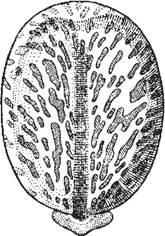
A characteristic feature of the seed coat is its coloration, which is determined by the presence of various pigments. Frequently, pigmented areas alternate with non-pigmented ones, creating a distinct pattern (e.g., castor bean seeds — Ricinus) (Fig. 206). The coloration of the seed coat also contributes to seed
dispersal.
Fig. 206. Characteristic pattern on the seed coat of the castor oil plant (Ricinus communis)
A fully formed mature seed is characterized by low moisture content and minimal hormonal and enzymatic activity. In this state, seeds are capable of withstanding unfavorable environmental conditions and can retain their germination capacity for extended periods. This state is known as physiological seed dormancy.
Angiosperm seeds vary greatly in size, shape, and mass. Typically, they are small (up to 1 cm in length), but occasionally they reach several tens of centimeters long. The tropical liana Entada (family Fabaceae) produces Heart-shaped seeds slightly smaller than a dessert plate. Orchid seeds are dust-like, about 3–5 µm in diameter. Some plant species have a remarkably constant shape and mass. For instance, the seeds of the carob tree (Ceratonia siliqua, family Caesalpiniaceae), with a mass of 0.2 g, were once used as a standard unit of mass in gemmology and named the "carat" (from the Arabic *qīrāt* — bean or seed). However, the shape and mass of seeds often vary considerably even within the same plant species. This phenomenon is known as heterospermy (seed polymorphism). For example, in sand spurry (Spergularia rubra), seeds located at the Base of the capsule are winged, whereas those in the upper part of the capsule are wingless. In plants characterized by heterospermy, seeds also differ in their germination rates, which ensures the establishment of a soil seed bank and promotes the long-term survival of the species in a given area (Fig. 207).
Fig. 207. Heterospermy in sea sandwort (Spergularia marina): 1—seed with a broad wing-like appendage formed at the base of the capsule; 2—wingless seed from the upper part

Some plants exhibit heterocarpy (e.g., pot marigold — Calendula officinalis), where individual plants produce morphologically distinct one-seeded fruits (cypselas) rather than differing seeds (Fig. 208).
Fig. 208. Heterocarpy in pot marigold (Calendula officinalis): A—upper part of the flowering plant; B—group of cypselas formed within the capitulum (HEAD) inflorescence; C—various types of cypsela fruits of marigold

Thus, the evolutionary development of the seed as a reproductive and dispersal unit has provided angiosperms with a number of significant advantages that contributed to their widespread success. These advantages include the following:
✵ angiosperm plants do not require liquid water for fertilization, making them better adapted to terrestrial existence;
✵ the seed coat provides protection for the embryo;
✵ the seed contains stored nutrient reserves necessary for seedling development;
✵ seeds frequently possess specialized adaptations for dispersal;
✵ seeds are capable of remaining dormant for extended periods and withstanding adverse conditions;
✵ seeds are formed as a result of the combination of Asexual and sexual processes, which provides the species with advantages associated with genetic Variability.
Last update: 07/08/2026
Editorial and Educational Adaptation: This material has been compiled based on the primary/original source text. The project team performed an editorial review, corrected technical inaccuracies, structured sections, and adapted the content for an educational format.
What was processed:
- elimination of formatting defects (OCR errors, structural breaks, corrupted characters);
- editorial organization of content;
- standardization of terminology in accordance with academic sources;
- verification of factual statements against the original source text.
All mentions of the author, publication year, and origin of the primary text have been preserved in accordance with the source.