PLANT MORPHOLOGY - T. A. Sautkina - 2012
CHAPTER 9. DEVELOPMENT, STRUCTURE, AND TYPES OF SEEDS AND FRUITS
9.2. Fruit Development and Structure
The Development of the ovule into a seed is accompanied by The formation of a fruit. A fruit is an organ that typically develops from the enlarging Ovary of a flower following Fertilization. As this happens, the styles or stylodia wither, sometimes transforming into various adaptations for seed dispersal. The stamens and perianth usually wither and fall off, although the sepals frequently persist on the fruit (as in Fabaceae and Solanaceae). A fruit contains one, several, or many seeds surrounded by a pericarp, which ensures their protection and dispersal. Although fruits typically develop As a result of fertilization, in some angiosperms they can form without fertilization via parthenocarpy. Such fruits lack fully developed seeds and are most commonly found in cultivated plants (such as bananas, cucumbers, mandarins, and grapes).
The morphological basis of a fruit is the gynoecium, and primarily the ovary. Frequently, other floral elements (such as the receptacle, stamen bases, and sepals) also take part in fruit formation, especially in plants with an inferior ovary. Examples include certain Rosaceae species, in which the fleshy part develops from a heavily enlarged receptacle (such as strawberries, rose hips, and apples).
During fruit formation, the ovary walls expand to form the pericarp. It accumulates various nutrients, including Proteins, starch, sugars, oils, and Vitamins. The pericarp protects the seed or seeds enclosed within the fruit. In most plants, the pericarp is differentiated into three layers: the exocarp (outer layer), mesocarp (middle layer), and endocarp (inner layer). Histologically, these correspond to the layers of the carpel (Fig. 209).
Class="center">Fig. 209. Diagram of fruit Structure: A—longitudinal section; B—sectional view of the pericarp of a dry drupe of the coconut palm (Cocos nucifera): 1—exocarp; 2—mesocarp; 3—endocarp; 4—seed coat; 5—seed endosperm; 6—seed embryo
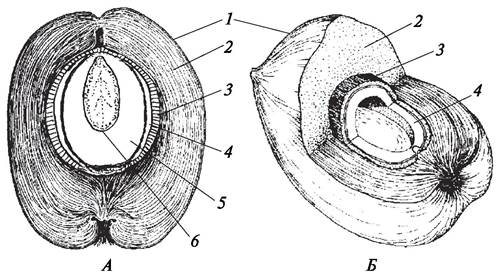
The exocarp (from Greek exo — outside) derives from the outer epidermis and consists of tightly packed Cells with thickened outer walls. For instance, in cherry or plum fruits, it forms a thin, glossy, or waxy outer layer that peels off easily; in citrus fruits, it forms a yellow or orange glandular layer (flavedo). Stomata are present in the exocarp of immature fruits, but become indistinct in ripe ones. Sometimes small lenticels develop within it, as is the case in apples.
The mesocarp (from Greek mesos — middle) develops from the mesophyll of the carpel. Much like leaf mesophyll, it consists of parenchyma containing vascular bundles. Typically, the mesocarp is more developed than the exocarp and endocarp. For example, in cherries and plums, the mesocarp forms the edible, fleshy pulp of the fruit, whereas in citrus fruits it forms the spongy, whitish layer (albedo) located directly beneath the flavedo. The mesocarp can also be dry and poorly developed (as in siliques and legumes).
The endocarp (from Greek endos — within) originates from the inner epidermis of the carpel and can be either single-layered or multi-layered. In cherries, plums, and other stone fruits, the endocarp is represented by sclerified tissue that forms the pit (stone) enclosing the seed. In citrus fruits, the endocarp is highly modified, forming the juicy main edible part of the fruit. The relative thickness of the pericarp layers varies among species; it is characteristic of each individual species and is likely related to specific adaptations for seed dispersal.
9.2.1. Principles of Fruit Classification
Fruits exhibit remarkable morphological diversity in terms of size, shape, color, pericarp consistency, dehiscence mechanisms, and the presence of various outgrowths or appendages. Structural Features of fruits are most often associated with seed dispersal (dissemination). This diversity serves as the basis for the simplest and most widely used practical morphological classification of fruits. It accounts not only for external features but also for certain internal and Anatomical Characteristics, such as the number of carpels forming the pistil, the number of locules in the ovary, the number of seeds, the mode of fruit dehiscence, and several other traits.
Fruit formation may involve a single pistil or a group (multiple) of pistils belonging to an apocarpous polycarpellary gynoecium.
Accordingly, fruits are categorized as simple, aggregate (complex), schizocarpic, or lomentaceous. A special type of structure is represented by multiple-fruit clusters (infructescences).
A simple fruit develops from a single pistil formed by either an apocarpous unicarpellary gynoecium (such as cherry or pea) or a syncarpous gynoecium (such as poppy, tulip, corn cockle, or wheat).
An aggregate fruit forms from a flower with an apocarpous polycarpellary gynoecium, in which each individual pistil develops into a separate little fruitlet (such as marsh marigold, avens, anemone, raspberry, blackberry, or magnolia). The individual
fruitlets making up an aggregate fruit can vary in type: nutlets, drupelets, or follicles. Depending on this, aggregate fruits are referred to as etaerios of nutlets (strawberry, anemone), etaerios of drupes (raspberry), or etaerios of follicles (magnolia, marsh marigold).
A schizocarpic fruit develops from a multilocular ovary of a syncarpous gynoecium when each ovary locule develops into an independent fruitlet (mallow) that separates from adjacent ones along a longitudinal split. The individual segments of schizocarpic fruits are termed mericarps. Mallow fruits that break apart into open mericarps are known as cheese-cakes; the schizocarpic fruits of Boraginaceae and Lamiaceae are known as cenobia (consisting of four nutlet-like lobes).
Lomentaceous fruits develop from an apocarpous or paracarpous gynoecium and break apart along transverse constrictions into individual one-seeded (crownvetch, serradella) or two-seeded (wild radish) segments.
An infructescence forms from an entire inflorescence when the Ovaries of individual flowers do not develop into separate, isolated fruits, but instead fuse together into a single composite structure (pineapple, fig, mulberry, beet, spinach, etc.).
The most widespread and practically useful morphological classification of fruits is based on the consistency of the pericarp.
Depending on pericarp consistency, fruits are divided into dry and fleshy. They may contain a single seed, as in cherry plum, nasturtium, or hazel, or be multi-seeded, as in jimsonweed, carnation, bellflower, petunia, and other plants.
Dry and fleshy one-seeded fruits are indehiscent; the seeds are released only as a result of pericarp decay, which typically occurs during seed germination. Dry multi-seeded fruits, as a rule, possess mechanisms for dehiscence and seed release, opening either upon maturation or shortly thereafter.
Dehiscent multi-seeded dry fruits are classified According to the number of carpels and ovary locules that form them, THE POSITION OF the ovary within the flower, and the type of gynoecium. These include the follicle, legume, silique (and silicle), and capsule.
The follicle is the simplest fruit type, formed by a single carpel. It is unilocular and dehisces along the line of fusion of the carpel margins (the ventral suture). When open, the fruit resembles a flat leaf. Follicles can be solitary (as in larkspur) or aggregate, forming a polifollicle (peony, globe flower, marsh marigold, columbine, magnolia) (Fig. 210).
Fig. 210. Follicles: 1—aggregate follicle of the globeflower (Trollius europaeus); 2—aggregate follicle of the grass-rush (Butomus umbellatus); 3—follicle of the larkspur (Consolida regalis)

The legume (pod) is a unilocular fruit formed by a single carpel; it dehisces along two Valves—at the line of fusion of the carpel margins (the ventral suture) and along the midrib (the dorsal suture). The seeds (sometimes a single seed, as in clover or sainfoin) are attached along the ventral suture. In a typical
legume, dehiscence is accompanied by the sudden twisting of the valves and the dispersal of seeds. Legumes vary greatly in appearance: straight (pea, bean, caragana, gleditsia), spirally twisted (alfalfa), bladder-like (bladder-pod milkvetch), and jointed (lathyrus vetch, peanut, crown vetch). Legumes also differ in seed count, ranging from one to several. The pericarp of legumes can be either dry or fleshy. For instance, in the Japanese pagoda tree (Styphnolobium japonicum), the legume features a fleshy pericarp that does not dehisce, but instead dries up upon maturation and breaks apart into segments. Legumes vary dramatically in size, reaching up to 1.5 m in the tropical plant Entada (Entada pursaetha) or measuring no more than 2–3 mm in clovers. The legume is characteristic of plants from the families Fabaceae, Mimosaceae, and Cesalpiniaceae (Fig. 211).
Fig. 211. Various legume fruit forms in members of the Fabaceae family: A—dehiscent spirally twisted legumes (1—alfalfa — Medicago sativa; 2—black medick — Medicago minima); B—indehiscent one-seeded legumes (1—tall sweet clover — Melilotus altissima; 2—sainfoin — Onobrychis arenaria); C—dehiscent linear legume of the garden pea — Pisum sativum; D—jointed legumes with one-seeded segments (1—crown vetch — Coronilla varia; 2—hedysarum — Hedysarum sp.)

The silique and silicle are fruits developing from a superior ovary of a syncarpous (paracarpous) gynoecium composed of two carpels. They dehisce longitudinally along two sutures from bottom to top. A false septum, formed by the Placenta, divides the fruit into two locules. Seeds are attached along its margin in one or two rows. Such fruits are characteristic of the Brassicaceae family (cabbage, turnip, stock, etc.). Siliques and silicles differ in The ratio of the fruit's length to its width. If the length exceeds the width by 3–4 times or more, the fruit is called a silique (rapeseed, mustard); if the length is only slightly greater than or equal to the width, it is a silicle (pennycress, shepherd's purse, honesty). In the common weed wild radish, the silique is jointed: it does not dehisce by valves, but breaks apart into segments along constrictions (Figs. 212, 213).
Fig. 212. Structure of siliques in members of the Brassicaceae family: A—silique with a narrow beak (Indian mustard — Brassica juncea); B—silique with a sword-shaped beak (white mustard — Sinapis alba); C—jointed silique (wild radish — Raphanus raphanistrum); D—indehiscent silique (cultivated radish — Raphanus sativus)

Fig. 213. Various Forms of silicles in members of the Brassicaceae family: A—marsh yellowcress (Rorippa palustris); B—ballhead nenesed (Neslia paniculata); C—hoary cress (Cardaria draba); D—gold-of-pleasure (Camelina sativa); E—hoary alyssum (Berteroa incana); F—common shepherd's purse (Capsella bursa-pastoris); G—bitter candytuft (Iberis amara); H—field pennycress (Thlaspi arvense)

Capsules are a group of fruits encompassing all varieties of dehiscent fruits that do not fit into the previous three groups. A capsule can be unilocular or multilocular, which usually depends on the number of locules in the ovary, though sometimes this feature is unrelated. Methods of capsule dehiscence vary widely. They may open via apical Teeth (corn cockle, carnation, sticky catchfly, primrose), pores (poppy), a operculum/lid (plantain, henbane), or valves. Capsule valves may separate along the lines of carpel margin fusion—the ventral suture (violet, St. John's wort, large-flowered foxglove), or along the midribs of the carpels—the dorsal suture (lily, iris, tulip). In some cases, the septa remain joined together in the center while the valves pull away from them (datura). Sometimes, fruits that deviate from typical capsules and resemble other fruit types are given special names. For instance, in greater celandine, the long, narrow capsule resembling a silique that dehisces by two valves is called a siliquiform capsule. Follicle-like capsules that open along a single suture (like follicle fruits) are formed by members of the Asclepiadaceae family (swallow-wort, milkweed) (Fig. 214).
Fig. 214. Structure of capsules: A—corn poppy (Papaver rhoeas); B—black henbane (Hyoscyamus niger); C—jimson weed (Datura stramonium); D—common milkweed (Asclepias syriaca); E—horned poppy (Glaucium corniculatum)

Indehiscent one-seeded dry fruits differ from one another in traits such as the thickness and density of the pericarp, and the presence or absence of appendages on the pericarp. Dry indehiscent fruits include the nut (nutlet), achene, caryopsis, samara, and grain (Fig. 215).
Fig. 215. Dry indehiscent fruits: A—nut (common hazel — Corylus avellana); B—nutlet (curled dock — Rumex crispus); C—grain/caryopsis (common wheat — Triticum aestivum); D—achene (English oak — Quercus robur); E—samara (white elm — Ulmus laevis); F—schizocarpic samara/double samara (Norway maple — Acer platanoides); G—aggregate nutlet on an enlarged fleshy receptacle (wild strawberry — Fragaria vesca); H—nutlet and aggregate nutlet (meadow buttercup — Ranunculus acris)

The nut and nutlet are fruits featuring a hard, woody pericarp enclosing a single, free seed within. The nut and nutlet differ from each other only in size. Fruits of this type are found in the buttercup family (Ranunculaceae) and buckwheat family (Polygonaceae). The numerous nutlets of the strawberry sit on an enlarged, fleshy receptacle, forming a specialized aggregate fruit known as an etaerio of achenes or a strawberry fruit. A specialized aggregate nutlet—the cynarhodium—is formed in rose hips (Rosa). In this fruit, individual nutlets are enclosed within a urn-shaped, fleshy hypanthium.
In some plants (such as hazel), the nut is enclosed in a specialized structure called an involucre (or husk), which develops from enlarged bracts.
The acorn is structurally similar to the nut. It has a leathery or woody pericarp. At its base, the acorn is surrounded by a cupule, which, unlike the hazel involucre, is formed by fused sterile branches of a cymose inflorescence (found in oaks — Quercus, beeches — Fagus, and chestnuts — Castanea). In beech and chestnut, 2–3 acorns develop within a single cupule. The cupule of the chestnut is covered with long outgrowths (emergences).
The achene is a relatively small fruit with a leathery pericarp that is softer than that of a nut or acorn and easily separates from the seed. The achene develops from two carpels, yet Functions as a unilocular fruit containing a single seed. This fruit type is widespread in the Asteraceae (sunflower — Helianthus annuus, cornflower — Centaurea cyanus, beggarticks — Bidens tripartida), Valerianaceae, and Urticaceae families. In many Asteraceae, the achene bears a pappus, while others feature hooks. The schizocarpic mericarp (splitting into two parts) of the Apiaceae is also called a cremocarp, as it consists of two mericarps that separate upon maturation while remaining suspended from the vascular strands of the carpophore.
Samaras are fruits similar to achenes and nutlets, equipped with wing-like outgrowths of the pericarp. They occur predominantly in woody and shrubby plants, such as elm, ash, alder, and birch, and among herbaceous plants, in rhubarb. Maples are characterized by a schizocarpic samara (double samara).
The caryopsis is formed by the fusion of the seed coat with a thin pericarp. The caryopsis develops from two carpels of a superior ovary with a paracarpous gynoecium. It is characteristic of grasses (wheat, rye, barley, oats, corn, etc.). Caryopses can be naked (rye, wheat) or covered in hulls (barley, oats). The hulls represent floral bracts (glumes and lemmas/paleas) that persist on the fruits and enlarge after flowering.
Fleshy fruits are characterized by a more or less succulent, fleshy pericarp that surrounds one or many seeds (Fig. 216). Fleshy fruits develop from one or several carpels. The fleshy portion of these fruits is typically represented by the mesocarp, which consists of thin-walled cells with large vacuoles. Fleshy fruits are often brightly colored due to the presence of the anthocyanin pigment in The Cell sap (cherry, plum, black nightshade) or the formation of chromoplasts (rowan, rose hip, tomato). They occur in species across A wide variety of families. Fleshy fruits include the berry, the aggregate group of berry-like fruits (pepo, hesperidium, pome), and the drupe.
Fig. 216. Diversity and structure of fleshy fruits: 1—apple (domestic apple - Malus domestica); 2—hesperidium (sweet orange - Citrus sinensis); 3—fleshy drupe (common plum - Prunus domestica); 4—balausta (pomegranate - Punica granatum); 5—pepo (bottle gourd - Lagenaria siceraria); 6—hip or cynarodium (dog rose - Rosa canina); 7—aggregate drupe (raspberry - Rubus idaeus); 8—fleshy aggregate follicle (schisandra - Schizandra chinensis); berry: 9—blackcurrant (Ribes nigrum);
10—spreading gooseberry (Grossularia reclinata); 11—banana (Musa sp.)

A berry is a multi-seeded fruit with a fleshy pericarp covered by a thin Skin. Berries in various plants (blueberry, cranberry, grape, gooseberry, currant, tomato, eggplant, persimmon, banana) have different structures. In some plants, such as gooseberries and currants, the fleshy part of the fruit is formed not by the pericarp, but by the juicy seed coats.
The fruit STRUCTURE OF THE pomegranate is rather unique: the pericarp forms a leathery outer layer and membranous septa that develop from the ovary, while the juicy part
is the seed coat originating from the integuments. This specific type of fruit is called a balausta.
A pepo is a specialized type of berry that develops from an inferior ovary. It is characterized by strongly developed vascular bundles in the pericarp and a hard, often woody exocarp. Pepos are typical of the Cucurbitaceae family (pumpkin, cucumber, melon, watermelon, luffa, etc.).
A pome develops from an inferior ovary. Only the absolute core of the fruit is formed from the ovary walls. The endocarp becomes relatively rigid and leathery, enclosing the chambers with freely lying seeds. The fleshy edible part is also formed by the expanded bases of the stamens, sepals, petals, and the receptacle. The pome is characteristic of apple, pear, and quince.
A hesperidium is a multilocular, multi-seeded fleshy fruit with a thick, leathery, colored exocarp rich in Essential Oils. The mesocarp is white, dry, and fibrous. The juicy part of the fruit (endocarp) is formed by expanded hairs originating from the inner epidermis of the ovary, which transform into juice vesicles. The hesperidium is typical of citrus fruits (lemon, tangerine, orange).
A drupe is a single-seeded fruit developing from a single carpel. It is characterized by a clear Differentiation of the pericarp into three distinct layers: a thin leathery exocarp, a fleshy, juicy mesocarp, and a woody endocarp that forms the pit (stone). It occurs predominantly in Rosaceae (apricot, cherry, blackthorn). Almonds and coconuts produce a dry drupe, in which the mesocarp of the mature fruit becomes fibrous and dry.
Alongside this practical morphological classification of fruits, morphogenetic classifications exist that reflect the evolutionary development of this plant organ. The morphogenetic classification primarily addresses the theoretical goals of evolutionary Morphology, specifically carpology (The Study of fruits), and can be applied in phylogenetic systematics.
Modern morphogenetic classifications are based mainly on the type of gynoecium from which the fruit develops: apocarpous, syncarpous, lysicarpous, or paracarpous, as well as the position of the ovary within the flower—superior or inferior. The number of locules in the ovary is also taken into account. Apocarpous fruits are considered the most primitive, while among coenocarpous fruits, syncarpous ones are the most basic.
Taking this classification approach into account, all morphological fruit types can also be grouped from a morphogenetic perspective. Thus, capsules may be: a) superior syncarpous: lily, onion, tobacco, jimsonweed, henbane, snapdragon; b) inferior syncarpous: iris, gladiolus; c) inferior paracarpous: orchid, lesser butterfly-orchid; d) superior lysicarpous: corn cockle, stitchwort, loosestrife, primrose. Berries: a) superior syncarpous: grape, tomato, potato, lily of the valley, asparagus, Solomon's seal; b) inferior syncarpous: cranberry, lingonberry, blueberry; c) superior paracarpous: capers, papaya; d) inferior paracarpous: currant, gooseberry; e) superior lysicarpous: bladder campion. The pome belongs to inferior syncarpous fruits, and the pepo to inferior paracarpous ones. Follicles and legumes are always superior apocarps, as they develop from the superior ovary of an apocarpous gynoecium. Overall, it should be noted that identical morphological fruit types can develop from Different types of gynoecium. This indicates convergent evolution associated with seed dispersal mechanisms.
Last update: 07/08/2026
Editorial and Educational Adaptation: This material has been compiled based on the primary/original source text. The project team performed an editorial review, corrected technical inaccuracies, structured sections, and adapted the content for an educational format.
What was processed:
- elimination of formatting defects (OCR errors, structural breaks, corrupted characters);
- editorial organization of content;
- standardization of terminology in accordance with academic sources;
- verification of factual statements against the original source text.
All mentions of the author, publication year, and origin of the primary text have been preserved in accordance with the source.