PLANT MORPHOLOGY - T. A. Sautkina - 2012
CHAPTER 8. POLLINATION AND FERTILIZATION IN ANGIOSPERMS. EMBRYO AND ENDOSPERM DEVELOPMENT
8.3. The Concept of Apomixis
The term "apomixis" was introduced in 1906 by G. Winkler to designate what was initially believed to be reproduction occurring with the participation of seeds, yet independent of the fusion of male and female Gametes (the Fertilization process).
As subsequent embryological studies have shown, apomixis cannot be viewed as a process associated with fertilization anomalies (M. P. Solntseva, 1991). In this mode of seed reproduction, the fusion of a sperm Cell with polar nuclei (or the central Cell Nucleus) invariably occurs; furthermore, in some instances of apomictic seed formation, the sperm penetrates the egg cell, although fusion with its nucleus is not observed. Consequently, apomixis should not be termed asexual-seed reproduction (a term introduced by S. S. Khokhlova in 1946), as is done in A number of works. According to modern terminology, apomixis is a special type of seed reproduction characterized by various deviations from typically proceeding macrosporogenesis, the sexual process, or both.
The phenomenon of apomixis has long attracted the attention of various researchers attempting to elucidate its evolutionary origins and establish its Classification. Despite the fact that a number of classifications of apomixis types have been proposed to date, practically none of them is universally accepted.
Current views hold that apomixis may be permanent (hereditary) or sporadic (non-hereditary); depending on the features of macrosporogenesis, it can be unreduced (diploid) or reduced (haploid). The terms "unreduced" and "reduced" apomixis designate categories of apomixis and are used traditionally.
In the modern classification of apomixis proposed by M. P. Solntseva (1991), The concepts of "apomixis type" and "apomixis form" are also introduced. The classification of apomixis types is based on The Nature of aberrations in the sexual process. M. P. Solntseva distinguishes six types of apomixis: hemigamy, androgenesis, pseudogamy, parthenogenesis, apogamety, and adventive embryony.
Hemigamy is a type of apomixis in which the nuclei of the sperm and the egg cell fail to fuse. Located within the Cytoplasm of the egg cell, the sperm nucleus cannot merge with the egg nucleus, yet it remains viable, stimulates the division of the egg nucleus, and divides itself as well. As a result, there is formed
an embryo in which some Cells are of maternal origin and others of paternal origin, leading to The Development of a chimeric embryo. Thus, in hemigamy, the disruption of the sexual process occurs at the very final stage—the stage of fertilization. Hemigamy was first described in cutleaf coneflower (Rudbeckia laciniata) by E. Battaglia in 1946.
Androgenesis is a type of apomixis in which the embryo develops from an egg cell whose own nucleus is eliminated and replaced by the sperm nucleus. Therefore, the Cells of the embryo possess paternally derived nuclei, and the plants developing from such zygotes exhibit traits of the paternal species (androgynous progeny). Androgenesis has not been detected by plant embryologists, but it is well substantiated by geneticists. It has been described in smooth hawksbeard (Crepis tectorum) and cultivated tobacco (Nicotiana tabacum).
Pseudogamy is a type of apomixis in which the sperm penetrates the cytoplasm of the egg cell but is unable to advance further and degenerates. Meanwhile, it somehow stimulates the Development of the egg cell, resulting in The formation of individuals with maternal inheritance (matroclinous progeny).
In parthenogenesis, the embryo develops either prior to pollination (often referred to as "fertilization-free"), whereby the developing daughter organisms invariably exhibit maternal inheritance (gynogenesis), or following pollination, in which case the sperm penetrates the egg cell but does not fuse with it, instead taking its place as the egg cell degenerates (androgenesis). Reduced parthenogenesis—whereby haploid maternal-type plants are formed—was first induced in jimsonweed (Datura stramonium) by exposing the plant to low temperatures. Unreduced parthenogenesis is characteristic of cinquefoils, bluegrasses, and a number of other plants. Androgenesis has been noted in certain species of tobacco, pepper, and hawksbeard.
Apogamety is a type of apomixis in which the embryo develops not from a zygote, but from synergids (synergid apogamety) or antipodals (antipodal apogamety). Synergid apogamety is characteristic of many orchids and occurs much more frequently than antipodal apogamety, which has been discovered in certain species of hawkweeds. Embryos originating from synergids or antipodals are smaller in size than those formed from a zygote.
Adventive embryony is a type of apomixis in which embryo development initiates in the Tissues of the nucellus or integuments and subsequently invades a typical embryo sac, where its further development takes place. Adventive embryony has been described in more than 200 species belonging to 47 families at various stages of phylogenetic development (M. P. Solntseva, 1991).
Thus, the type of apomixis is determined by embryological features.
The form of apomixis is governed by the varying course of Meiosis, which essentially determines the nature of macrosporogenesis (megasporogenesis). The following forms of apomixis are distinguished: euspory, hemieuspory, aneuspory, and apospory.
Under the eusporic form of apomixis, macrosporogenesis proceeds typically, without meiotic irregularities, and apomixis is realized at the haploid level. Anomalies leading to the appearance of diploid elements in the embryo sac may arise during the Formation of the female gametophyte.
Under the hemieusporic form of apomixis, The First stage of meiosis (meiosis I) proceeds correctly, whereas the Second Stage (meiosis II) is omitted. Chromosome reduplication occurs during the prolonged interphase of meiosis I.
The aneusporic form of apomixis is observed in cases of various meiotic irregularities, resulting in the restoration of the diploid chromosome number.
Apomixis may develop against the Background of apospory, in which the embryo sac develops not from a macrospore, but from the cells of the integuments or nucellus.
According to M. P. Solntseva's proposal, the classification of apomixis should take both factors into account—both the form and the type of apomixis (e.g., eusporic parthenogenesis; hemieusporic apogamety, etc.). Under eusporic forms of apomixis, parthenogenesis alone occurs without pollination, whereas all Other types of apomixis are preceded by pollination. Under hemieuspory, aneuspory, and apospory, such types of apomixis as hemigamy, androgenesis, and pseudogamy invariably arise against the background of pollination. Parthenogenesis and apogamety under these forms of apomixis may develop either in the presence of pollination or in its absence.
Apomixis is widespread in nature and is utilized in plant breeding and seed production (D. F. Petrov, 1988). Apomicts predominantly inhabit regions with harsh environmental conditions as a rule. Plants with an apomictic mode of embryo development possess a number of highly valuable traits. They are resistant to adverse conditions, characterized by intensive seed and Vegetative Reproduction, and exhibit robust growth. As a specific mode of seed embryo formation, apomixis has an adaptive character and is not predetermined by the Evolution of the life cycle.
8.4. Initial Stages of Endosperm and Embryo Formation
As indicated earlier, following the fertilization process, the zygote and the primary endosperm nucleus enter a dormant state, after which their development begins.
The primary endosperm cell nucleus (or primary nucleus) is the first to begin dividing (Fig. 198). The initial mitotic division yields two nuclei: one shifts toward the micropylar pole and settles near the zygote, while the other migrates to the chalazal region. Subsequently, endosperm nuclear divisions in the micropylar and chalazal Zones of the embryo sac proceed asynchronously. Division is much more active in the micropylar zone, whereas the rate slows down in the chalazal zone. This difference affects nuclear size, making the nuclei in the chalazal zone larger than those in the micropylar zone. Furthermore, in some plants, particularly legumes, nuclear division in these two zones may follow different patterns. Near the zygote, nuclei divide exclusively by mitosis. In the chalazal zone, mitotic division is frequently accompanied by amitotic division. Amitosis is a highly specialized type of division that does not disrupt the functionally active state of The Nucleus. This is of great biological significance, as it is precisely through the chalazal part of the ovule that nutrients enter the embryo sac, where they actively accumulate within the endosperm.
Class="center">Fig. 198. The first stage of endosperm development in legumes: mitotic division of the primary endosperm nucleus: 1—nucellar cells; 2—nucleolus of the central Nucleus of the embryo sac; 3—primary endosperm nucleus; 4—embryo sac cavity; 5—cytoplasmic strands within the embryo sac cavity

Depending on whether or not cytokinesis occurs during the Cytology/cytology/16.html">Early stages of endosperm formation, Three types of endosperm are distinguished: nuclear, cellular, and helobial (intermediate) (Fig. 199).
Fig. 199. Types of endosperm: A—nuclear (mountain parsley — Peucedanum oreoselinum); B—helobial (floating pondweed — Potamogeton natans); C—cellular (bog bean — Menyanthes trifoliata): 1—endosperm nuclei in the cytoplasm of the embryo sac; 2—micropylar chamber of the embryo sac with nuclear endosperm; 3—chalazal chamber containing a single endosperm cell; 4—endosperm cells within the embryo sac cavity; 5—developing proembryo; 6—nucellar cells

In the nuclear type of endosperm development, nuclear division is not accompanied by the formation of cell walls for an extended period, and the nuclei float freely within cytoplasmic strands. This type of endosperm is characteristic of many members of the class Dicotyledones. Subsequently, the nuclear endosperm either degenerates and is absent in mature seeds, as in legumes, or becomes cellular, adopting the typical Structure of storage tissue.
During the formation of cellular endosperm, every mitotic nuclear division is immediately followed by cytokinesis. This is how the endosperm of cereals develops.
The helobial type of endosperm development has been identified in monocots belonging to the families Alismataceae, Butomaceae, and Hydrocharitaceae, which were previously grouped under the order Helobiales (an order now abolished). Following the First Division of the endosperm nucleus in helobial development, a Cell wall forms, dividing the embryo sac into two unequal chambers: a small chalazal chamber and a large micropylar chamber. In the chalazal chamber, nuclear division either ceases entirely or undergoes only a few rounds before the nuclei degenerate. In the micropylar chamber, the nuclei divide mitotically with each division accompanied by cytokinesis, and subsequent endosperm development proceeds via the cellular pathway.
Gradually, as development progresses, storage nutrients (starch, Proteins, and fats) accumulate within the endosperm cells while Water content decreases, turning it into a physiologically dead tissue.
The first division of the zygote nucleus begins only after at least four endosperm nuclei have formed in the embryo sac. The zygote nucleus divides mitotically, with each nuclear division accompanied by the formation of cell walls. As a result of these divisions, the number of cells derived from the zygote increases, forming a two-celled (Fig. 200) and subsequently a four-celled proembryo (Fig. 201).
Fig. 200. Mitotic division of the zygote nucleus and formation of the two-celled proembryo: 1—basal cell; 2—terminal cell
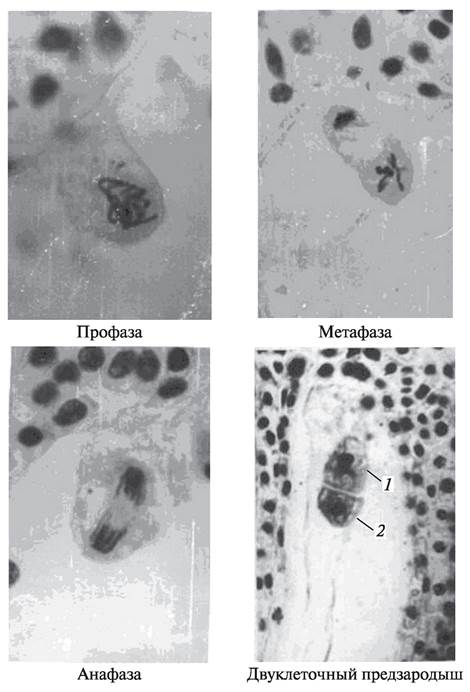
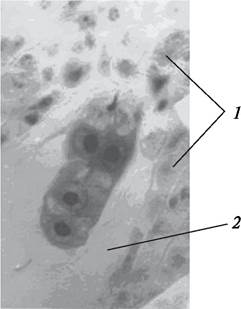
Fig. 201. Four-celled proembryo of the broad bean (Vicia faba) within the embryo sac cavity: 1—nucellar cells; 2—embryo sac cavity
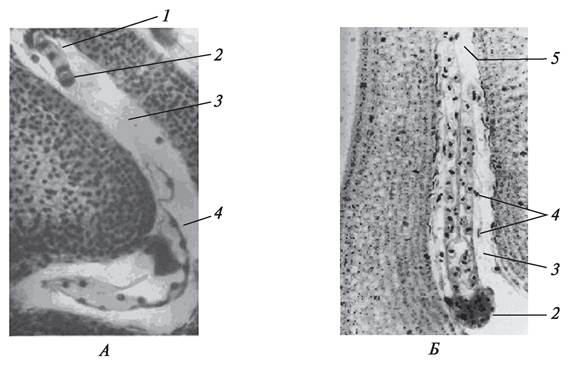
However, differentiation into vegetative Organs does not occur until a suspensor is formed and a spherical mass of cells develops, which will ultimately give rise to the embryo proper. The suspensor exhibits varied structures, a feature particularly well-studied in legumes (Fig. 202).
Fig. 202. Developing embryo and nuclear endosperm of the broad bean (Vicia faba): A—developing proembryo and suspensor 48 hours after pollination; B—multicellular proembryo and fully formed suspensor 96 hours after pollination: 1—developing suspensor; 2—spherical proembryo;
3—embryo sac cavity; 4—nuclear endosperm; 5—fully formed suspensor consisting of four multinucleate cells
Following double fertilization, the ovule enlarges and gradually transforms into a seed. The pistil also undergoes substantial changes to form the fruit. Seeds and fruits represent the ultimate products of the complex reproductive processes taking place within the flower.
With the formation of the fruit, the flower exhausts its Functions as a reproductive organ and ceases to exist. Thus, the flower is a short-lived reproductive organ characteristic of angiosperms.
Last update: 07/08/2026
Editorial and Educational Adaptation: This material has been compiled based on the primary/original source text. The project team performed an editorial review, corrected technical inaccuracies, structured sections, and adapted the content for an educational format.
What was processed:
- elimination of formatting defects (OCR errors, structural breaks, corrupted characters);
- editorial organization of content;
- standardization of terminology in accordance with academic sources;
- verification of factual statements against the original source text.
All mentions of the author, publication year, and origin of the primary text have been preserved in accordance with the source.