Pharmacognosy with the Basics of Plant Biochemistry - Kovalyov V. M. 2004
Special Part
Alkaloids
Medicinal plants and raw materials containing indole alkaloids
PASSIFLORA HERB — HERBA PASSIFLORAE INCARNATAE
Purple passionflower — Passiflora incarnata L., fam. Passifloraceae
Purple passionflower (wild apricot, apricot vine); the generic name comes from the Latin passio, meaning "suffering," associated with the "Passion of Christ," and flos, meaning "flower"; the specific epithet incarnatus, -a translates here as "incarnate," denoting the flower embodying the suffering of Jesus Christ.
Plant Description. A perennial herbaceous liana that can reach up to 6 m in length under the humid subtropical conditions of the Caucasus. The rhizome is well-developed and horizontal; the stem is creeping and trails along the ground in the absence of support, leafy, and woody at the base. The leaves are simple, grayish underneath, and finely serrated along the margins. Tendrils develop in the leaf axils, allowing the plant to climb and cling to Supports. The flowers are highly distinctive, solitary, bisexual, large (about 5 cm or more in diameter), on long pedicels; the petals are elongated, pale lilac, with a two-tiered arrangement of abundant fringes. Above these lies a ring of stamens, followed by a ring of pistils. The fruit is edible, juicy, berry-like, turning orange upon ripening, containing three chambers filled with black seeds.
Distribution. The native habitat of passionflower is North America. It is widely cultivated.
Harvesting. The herb is harvested throughout the growing season: during the budding, flowering, and early fruiting stages.
Chemical composition of the Raw Material. Passionflower herb contains up to 0.05% total Alkaloids, with harmine, harman, and harmol being the principal constituents.
In addition to alkaloids, the herb contains pectic substances, Phenolic Compounds (Flavonoids, Coumarins, Quinones), and ascorbic acid.
Class="center">
Biological Activity and Application. Passionflower preparations (liquid passionflower extract, Passit, Novo-Passit) are used as sedatives for neurasthenia, insomnia, chronic alcoholism, and menopausal disorders.
In homeopathy, the fresh herb is utilized as a hypnotic, mild antispasmodic, analgesic, and antirheumatic remedy.
RAUWOLFIA ROOTS — RADICES RAUWOLFIAE
Serpentine wood — Rauwólfia serpentina Benth., vomitwort — Rauwólfia vomitoria Afz., devil-pepper — Rauwólfia canescens L., fam. Apocynaceae
Serpentine wood, vomitwort, devil-pepper; the plant is named in honor of the botanist and physician L. Rauwolf. The Latin serpentinus, -a means "serpentine" or "snakelike," reflecting the traditional use of the plant in India as an antidote to venomous Snakebites.
Plant Description. A small evergreen subshrub. The roots are curved with purplish lateral rootlets. The surface is brown and longitudinally wrinkled. The fracture is light-colored and non-fibrous; the bark is narrow, and the wood occupies two-thirds of the cross-section. The leaves grow in whorls of 3–5, and are dense, glabrous, oblong-elliptic, and pointed. The flowers are arranged in umbel-like inflorescences. The corolla is white or pink, tubular, five-lobed, with overlapping lobes. The pedicels and sepals are bright red. The fruits are red, consisting of two semi-fused juicy drupes.
Distribution. Rauwolfia serpentina grows in India, Pakistan, Indochina, Thailand, Indonesia, Java, and Sri Lanka, and is cultivated in India. Rauwolfia canescens has a broad distribution spanning the tropical regions of South America, the Caribbean, India, and Australia. Rauwolfia vomitoria inhabits the tropical regions of Africa (Congo).
Chemical COMPOSITION OF THE Raw Material. Rauwolfia species contain approximately 100 indole alkaloids, yielding a total of 0.7–2.4%; R. serpentina contains 0.8–1.3%, and R. vomitoria contains over 1.5%. The ROOT bark contains ten times more alkaloids than the wood. The principal BIOLOGICALLY ACTIVE SUBSTANCES are reserpine, rescinnamine, ajmaline, and serpentine.
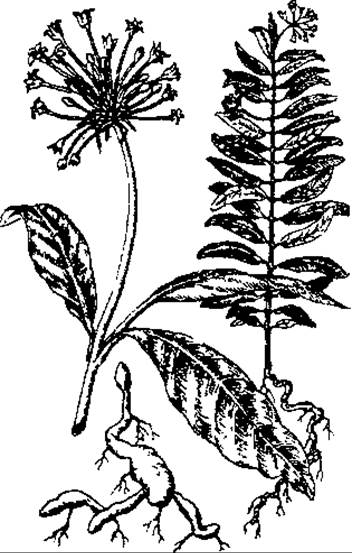
Biological Activity and Application. Raunatin, Rauvazan, reserpine, and combination drugs containing it (Adelphane, Crystepin, Brinerdin, etc.) are prescribed for Hypertension and psychoneuroses.
Rescinnamine and its preparations (Canescine, Recanescine) exhibit hypotensive effects similar to reserpine, but without the adverse side effects. Ajmaline demonstrates antiarrhythmic activity.
Abroad, the extraction of alkaloids is permitted from other Rauwolfia species: Rauvolfia micrantha, R. densiflora, R. peracensis (Mexico, Guatemala). In African countries, reserpine is obtained from Rauvolfia caffra, R. mombasiana, R. oreogiton, R. obscura, R. cumminsii, R. welwitschii, and R. rosea.
In homeopathy, the rhizome with roots is used as a hypotensive agent.
LESSER PERIWINKLE HERB — HERBA VINCAE MINORIS
Lesser periwinkle — Vіnса mіnor L., fam. Apocynaceae
Lesser periwinkle; the generic name comes from the Latin vincere, meaning "to conquer" (referring to its evergreen foliage), or from vincire, meaning "to bind," due to the flexible, twining stems of the plant; minor means "smaller."
Plant. A small, evergreen, polycarpic subshrub. Shoots are of two types: vegetative self-rooting, prostrate, and generative, flowering, erect, 20-40 cm long; leaves are petiolate, elliptic, entire, acute, narrowed at the base, coriaceous, glabrous, dense, wintering, 3-5 cm long and 1-3 cm wide.
Dark green and glossy above, paler below. Flowers are solitary, located in the leaf axils; the calyx is deeply five-cleft; the corolla is violet-blue, with a long tube that widens toward the top.

Fruit — an oblong-fusiform green follicle, 7-8 cm long. Seeds are small, brownish, oblong, tuberculate. It flowers from April to September.
Distribution. Found in the southern Regions of the European part of the CIS, in broad-leaved forests of Ukraine, the Baltic states, Belarus, Moldova, and Crimea.
Harvesting. Industrial harvesting of periwinkle herb for export is carried out from May to July. It is cut with sickles or scythes. Rooted shoots and plants should not be pulled out by the roots, as this leads to the destruction of thickets. Harvesting in the same Location should be performed no more than once every three years. The collected raw material is dried outdoors, in an attic, or in dryers at a Temperature of 40-50 °C.
Chemical composition of the raw material. The herb is rich in indole alkaloids. Minorine (vincamine) was the first to be identified, followed by isovincamine and other eburnane derivatives. Later, it was established that isovincamine is a mixture of vincamine, vincaminine, vincine, and vincinine. The PHYSICOCHEMICAL PROPERTIES OF these alkaloids are similar to those of reserpine. In addition, vincaminorin, its isomer vincaminoreinh, pervicine, and vincamidine have been isolated. Besides alkaloids, ursolic acid, the flavonoid robinin, and leucoanthocyanins have been found in the periwinkle herb.
Biological activity and application. Devincan, vincapan, and vincaton are used for hypertension and cerebral vascular spasms.
In homeopathy, the entire fresh plant collected at the beginning of flowering is used for exhaustively long uterine hemorrhages and weeping eczemas on the scalp.
MADAGASCAR PERIWINKLE LEAVES — FOLIA CATHARANTHI ROSEI
Madagascar periwinkle, rosy periwinkle — Catharаnthus róseus G. Don, syn. Vinca rósea L., fam. Apocynaceae — Apocynaceae
Madagascar periwinkle, rosy periwinkle; the name comes from catharos (pure) and anthos (flower); Latin roseus, -a — pink; vinca — the abbreviated Latin name of the plant vincaperivinca.
Plant. Under tropical conditions, it is a perennial, evergreen subshrub 30-60 cm high with a straight or creeping stem. It is cultivated as an annual crop. The stem is glabrous, with varying degrees of pubescence in some forms. Leaves are short-petiolate, oblong-elliptic, glossy, opposite, dark green above, sometimes pubescent below, with clearly visible venation, up to 8 cm long and up to 3.5 cm wide. Flowers are regular, clustered 2-4 at the SHOOT tips. The calyx is green, with five sepals, separate-leaved. There are five petals, white or pink. The fruit — a sickle-shaped, dark brown twin follicle up to 5 cm long.
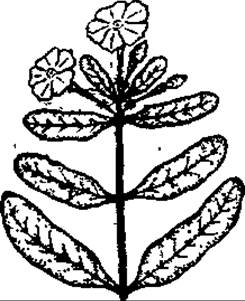
Distribution. The plant originates from Madagascar and is widespread in the tropics of both hemispheres. It is cultivated in Florida, Africa, and Australia. In the CIS, it is cultivated in the humid subtropics of Georgia (Adjara), Krasnodar Krai, and Kazakhstan.
Harvesting. The herb is mown during the period of mass flowering and the beginning of seed ripening at a height of 10-15 cm from the ground. Air-shade drying or artificial drying at a temperature of 40-50 °C is used. The dry herb is threshed to remove coarse stems.
Chemical composition of the raw material. Over 80 indole group alkaloids have been extracted from the Madagascar periwinkle herb, including 26 dimeric bases with an indole-indoline Structure. The main monomeric alkaloid is ajmalicine (raubasine, 0.1 %); in addition, serpentine, vindolinine, lochnerine, etc., have been isolated. High pharmacological activity is exhibited by four dimeric indole-indoline components: the alkaloids vinblastine (vincaleukoblastine, 0.005 %), vincristine (vincaleukocristine, 0.001 %), leurosine (vinleurosine), leurosidine (vincosidine), as well as vindesine, leukocristine, rowidine, and leurosivine. Among the monomeric bases, catharanthine and vindoline are the most valuable. Vinblastine was isolated in 1958, and vincristine was investigated later, in 1963.
The maximum amount of alkaloids is observed during the phase of mass flowering of the plant, while the maximum of the six main alkaloids occurs during the phase of mass fruiting. When cultivated in the Caucasus, vindoline and leurosine predominate in the herb. The alkaloid composition of the roots differs significantly from that of the aboveground part of the Madagascar periwinkle.
Biological activity and application. Madagascar periwinkle leaves are used to obtain the preparations rosevin, vinblastine, and vincristine (alkaloid sulfates), which exhibit antitumor activity. They are used in the complex therapy of leukemias and malignant neoplasms.
STRYCHNINE TREE SEEDS — SEMINA STRYCHNI (VOMIT NUT — NUX VOMICA)
Strychnine tree, vomit nut — Strychnos nux-vomica L., fam. Loganiaceae — Loganiaceae
Strychnine tree, St. Ignatius' bean; the name comes from the Greek strychnos — the name of a poisonous plant; Latin nux — nut, vomicus, -a — emetic.
Plant. A small deciduous tree with opposite oval leaves. Flowers are small, greenish, pentamerous, with a tubular corolla, gathered in semi-umbels in the leaf axils. The fruit is berry-like, globose, bright orange-red, large, resembling a citrus fruit. The rind is hard. The mesocarp is in the form of a colorless gelatinous pulp containing 26 seeds! The seeds are round, 0.7-1.5 cm in diameter, up to 7 mm thick, flat, hard, slightly convex on one side. In the center of the convex side, There is a hilum in the form of a small tubercle. The color is gray, yellowish-, or greenish-gray. Externally, the seeds are silky-glossy due to numerous hairs adhering to the surface. Odorless.
Distribution. Tropical forests of Ceylon, India, Burma, Australia; cultivated in the tropical regions of Asia and Africa.
Harvesting. The raw material is harvested during the fruiting phase. The plant is poisonous.
Chemical composition of the raw material. All PARTS OF THE plant contain alkaloids, with the highest concentration found in the seeds (1–2%). The principal alkaloids are strychnine and brucine. Other alkaloids account for up to 30% of the total alkaloid content. Reserve substances include starch and Proteins; chlorogenic acid, the iridoid derivative loganin, and loganin acid also accumulate.
Biological activity and application. Nux vomica tincture and dry extract are produced from imported raw Materials. They are used for the reflex stimulation of the Central Nervous system and as tonic agents.
In homeopathy, dried and pulverized seeds are utilized. The remedy acts on patients experiencing states of hyperexcitation. It is considered a regulator of the gastrointestinal tract and is prescribed for spastic conditions of the intestine and enteritis accompanied by painful tenesmus; it is also indicated for alcoholism, impotence, headaches accompanied by nausea, trigeminal neuralgia, optic atrophy, glaucoma, etc.

ERGOTAMINE (ERGOTOXINE) STRAIN ERGOT — CORNUA SECALIS CORNUTI STAM ERGOTAMINI (ERGO TOXINI)
Ergot (spurred rye) — Claviceps purpurea Tulasne, family Clavicepitaceae, class Ascomycetes.
Ergot, spurred rye; from the Latin clava — club and caput — HEAD; purpureus, -a, -um — purple, referring to the color of the sclerotia.
The plant. Ergot parasitizes many species of both cultivated and wild cereals, being especially common on rye; it also infects wheat (particularly durum wheat), barley, couch grass, and other grasses.
The developmental cycle comprises three successive stages: sclerotial, ascogenous (marsupial), and conidial. The sclerotia (ergot grains) serve as the Medicinal plant raw material (MPRM).
Procurement. Industrial production of ergot alkaloids can be carried out using three Methods: cultivation on living plants and extraction of alkaloids from sclerotia; Biosynthesis in saprophytic ergot culture; and partial or complete Chemical synthesis of the alkaloids.
The most cost-effective method is the cultivation of ergot on rye. To infect plants in the field, a suspension of fungal conidia—obtained from saprophytic cultures or from greenhouse-grown rye—is applied using specialized equipment.
The sclerotia are harvested either manually or mechanically.
Research on the tissue culture production of ergot alkaloids is underway in the CIS, the USA, Germany, Canada, Sweden, Japan, and other countries, focusing on directing biosynthesis toward The formation of biologically active peptide alkaloids.
The raw material consists of whole, elongated, slightly curved, trihedral sclerotia (grains) tapering at both ends, 3–4 cm in length, resembling cereal grains. Externally, the sclerotia are blackish-purple, matte, occasionally covered with a readily wipeable whitish bloom, almost always featuring longitudinal furrows. The fracture edge is white, yellowish-white, or pale purple with a narrow black-purple border; they have an unpleasant taste and a faint fungal odor.
Chemical composition of the raw material. Alkaloids are localized exclusively within the fungal sclerotia in amounts ranging from 0.01–0.2%. However, certain strains accumulate over 1% of alkaloids. There is a wide variation in the ratios of the main alkaloid groups, influenced by both the host plant species and the cultivation region.

Classical ergot alkaloids are derivatives of lysergic and isolysergic acids (ergoline alkaloids).
More than 20 alkaloids are known in the first group, 18 of which are diastereoisomers of nine compounds. In the total alkaloid content of the ergotamine strain, ergotamine accounts for approximately 70%, while in the ergotoxine strain, ergotoxine similarly comprises 70% of the total alkaloid sum.
In addition to lysergic acid derivatives, ergot contains clavine-group alkaloids. As a rule, these are present in significantly lower amounts and accumulate in ergot parasitizing wild grasses.
Other notable chemical compounds include simple amines (histamine, tyramine, acetylcholine), Amino Acids, imidazole alkaloids, fatty oil (30–35%), ergosterol (about 0.1%), and fungisterrol. Ergot also contains milk sugar and xanthone derivatives (ergochrysin, ergoflavin, secalonic acids A and B). The purple coloration of the sclerotia results from a combination of anthocyanin pigments, known as ergochromes, with yellow pigments.
Biological activity and application. Liquid and thick ergot extracts, ergotal (a mixture of ergotoxine strain alkaloid phosphates), methylergometrine maleate, and ergotamine hydrotartrate are used in monotherapy and as components of combined medicinal products. They are employed in obstetrics and gynecology as uterotonic agents (predominantly ergometrine derivatives). Additionally, ergotamine is used as an adrenolytic agent in neurology.
Semi-synthetic derivatives exhibit low toxicity and enhanced adrenolytic activity. They are prescribed for vascular spasms and hypertension (dihydroergotamine and dihydroergotoxine).
Ergotryptine is utilized in The production of the semi-synthetic drug Parlodel (bromocriptine), which inhibits prolactin secretion and is used in the Treatment of breast tumors.
In homeopathy, dried sclerotia are used for central and peripheral Circulatory Disorders, paresthesia, severe arterial Circulation disorders, cerebral atherosclerosis, cataracts, thromboangiitis obliterans (Buerger's disease), and gangrene.
Last update: 06/08/2026
Editorial and Educational Adaptation: This material has been compiled based on the primary/original source text. The project team performed an editorial review, corrected technical inaccuracies, structured sections, and adapted the content for an educational format.
What was processed:
- elimination of formatting defects (OCR errors, structural breaks, corrupted characters);
- editorial organization of content;
- standardization of terminology in accordance with academic sources;
- verification of factual statements against the original source text.
All mentions of the author, publication year, and origin of the primary text have been preserved in accordance with the source.