Pharmacognosy with the Basics of Plant Biochemistry - Kovalyov V. M. 2004
Special Part
Alkaloids
Indole Alkaloids (Tryptophan Group)
Indole Alkaloids contain an indole Nucleus or its derivatives—dihydroindole, hydroxyindole, pseudoindole, and N-acylindole—in their molecular Structure. They are widely distributed in the plant kingdom, comprising over 1,400 representatives across 40 families. Plants from the Apocynaceae family are particularly rich in these compounds (containing about 600 substances), followed by Rubiaceae and Loganiaceae.
Biogenetically, indole alkaloids are derived from Tryptophan, which in The First stage of Biosynthesis undergoes decarboxylation to form tryptamine. Further on, various types of Condensation reactions are possible between tryptamine (or its N-methyl derivative) and diverse metabolites. This process is typically accompanied by cyclization yielding a six- or five-membered N-heterocycle, and frequently other cyclic structures as well. For instance, the condensation of tryptamine with activated acetate produces harman-type indole alkaloids.
Tryptophan gives rise to indole alkaloids sometimes without prior decarboxylation. For example, The biosynthesis of ergot alkaloids (claviceps alkaloids) begins with the condensation of tryptophan with an "activated isoprene"—isopentenyl diphosphate. Subsequently, through a series of complex reactions, these two components form polycyclic compounds containing two N-heterocycles: lysergic and isolysergic acids (stereoisomers), which serve as precursors for all ergot alkaloids.
Under the action of the enzyme strictosidine synthase, tryptophan condenses with the secoiridoid secologanin to yield strictosidine, which serves as a common precursor for numerous iridoid indole alkaloids of diverse structures.
Two main classes of indole alkaloids are distinguished. The first, relatively small Class includes alkaloids featuring single indole moieties. They are grouped into the so-called "harman type" (β-carboline). However, the more complex The structure of such substances, the less frequently they occur in nature. For example, harman has been isolated from plants of 19 families, koenigine is found exclusively in the Rutaceae family, and nitrarine is restricted to the genus Nitraria (Zygophyllaceae).
The second class comprises over 1,200 alkaloids and is characterized by the presence of two structural units: an indole unit and a monoterpene unit derived, as mentioned above, from secologanin. Within this class of alkaloids, several major structural types can be identified: yohimbane (yohimbine, ajmalicine, serpentine, corynantheine), reserpine (reserpine, deserpidine, rescinnamine), aspidospermatane (vindoline, dichotine), and strychnane (strychnine, brucine, α- and β-colubrine, vomicine). Alkaloids featuring a rearranged secologanin moiety are classified into the eburnane type (alkaloids of Vinca minor) and the ibogaine type (catharanthine, ajmaline, ellipticine). A separate group is constituted by bimolecular alkaloids possessing two indole or two dihydroindole nuclei (C-dihydrotoxiferine), or mixed ones containing two different nuclei (such as an indole and a dihydroindole nucleus, or a pseudoindole and a dihydroindole nucleus—vincaticine, catharine, vinblastine, vincristine, etc.).
Certain indole alkaloids are widely used in medicine as tranquilizers (reserpine), Central Nervous system stimulants (strychnine), uterotonics (brevicoline), antiarrhythmic agents (ajmaline), and hypotensive drugs (vincamine), as well as preparations that lower intraocular pressure (physostigmine). Many alkaloids in this group are toxic (brucine, C-toxiferine, etc.).
Harman type (β-carboline). Norharman, or β-carboline, serves as the parent base for alkaloids of this type.
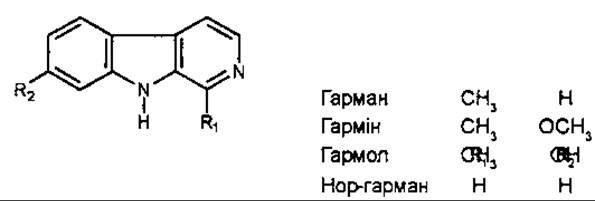
Harman, harmine, and harmol are indole alkaloids found in the genus Passiflora (Passifloraceae). Harman is a very widespread compound, though it accumulates in plants in small quantities. Besides Passiflora, harmine accumulates in Peganum harmala (Zygophyllaceae) and within the Elaeagnaceae family. It exhibits hallucinogenic properties. Harmaline, a dehydration product of harmine, is a potent monoamine oxidase (MAO) inhibitor.
Yohimbane type (Corynanthe). These structurally complex alkaloids are distributed across the Apocynaceae, Loganiaceae, Rubiaceae, and Euphorbiaceae families. Their chemical framework is based on the yohimbane Skeleton with various substituents at C-16, as well as at carbon atoms 10, 11, 17, and 18. The presence of three asymmetric carbon atoms allows for the existence of multiple optical isomers.
Yohimbine is the principal alkaloid of the bark of Pausinystalia yohimbe (syn. Corynanthe yohimbe, Rubiaceae) and can exist in the form of 32 optical isomers.
Yohimbine is a sympatholytic agent that lowers Blood pressure. It is used in the form of yohimbine hydrochloride (yohimbine preparation) as a tonic for impotence and menopausal disorders.

Yohimbine

Ajmalicine

Serpentine
Ajmalicine is a yohimbine derivative that accumulates in plants of the Apocynaceae family. It is a very weak base, exhibits sympatholytic activity, blocks α-receptors, and enhances cerebral Blood Circulation. It is a component of antihypertensive medications.
Serpentine is a very strong quaternary base synthesized in several species of the genera Rauvolfia and Vinca. Like ajmalicine, it is biogenetically related to yohimbine-type alkaloids.
Reserpine type. Reserpine is the most pharmacologically active substance found in Rauwolfia roots (Radices Rauwolfiae). Unlike the previous group, these compounds feature a ring conjugated with trimethoxybenzoic acid. It is a weak base. Upon Hydrolysis, reserpine yields reserpic acid, 3,4,5-trimethoxybenzoic acid, and methanol.
Reserpine is a sympatholytic agent with psycho-sedative and antipsychotic properties. Its calming effect is mediated through the Cerebral Cortex, hypothalamic region, and the reticular Formation of the Spinal Cord. By reducing sympathetic tone, reserpine conversely enhances parasympathetic tone. This results in bradycardia, increased intestinal peristalsis, elevated Hydrochloric acid secretion in The Stomach, and other physiological effects. Additionally, reserpine induces hypothermia and decreases metabolic rate.
The sedative and hypotensive effects of reserpine are associated with the depletion of serotonin and catecholamines within the central nervous system, which diminishes adrenergic stimulation of peripheral Organs, including vascular adrenoceptors. At a dose of 0.25 mg, reserpine produces a significant and prolonged drop in blood pressure. Overdose can lead to psychiatric disturbances and depression. Furthermore, reserpine exhibits strong ulcerogenic activity, making it a valuable tool in experimental pharmacology for inducing gastric ulcer models in animals.

Reserpine

Rescinnamine
Reserpine is a component of multi-ingredient sedative and anxiolytic formulations.
Rescinnamine differs from reserpine by containing a trimethoxycinnamoyl radical in ring E instead of a trimethoxybenzoyl radical.
Aspidosperma type. Alkaloids belonging to this type are dihydroindole derivatives and are widely distributed in the Apocynaceae family, specifically within genera such as Aspidosperma, Vinca, and Catharanthus.
Vindoline is the principal alkaloid found in the leaves of Catharanthus roseus. It features a dimeric structure and serves as a structural precursor for vinblastine and vincristine.
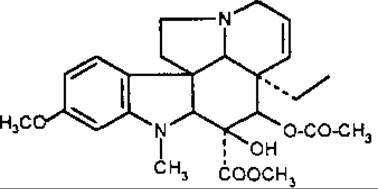
Vindoline

Vinpocetine
Eburnane type. Vincamine is an alkaloid derived from the lesser periwinkle (Vinca minor, Apocynaceae). Similarly to reserpine, it lowers blood pressure, exerts a mild sedative effect, and also exhibits hemostatic and anti-inflammatory properties.
Iboga type. These alkaloids possess an isoquinoline structure conjugated with an indole moiety.
Catharanthine is one of the major alkaloids found in the leaves of Catharanthus roseus (Apocynaceae) and other species within this genus.

Catharanthine

Ajmaline
Ajmaline is a Rauwolfia ROOT alkaloid biogenetically related to serpentine. It lacks neuroleptic properties, moderately increases blood pressure, and enhances coronary blood flow. It is clinically utilized as an antiarrhythmic agent.
Strychnos alkaloids. These comprise a distinct group of nux-vomica alkaloids characterized by a complex, condensed polynuclear structure consisting of seven rings and incorporating a terpenoid moiety. Ring A is aromatic; out of the two nitrogen atoms, only one is tertiary (N-19), exhibiting basic properties and The ability to form salts. The second nitrogen atom is incorporated into a lactam ring, which can be cleaved upon Treatment with alcoholic alkali to yield a carboxyl and an amino group.
Strychnine is the primary alkaloid found in nux-vomica seeds (Semina Strychni, Strychnos nux-vomica L., Loganiaceae). It was isolated in 1819 by Pelletier and Caventou, though its structure was not elucidated until the 1960s. Strychnine is classified as a potent plant poison. In therapeutic doses, it stimulates the central nervous system, predominantly enhancing the reflex excitability of the spinal cord.

R1 = R2 = Н — Strychnine
R1 = R2 = OCH3 — Brucine
Strychnine stimulates the Adrenal Glands to release adrenaline into the bloodstream. Prolonged administration of strychnine preparations prolongs conditioned Reflexes, which can persist for approximately two months after cessation of treatment.
Brucine is a dimethoxy derivative of strychnine, possessing 50 times less physiological activity than the latter. It has no Practical Application, though it is used in analytical chemistry as a reagent for the nitrate ion.
Dimeric indole alkaloids. These alkaloids are built from two simple indole or dihydroindole alkaloids and typically feature a highly complex chemical structure. They can be symmetrical, consisting of identical fragments, or asymmetrical. Certain dimeric indole alkaloids are used in medical practice, such as vinblastine, vincristine, toxiferine C, etc.
Vinblastine is one of the most important alkaloids of the rosy periwinkle (*Catharanthus roseus*). It is an asymmetrical dimer formed from vindoline and velbanamine, isolated in 1958. It exhibits cytostatic activity, arresting Cell mitosis at metaphase.

R = СН3 — Vinblastine,
R = СНО — Vincristine
Vincristine contains a formyl group at the nitrogen atom of the vindoline core. It acts similarly to vinblastine and is used in pediatric leukemia. It accumulates in periwinkle leaves in extremely small quantities. Methods for converting vinblastine into vincristine have been developed, alongside the total synthesis of these compounds.
The bulk of toxic curare alkaloids consists of dimeric isoquinoline compounds. Calabash curare, prepared from the poison nut *Strychnos toxifera* (Loganiaceae), contains dimeric indole alkaloids featuring two quaternary nitrogen atoms, such as toxiferine C, which exhibits a very potent curariform effect.

Toxiferine C
Ergot alkaloids (ergoline alkaloids). Ergot is a parasitic fungus that grows on the grains of cereal grasses. Clavepsitoxicosis, or ergotism—a condition caused by the ability of ergot alkaloids to induce smooth Muscle and vascular contraction—is now rarely seen in humans. Ergotism was once so widespread in Western and Central Europe that in 1095 Pope Urban II established the Order of St. Anthony, dedicated to treating sufferers of the disease. This gave rise to the historical name of the condition, "Saint Anthony's fire" (ignis sacer).

Ergoline

D-Lysergic acid

D-Isolysergic acid

Ergometrine
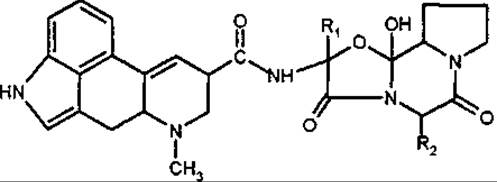
Core structure of peptide ergot alkaloids
The Chemical Structure of ergot alkaloids is based on the ergoline skeleton, from which D-lysergic or D-isolysergic acid is derived.
Only levorotatory derivatives of D-lysergic acid exhibit pharmacological activity. The names of levorotatory and dextrorotatory alkaloids are differentiated by the suffix "-ine". The main alkaloids can be divided into three groups, as shown in Table 16.
Table 16
Main groups of ergot alkaloids

Ergo alkaloids are divided into simple lysergic acid amides and peptide alkaloids. The first group includes ergometrine, which is an aminopropanol of lysergic acid. Peptide alkaloids (ergopeptines) contain a D-lysergic acid core linked to several Amino Acids via peptide bonds into cyclic structures. Proline is invariably one of these amino acids.
Ergotamine features a peptide moiety composed of a-hydroxyalanine, phenylalanine, and proline. The ergotamine group also includes ergosine, in which the peptide portion consists of a-hydroxyalanine, leucine, and proline.
The ergotoxin group comprises ergocristine, ergocryptine, and ergocornine. The peptide moiety of ergocristine consists of a-hydroxyvaline, phenylalanine, and proline; that of ergocryptine consists of a-hydroxyvaline, leucine, and proline; and that of ergocornine consists of a-hydroxyvaline, valine, and proline.
In addition to lysergic acid derivatives, ergot contains so-called clavine alkaloids, which are built upon an ergoline skeleton.

R=H, OH, or -OC(O)CH3
Ergoline

Chanoclavine
The most important compounds in this group are agroclavine, elymoclavine, lysergine, setoclavine, and penniclavine. Chanoclavine features an open ring D and serves as a precursor to all ergo alkaloids. These compounds do not possess independent pharmacological significance.
Ergot alkaloids exert complex effects on the Organism. Their MAIN TYPES OF pharmacological activity include: oxytocic (uterine) action; peripheral a-adrenolytic action; and central nervous system (CNS) effects.
Therapeutic doses of these alkaloids typically increase tone and induce specific rhythmic activity in the Uterus. The uterine musculature is particularly sensitive during Pregnancy and the postpartum period. Ergometrine exerts the most powerful effect on the myometrium, though it lacks adrenolytic activity. It is used as an uterotonic agent to enhance uterine contractions.
Ergocristine and ergocryptine inhibit the secretion of the hormone prolactin, thereby affecting the growth of neoplasms. Researchers are investigating various semi-synthetic products both as standalone therapeutic agents and in combination with other substances. The semi-synthetic derivative 2-bromo-a-ergocryptine stimulates dopamine receptors and is used in the treatment of Parkinson's disease (under the trade name Parlodel). Lysergic acid diethylamide (LSD) is a potent narcotic substance with psychotropic effects.
Other indole alkaloids. Physostigmine is the principal alkaloid of the Calabar bean (*Physostigma venenosum*, Fabaceae), a liana growing in the tropical forests of West Africa. Alkaloids of this chemical structure have not been found in plants of other genera. It is an ester of carbamic acid. Biogenetically, physostigmine is derived from 5-OH-tryptophan. The alkaloid is highly sensitive to light and degrades rapidly. Pharmacologically, it is closely related to galantamine from the bulbs of *Galanthus woronowii*; it exhibits anticholinesterase activity. Physostigmine enhances the secretion of salivary, sweat, and bronchial glands, as well as gastric and intestinal secretion, constricts the pupil (miosis), and lowers intraocular pressure.

Physostigmine

Betanin R=sugar
Betanins, or betalains, are also derivatives of dihydroindole. These are colored, nitrogen-containing compounds. They were first isolated from the order Centrosperma, family Caryophyllaceae, and are characteristic of the red beet (*Beta vulgaris* ssp. *esculenta*, family Chenopodiaceae).
It is known that in 10% of people, when consuming beets, these natural pigments are not converted into colorless compounds but are excreted unchanged in the urine. This genetic trait can be utilized in diagnostic medicine.
Last update: 06/08/2026
Editorial and Educational Adaptation: This material has been compiled based on the primary/original source text. The project team performed an editorial review, corrected technical inaccuracies, structured sections, and adapted the content for an educational format.
What was processed:
- elimination of formatting defects (OCR errors, structural breaks, corrupted characters);
- editorial organization of content;
- standardization of terminology in accordance with academic sources;
- verification of factual statements against the original source text.
All mentions of the author, publication year, and origin of the primary text have been preserved in accordance with the source.