Harper's Illustrated Biochemistry, Volume 1 - Murray R. 1993
Bioenergetics and Metabolism of Carbohydrates and Lipids
Bioenergetics
The role of high-energy phosphates in bioenergetics and energy capture processes
To sustain life processes, all organisms must obtain Free energy from their external environment. In autotrophic organisms, METABOLISM is coupled with a simple exergonic process occurring in their surroundings: green plants utilize sunlight energy, whereas certain autotrophic Bacteria thrive on the reaction Fe2+ → Fe3+. Heterotrophic organisms, in turn, derive energy by coupling their metabolism with The breakdown of complex organic molecules acquired from outside. In all these processes, ATP plays a central role, ensuring The transfer of free energy from exergonic to endergonic processes (Figs. 11.3 and 11.4). As shown in Fig. 11.5, ATP is a nucleotide containing adenine, ribose, and three phosphate groups. In intracellular reactions, ATP Functions as an Mg2+ complex (Fig. 11.6).
The vital role of phosphates in metabolic processes became clear after the chemical details of Glycolysis were elucidated and the roles of ATP, adenosine diphosphate (ADP), and inorganic phosphate (Pi) in this pathway were established. Initially, ATP was viewed merely as a carrier of phosphate radicals during phosphorylation. Its true role in biochemical energetics was demonstrated in experiments showing that Muscle contraction involves the breakdown of ATP and creatine phosphosphate, and that their resynthesis is driven by energy supplied by oxidative processes within the muscle. The final clarity was brought by Lipmann, who introduced The concepts of "energy-rich phosphates" and "high-energy phosphate bonds" and highlighted their significance in Bioenergetics.
Class="center">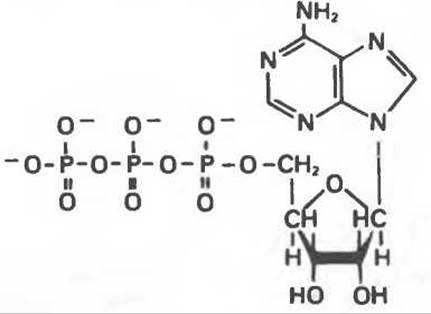
Fig. 11.5. Adenosine triphosphate (ATP).
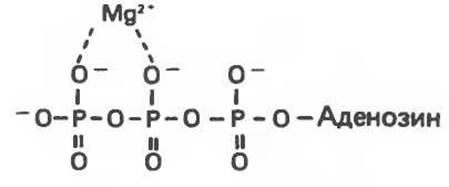
Fig. 11.6. Magnesium complex of ATP (Mg-ADP has a similar Structure).
Free energy of Hydrolysis of ATP and other Organic Phosphates
The Standard Free Energy of hydrolysis for A number of biochemically important organic phosphates is listed in Table 11.1. The relative capacity of each phosphate group to transfer to a suitable acceptor can be evaluated by the value of ∆G°' for hydrolysis (measured at 37° C). As seen from the table, the ∆G°' value for the hydrolysis of the terminal phosphate of ATP, equal to -30.5 kJ/mol, divides the listed compounds into two groups. One group comprises low-energy phosphates, represented by sugar esters formed during intermediate steps of glycolysis, which have a less negative ∆G°' than ATP. The other group consists of "energy-rich phosphates," which have a more negative ∆G°' than ATP. Compounds in this group, including ATP and ADP themselves, are typically anhydrides (e.g., the phosphate group at position 1,3-bisphosphoglycerate), enol phosphates (e.g., phosphoenolpyruvate), and phosphoguanidines (creatine phosphate, Arginine phosphate). Other biologically important compounds classified as "high-energy" include thiol esters formed by coenzyme A (such as acetyl-CoA), acyl carrier protein, amino acid esters involved in Protein Synthesis, S-adenosylmethionine (active Methionine), and UDPGlc (uridine diphosphate glucose).
Table 11.1. Standard free energy of hydrolysis of some biochemically important organic phosphates1
|
Compound |
∆G°' |
|
|
kJ/mol |
kcal/mol |
|
|
Phosphoenolpyruvate |
-61.9 |
-14.8 |
|
Carbamoyl phosphate |
-51.4 |
-12.3 |
|
1,3-Bisphosphoglycerate (product: 3-phosphoglycerate) |
-49.3 |
-11.8 |
|
Creatine phosphate |
-43.1 |
-10.3 |
|
АТР → ADP + Рі |
-30.5 |
-7.3 |
|
ADP → АМР + Pi |
-27.6 |
-6.6 |
|
Pyrophosphate |
-27.6 |
-6.6 |
|
Glucose-1-phosphate |
-20.9 |
-5.0 |
|
Fructose-6-phosphate |
-15.9 |
-3.8 |
|
AMP |
-14.2 |
-3.4 |
|
Glucose-6-phosphate |
-13.8 |
-3.3 |
|
Glycerol-3-phosphate |
-9.2 |
-2.2 |
1) The ∆G values for ATP and most Other Compounds are taken from Krebs and Kornberg (1957). Pi denotes inorganic orthophosphate.
High-Energy Phosphates
To indicate the presence of a high-energy phosphate group, Lipmann introduced the symbol  , which designates a high-energy (macroergic) phosphate bond. The symbol ~ implies that the transfer of the group attached by this bond to a suitable acceptor is accompanied by the release of a large amount of free energy. The term "group transfer potential" is sometimes preferred over "high-energy bond." ATP contains two high-energy phosphate groups and ADP contains one, whereas the phosphate bond in AMP is a low-energy bond (Fig. 11.7).
The Role of High-Energy Phosphates as the "Energy Currency" of The Cell
The intermediate position of ATP in the standard free energy of hydrolysis table (Table 11.1) enables it to serve as a high-energy phosphate donor to compounds positioned below it in the table. In the presence of appropriate enzyme systems, ADP can accept a high-energy phosphate (forming ATP) from compounds located above ATP in the table. Thus, the ATP/ADP cycle links processes that generate  with processes that consume
  (Fig. 11.8).
There are three Main sources of that provide energy capture and storage. 1. Oxidative Phosphorylation. This is quantitatively the most important source of  in aerobic organisms. The free energy required for The formation of is generated by the Respiratory Electron Transport chain operating in Mitochondria (p. 129). 2. Glycolysis. The overall conversion of one glucose molecule to lactate yields two (see Fig. 18.2) through Reactions Catalyzed by phosphoglycerate kinase and Pyruvate kinase (Fig. 11.9). 3. Citric Acid Cycle. One
  is generated directly during the cycle at the step catalyzed by succinyl-CoA synthetase (see Fig. 17.3).
Another group of compounds, phosphagens, acts as a reservoir of high-energy phosphates; these include creatine phosphate, found in vertebrate Muscles and Brain, and arginine phosphate, found in invertebrate muscles (Table 11.1).
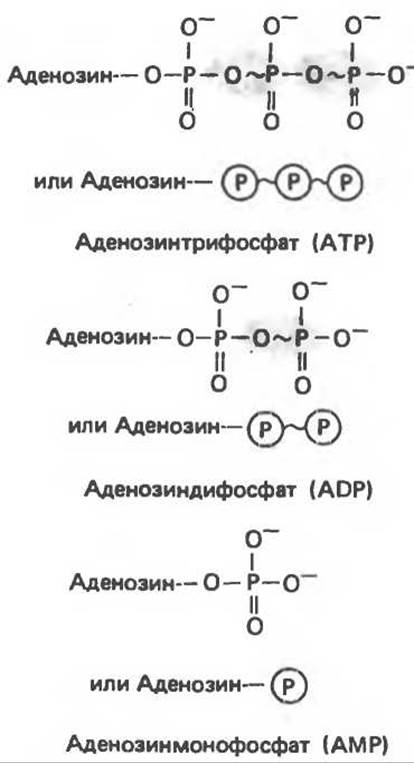
Fig. 11.7. Structures of ATP, ADP, and AMP, indicating the position and number of high-energy bonds (~).
Under physiological conditions, phosphagens maintain the required ATP concentration in muscles during its rapid depletion as an energy source for muscle contraction. Conversely, when sufficient ATP accumulates, the reaction shifts toward the formation of creatine phosphate; the concentration of the latter rises, allowing it to function as a storage form of high-energy phosphate (Fig. 11.10). However, if ATP acts as a phosphate donor in the synthesis of compounds with a lower free energy of hydrolysis (Table 11.1), the phosphate group becomes low-energy, for example:

Bioenergetics of Coupled Reactions
Let us examine the energetics of coupled reactions in greater detail (Figs. 11.1 and 11.3). The first step of glycolysis can be viewed as a coupled reaction (see Fig. 18.2). The phosphorylation of glucose by free phosphate to yield glucose-6-phosphate is a strongly endergonic reaction:
(1) Glucose + Pi → Glucose-6-phosphate + H2O
(∆G°' = +13.8 kJ/mol).
It must be coupled with another reaction whose exergonicity exceeds the endergoncity of glucose phosphorylation by the free enzyme. Such a reaction is the hydrolysis of ATP with the Cleavage of the terminal phosphate:
(2) АТР → ADP + Рі (∆G°' = -30,5 кДж/моль).
When processes (1) and (2) are coupled in the reaction catalyzed by the enzyme hexokinase, glucose phosphorylation readily proceeds under physiological conditions: the reaction equilibrium is strongly shifted to the right, rendering it practically irreversible.

A similar mechanism underlies many "activation" reactions.
Interconversion of adenine NUCLEOTIDES
Most Cells contain the enzyme adenylate kinase (myokinase). It catalyzes the reversible conversion of ATP and AMP into ADP:

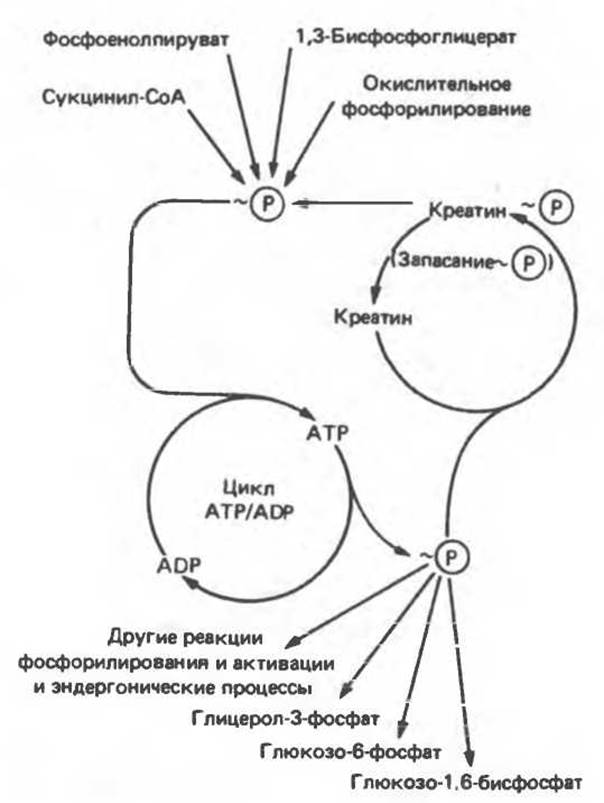
Fig. 11.8. The role of the ATP/ADP cycle in the high-energy phosphate transfer system. Note that  never exists in a free state, but is only transferred from one compound to another.
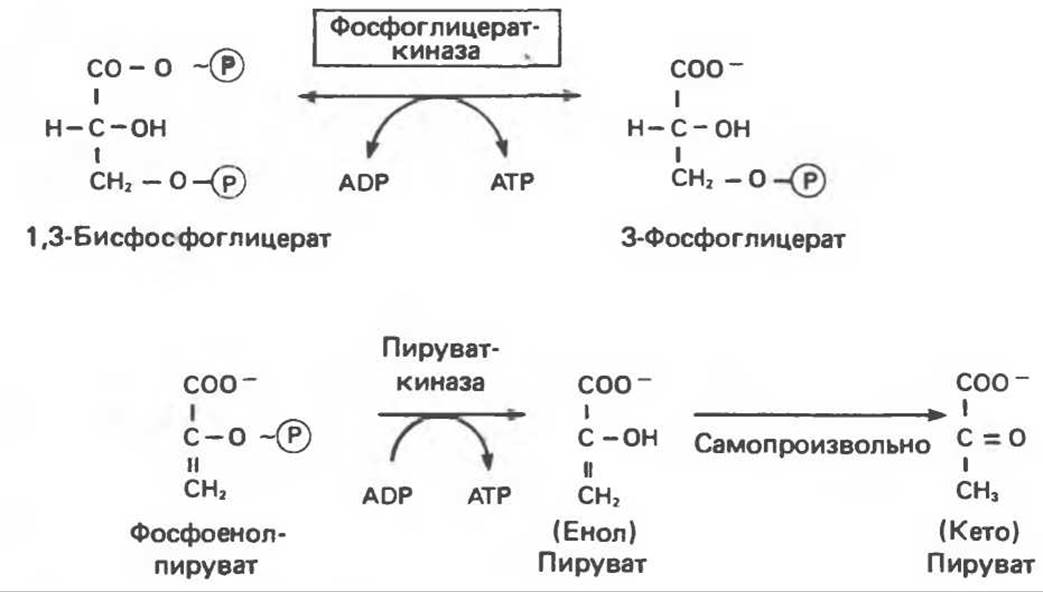
Fig. 11.9. Transfer of high-energy phosphate from glycolysis intermediates to ADP.
This reaction serves three functions: 1) it allows the high-energy phosphate of ADP to be used for ATP synthesis; 2) it allows AMP, generated in various ATP-dependent activation reactions, to be converted back into ADP via rephosphorylation; 3) it leads to an increased AMP concentration under conditions of declining ATP levels, serving as a metabolic (allosteric) signal to accelerate catabolic reactions, which in turn enhances ATP generation (p. 217).

Fig. 11.10. High-energy phosphate transfer between ATP and creatine.
Last update: 06/08/2026
Editorial and Educational Adaptation: This material has been compiled based on the primary/original source text. The project team performed an editorial review, corrected technical inaccuracies, structured sections, and adapted the content for an educational format.
What was processed:
- elimination of formatting defects (OCR errors, structural breaks, corrupted characters);
- editorial organization of content;
- standardization of terminology in accordance with academic sources;
- verification of factual statements against the original source text.
All mentions of the author, publication year, and origin of the primary text have been preserved in accordance with the source.