Human Biochemistry, Volume 1 - Murray R. 1993
Bioenergetics and Metabolism of Carbohydrates and Lipids
Bioenergetics
Coupling of Endergonic Processes with Exergonic Processes
Vital life processes—such as synthesis reactions, Muscle contraction, Nerve Impulse propagation, and Active Transport—derive energy through chemical coupling with oxidative reactions. This type of coupling is illustrated schematically in Fig. 11.1.
The conversion of metabolite A into metabolite B is accompanied by the release of Free energy. It is coupled with another reaction—the conversion of metabolite C into metabolite D, which can occur only with an influx of free energy. When The energy released during The breakdown of one compound is used (other than in the form of heat) to synthesize another compound, the corresponding reactions can no longer be described by the chemical terms "exothermic" and "endothermic." It is more accurate to call them exergonic and endergonic reactions; these terms indicate that the reaction is accompanied by a decrease or increase in free energy, regardless of the form in which the Energy is transferred. In practice, an endergonic process cannot proceed in isolation. It must be a component of a coupled exergonic/endergonic system, which is exergonic overall. Catabolic pathways (the breakdown or oxidation of "fuel" molecules) are typically exergonic reactions, whereas anabolic pathways are endergonic. The totality of Catabolic and anabolic processes constitutes METABOLISM.
Class="center">
Fig. 11.1. Coupling of exergonic and endergonic reactions.
If the reaction shown in Fig. 11.1 proceeds from left to right, the process must be accompanied by a decrease in free energy released in the form of heat. One possible mechanism for reaction coupling involves The formation of an intermediate compound I that is common to both reactions:
A + C → I → B + D.
In biological systems, A number of exergonic and endergonic reactions are coupled precisely in this manner. It should be noted that systems of this type incorporate a regulatory mechanism for The rate of oxidative processes, since the presence of a common intermediate for both the exergonic and endergonic reactions creates conditions where the rate of consumption of product D, According to the law of mass action, determines the rate of oxidation of A. This is precisely how Respiratory Control operates—a mechanism that allows the Organism to avoid uncontrolled auto-oxidation. Another example of coupling is dehydrogenase reactions (hydrogen atom abstraction reactions), in which the coupling agent is an intermediate hydrogen carrier (Fig. 11.2).

Fig. 11.2. Coupling of dehydrogenase and Hydrogenase reactions via an intermediate carrier.
An alternative mechanism for coupling exergonic and endergonic processes involves the synthesis of a high-energy compound during the exergonic reaction and the subsequent incorporation of this new compound into the endergonic reaction, thereby ensuring The transfer of free energy from the exergonic to the endergonic reaction (Fig. 11.3).
In Fig. 11.3, the symbol  denotes a compound with high potential energy, and the symbol
  denotes the corresponding compound with low potential energy. A distinct advantage of this mechanism is that
  , unlike I in the previous mechanism, does not necessarily share structural similarity with A, B, C, or D. This allows
 to serve as an energy carrier from A large number of exergonic reactions to an equally large number of endergonic processes, as shown in Fig. 11.4.
In living Cells, the primary high-energy intermediate (intermediary  ) is adenosine triphosphate (ATP).
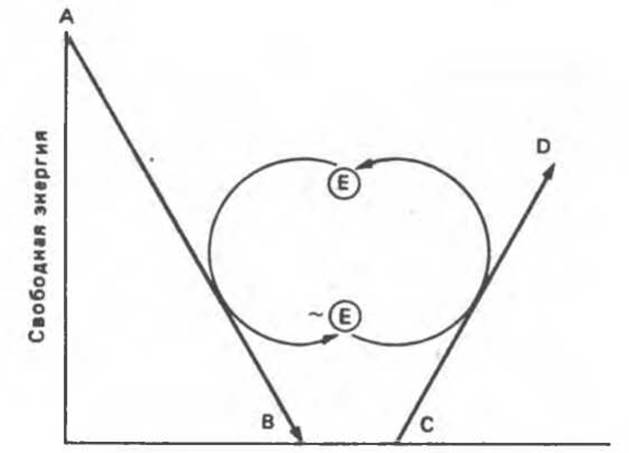
Fig. 11.3. Transfer of free energy from an exergonic to an endergonic reaction via a high-energy intermediate.

Fig. 11.4. Transfer of free energy from exergonic reactions to endergonic BIOLOGICAL PROCESSES INVOLVING a common high-energy compound.
Last update: 06/08/2026
Editorial and Educational Adaptation: This material has been compiled based on the primary/original source text. The project team performed an editorial review, corrected technical inaccuracies, structured sections, and adapted the content for an educational format.
What was processed:
- elimination of formatting defects (OCR errors, structural breaks, corrupted characters);
- editorial organization of content;
- standardization of terminology in accordance with academic sources;
- verification of factual statements against the original source text.
All mentions of the author, publication year, and origin of the primary text have been preserved in accordance with the source.