Human Biochemistry, Volume 1 - Murray R. 1993
Bioenergetics and Metabolism of Carbohydrates and Lipids
Bioenergetics
Pyrophosphate Metabolism
Reactions involving ATP that yield AMP are accompanied by The formation of inorganic pyrophosphate (PPi); an example is the activation of long-chain Fatty acids:
Class="center">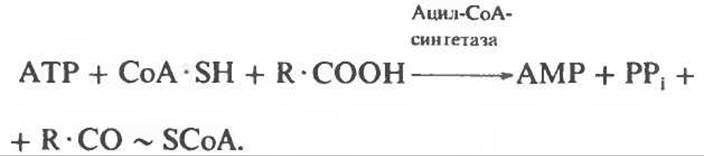
This reaction is accompanied by the dissipation of Free energy as heat, which drives it forward. This direction is further favored by the hydrolytic Cleavage of PPi catalyzed by inorganic pyrophosphatase, which has a large negative ∆G°' value (-4.6 kcal/mol). Note that activation involving pyrophosphate formation results in the loss of two  rather than one, as is the case when ADP and Pi are formed:
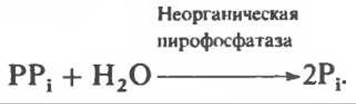

Fig. 11.11. Coupling of phosphate cycles with the interconversion of adenine NUCLEOTIDES.
The reactions involving phosphate and adenine nucleotides described above are schematically illustrated in Fig. 11.11.
Nucleoside Phosphates Related to ATP and ADP
With the participation of the enzyme nucleoside diphosphate kinase, nucleoside triphosphates analogous to ATP, but containing a base other than adenine, can be synthesized from their respective diphosphates:
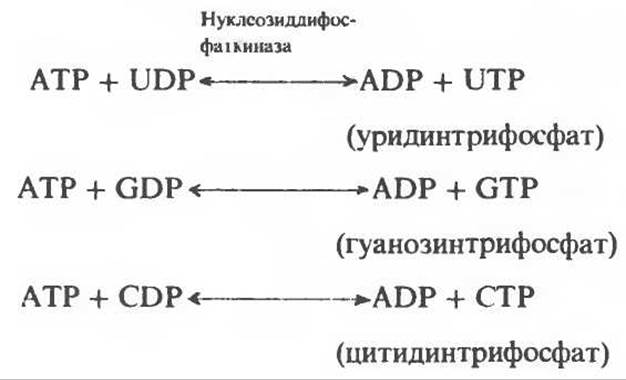
All of these triphosphates take part in cellular phosphorylation reactions. Nucleoside monophosphate Kinases, specific for particular purine or pyrimidine nucleoside phosphates, catalyze the formation of nucleoside diphosphates from the corresponding monophosphates.
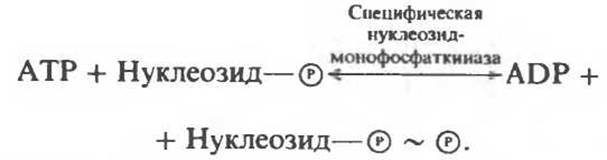
Specifically, adenylate kinase is a monophosphate kinase with narrow Specificity.
Ernster L. (ed.) Bioenergetics, Elsevier, 1984.
Harold F. M. The Vital Force: A Study of Bioenergetics, Freeman, 1986.
Klotz l. M. Introduction to Biomolecular Energetics, Academic Press. 1986.
Krebs H. A., Kornberg H. L. Energy Transformations in Living Matter, Springer, 1957.
Lehninger A. L. Bioenergetics: The Molecular Basis of Biological Energy Transformations, 2nd ed., Benjamin, 1971.
Last update: 06/08/2026
Editorial and Educational Adaptation: This material has been compiled based on the primary/original source text. The project team performed an editorial review, corrected technical inaccuracies, structured sections, and adapted the content for an educational format.
What was processed:
- elimination of formatting defects (OCR errors, structural breaks, corrupted characters);
- editorial organization of content;
- standardization of terminology in accordance with academic sources;
- verification of factual statements against the original source text.
All mentions of the author, publication year, and origin of the primary text have been preserved in accordance with the source.