Principles of Biochemistry, Volume 1 - A. Lehninger 1985
Biomolecules
Water
Chapter Summary
Water is the most abundant compound in living organisms. The relatively high values of the freezing point, boiling point, and heat of vaporization of water are due to strong intermolecular interactions manifested as numerous Hydrogen Bonds between adjacent water molecules. Liquid water consists of short-lived clusters of molecules linked to one another by hydrogen bonds. The polarity of water and the pronounced ability of its molecules to form hydrogen bonds make it an excellent solvent for many ionic compounds and other substances with polar molecules. Water also disperses amphipathic substances, such as soaps, forming aggregates of molecules called micelles in which the hydrophobic groups are sequestered on the inside and do not contact water, whereas the charged groups are located on the outer surface.
Water dissociates to a very small extent, yielding H+ and OH- ions. In dilute aqueous solutions, the concentrations of H+ and OH- ions are inversely related: Kw = [Н+][ОН] = 1∙10-14(at 25°C). The hydrogen ion concentration in biological systems is usually expressed as pH, the value of which is numerically equal to the negative logarithm of the H+ ion concentration (pH = - lg[H+]). The pH of aqueous solutions is measured using Glass electrodes sensitive to H+ ion concentration.
Acids can be defined as proton Donors, and bases as proton acceptors. A conjugate acid-base pair consists of a proton donor HA and its corresponding proton acceptor A-. The ability of an acid HA to donate its proton is characterized by its dissociation constant
Class="center">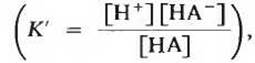
or by the pK' value, defined as — lgA-. The pH of a weak acid aqueous solution is quantitatively related to its pK' value and to the concentration ratio of its proton-donor and proton-acceptor forms.
A conjugate acid-base pair can function as a buffer that resists changes in pH upon The addition of alkali or acid to the solution; its buffer capacity is maximal at a pH value numerically equal to its pK'. The biologically most important buffer pairs are Н2СO3 - НСO-3 and H2PO-4 - HPO2-4. The catalytic activity of Enzymes is strongly dependent on pH.
Callewaert D.M., Jenyea J. Basic Chemistry: General, Organic, Biological, Worth, New York, 1980. It is useful to review this as well as other general chemistry textbooks.
Dick D. А. Т. Cell Water, Butterworths, Washington, 1966. Properties and Functions of water in living organisms.
Eisenberg D., Kauzmann W. The Structure and properties of Water, Oxford University Press, Fair Lawn, N.J., 1969. A Treatment of the physical chemistry of water designed for prepared readers.
Likens G. Е, Wright R. F., Galloway J. N, Butler T.J. Acid Rain, Sci. Am., 241, 43-51, October (1979).
Montgomery R., Swenson C. A. Quantitative Problems in Biochemical Sciences, 2d ed. Freeman, San Francisco, 1976.
Segel I. H. Biochemical Calculations, 2d ed., Wiley, New York, 1976.
Solomon A.K., The State of Water in Red Cells, Sci, Am., 244, 88-96, February (1971). An article dedicated to the investigation of water structure within The Cell.
1. Automobile antifreeze. Ethylene glycol, an alcohol containing two hydroxyl groups (СН2ОН—СН2ОН), is commonly used as an agent to lower the freezing point of water in an automobile radiator. Calculate the approximate concentration of ethylene glycol sufficient to prevent water from freezing at — 18 °C.
2. Vinegar imitation. One method for preparing vinegar (by no means the best) simply involves diluting acetic acid, the sole acidic component of vinegar, with water to the desired pH (see Table 4-4 and Fig. 4-9) and adding appropriate seasonings. Acetic acid at 25°C is a liquid with a density of 1.049 g/mL. Calculate The amount of acetic acid that must be dissolved in distilled water to produce 1 L of a solution simulating vinegar.
3. Acidity of gastric Hydrochloric acid. In clinical laboratories, to determine the acidity of gastric juice, 10.0 mL of gastric juice collected several hours after a meal is titrated with 0.1 N NaOH solution to a neutral reaction. Assume that 7.2 mL of NaOH solution was required for this. Since The Stomach contains no undigested food or beverages by this time, there are no buffers present in it. What is the pH of the gastric juice?
4. Measurement of acetylcholine content via pH change. The concentration of the neurotransmitter acetylcholine can be determined from the pH change accompanying acetylcholine Hydrolysis. Upon incubation of acetylcholine with catalytic amounts of the enzyme acetylcholinesterase, it is quantitatively converted into Choline and acetic acid, which dissociates to form an acetate ion and a hydrogen ion:

According to analytical data, a 15-mL aqueous solution containing an unknown amount of acetylcholine had a pH of 7.65. After incubation with acetylcholinesterase, the pH of the solution dropped to 6.87. How many moles of acetylcholine were contained in 15 mL of the initial solution, assuming that no buffers were present in the analyzed mixture?
5. Meaning of the pK' value of an acid. According to one of the most widely accepted Definitions of pK', this value is nothing other than the pH at which an acid is 50% ionized, i.e., it is a mixture of undissociated acid molecules and its conjugate base in a 50:50 ratio. Prove that this is correct, starting from the Equilibrium Constant expression.
6. Properties of a buffer. The amino acid Glycine is frequently used in biochemical practice as the main component of a buffer solution. The amino group of glycine, which has a pK' of 9.3, can exist either in the protonated form (-NH3) or as the free base (—NH2), which are in equilibrium with each other:

a) Over what pH range can glycine be used as an effective buffer due to its amino group?
b) What fraction of glycine molecules has their amino group in the protonated form (-NH+3) in a 0.1 M solution at pH 9.0?
c) What volume of a 5 M KOH solution should be added to 1.0 L of a 0.1 M glycine solution (pH 9.0) so that the pH of the mixture is exactly 10.0?
d) What must be the numerical ratio between the pH of the solution and the pK' of the amino group of glycine for the amino group of 99% of the glycine molecules to be in the protonated form?
Problem 7
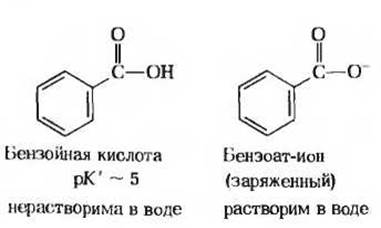
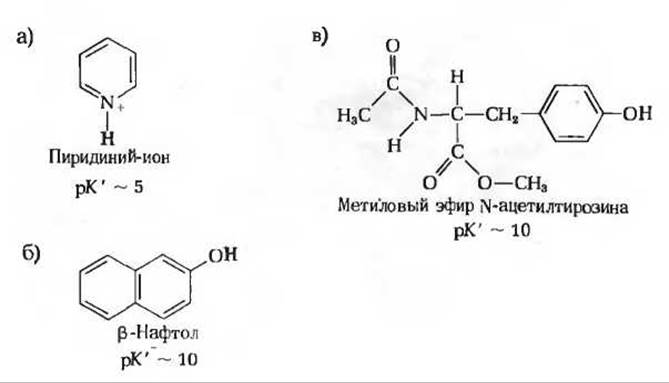
7. pH Dependence of Solubility. The pronounced polarity of Water and Its ability to readily form hydrogen bonds make it an excellent solvent for ionic substances. At the same time, this characteristic of water accounts for the poor solubility of non-ionizable, nonpolar Organic compounds such as benzene. In principle, the solubility of all organic acids and bases in water can be increased by deprotonation and protonation, respectively, both of which lead to The formation of charged species. For example, benzoic acid is sparingly soluble in water, but the addition of sodium bicarbonate increases the pH of the solution and deprotonates the benzoic acid molecules to form benzoate ions, which are highly soluble in water. Which of the solutions—0.1 M NaOH or 0.1 M HCl—should be added to water to increase the solubility of substances A, B, and C?
8. Treatment of Skin Rash Caused by Poison Ivy Contact. Long-chain alkyl derivatives of pyrocatechol contained in poison ivy Tissues cause a characteristic itchy rash.
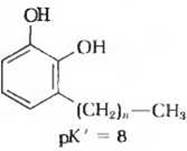
If you accidentally Touch poison ivy, which of the following treatments for the affected skin area would you choose and why?
(a) Washing the skin surface with cold water.
(b) Washing the skin surface with dilute vinegar or lemon juice.
(c) Washing the skin surface with soap and water.
(d) Washing the skin surface with soap, water, and baking soda (sodium bicarbonate).
9. pH and Drug Absorption. The widely used medication aspirin is a weak acid with a pK' of 3.5.
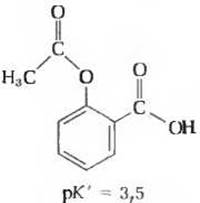
Aspirin is absorbed into the human bloodstream through the mucosal Cells of the stomach and Small Intestine. For a substance to be absorbed, it must readily cross cell membranes. The ability of a substance to pass through a cell membrane is determined by the polarity of its molecules: ionized (charged) and strongly polar molecules pass through slowly, whereas neutral hydrophobic molecules cross membranes rapidly. Where is aspirin more easily absorbed into the bloodstream—in the stomach or in the small intestine—if the pH of gastric juice in the stomach is close to 1, and in the small intestine it is close to 6? Provide a clear rationale for your choice.
10. Preparation of a Standard Buffer for pH Meter Calibration. The glass electrode used in commercially available pH meters produces an electrical signal proportional to the hydrogen ion concentration. To correctly determine the pH from the signal magnitude, the glass electrode must be calibrated using standard solutions with a known hydrogen ion concentration. Determine the amounts (in grams) of primary sodium phosphate monobasic (NaH2PO4·H2O; molecular weight 138.01) and secondary sodium phosphate dibasic (Na2HPO4; molecular weight 141.98) required to prepare 1 L of a standard buffer at pH 7.00, in which the total phosphate concentration is 0.100 M. (The Molecular Weight of the phosphate mixture will depend on their ratio). The pK' of primary sodium phosphate at 25 °C is 6.86.
11. Regulation of Blood pH by Respiration Rate.
a) The partial pressure of CO2 in the Lungs can change rapidly depending on the rate and depth of breathing. It is known that to get rid of hiccups, one needs to increase the concentration of CO2 in the lungs. This can be achieved by holding the breath partially, inhaling slowly and shallowly (hypoventilation), or inhaling and exhaling into a paper bag held tightly against the face. Under these conditions, the partial pressure of CO2 in the air space of the lungs exceeds normal levels. Explain why these Procedures affect blood pH.
b) Sprinters typically breathe heavily and deeply (hyperventilation) for about 1 to 2 minutes immediately before a race to eliminate CO2 from the lungs. Blood pH can spike up to 7.60 As a result. Explain why blood pH increases under these conditions.
c) During a short-distance sprint, Muscles produce a large amount of lactic acid from glucose stores. Based on this fact, explain why hyperventilation is beneficial before explosive running.
Last update: 06/08/2026
Editorial and Educational Adaptation: This material has been compiled based on the primary/original source text. The project team performed an editorial review, corrected technical inaccuracies, structured sections, and adapted the content for an educational format.
What was processed:
- elimination of formatting defects (OCR errors, structural breaks, corrupted characters);
- editorial organization of content;
- standardization of terminology in accordance with academic sources;
- verification of factual statements against the original source text.
All mentions of the author, publication year, and origin of the primary text have been preserved in accordance with the source.