Principles of Biochemistry Volume 1 - A. Lehninger 1985
Biomolecules
Water
"Acidic" rain pollutes our lakes and rivers
Pure Water in contact with "normal" air has a pH of about 5.6 rather than the theoretical value of 7. This is because air contains a very small amount of gaseous CO2 (about 0.04%, corresponding to a partial pressure of 0.3 mm Hg). When pure water with a pH of 7.0 equilibrates with atmospheric CO2, reversible reactions take place, generating H+ and HCO3- ions (see Box 4-3) and dropping the pH of the water to approximately 5.6:
Class="center">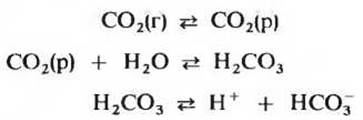
Over the past century or more, the acidity of precipitation—rain and snow in the eastern United States and Northern Europe—has gradually increased thirtyfold, driving down the pH of lakes and rivers in these regions from around 5.6 to well below 5.0.
"Acid" rain results from the interaction of rainwater with sulfur dioxide and nitrogen oxides in the atmosphere, which are produced by the combustion of coal and oil containing trace amounts of sulfur and nitrogen compounds. Consequently, rainwater essentially turns into a dilute solution of sulfuric and nitric acids. Fossil-fueled power plants and metallurgical facilities that burn coal and oil are typically equipped with tall smokestacks that discharge combustion products high into the atmosphere to prevent ground-level air pollution. As a result, the upper layers of the atmosphere over vast areas of the globe have become contaminated with these acids, which precipitate to the ground as rain. Local rainfall can occasionally be exceptionally acidic: during a storm in Scotland in 1974, rainwater reached a pH of 2.4 (even lower than the pH of vinegar!)
As a consequence of acid rain, the water in many lakes throughout Scandinavia, eastern Canada, northern New England, the Adirondack Mountains, and Florida has become so acidic that fish populations have been decimated or wiped out entirely, as many species cannot tolerate a pH below 5. Furthermore, this increased water acidity has already disrupted the delicate ecological balance between aquatic flora and fauna in several freshwater ecosystems. With coal consumption projected to rise in the future, this problem threatens to further degrade freshwater reserves unless fossil-fueled power plants and smelting operations are outfitted with effective emission-control systems to scrub pollutants from their exhaust gases.
Last update: 06/08/2026
Editorial and Educational Adaptation: This material has been compiled based on the primary/original source text. The project team performed an editorial review, corrected technical inaccuracies, structured sections, and adapted the content for an educational format.
What was processed:
- elimination of formatting defects (OCR errors, structural breaks, corrupted characters);
- editorial organization of content;
- standardization of terminology in accordance with academic sources;
- verification of factual statements against the original source text.
All mentions of the author, publication year, and origin of the primary text have been preserved in accordance with the source.