Biochemistry and Molecular Biology - Belyasova N.A. 2002
Metabolism. Energy-Requiring Processes
Lipid Biosynthesis
Biosynthesis of Polar and Nonpolar Lipids
Lipid Biosynthesis in Eukaryotic Cells takes place on the membranes of the smooth Endoplasmic reticulum. Most of the Enzymes involved in these processes are membrane-associated and represent Lipoproteins.
The main precursors for the synthesis of neutral Lipids (triacylglycerols) as well as polar phospho- and Glycolipids are activated Fatty acids and glycerol-3-phosphate. Fatty acid activation proceeds via the following reaction:
Class="center">Жирная кислота + АТР + СоА → Ацил-S-СоА + АМР + PPi
Glycerol-3-phosphate is formed either by direct phosphorylation utilizing ATP in the presence of glycerol kinase, or through the reduction of the glycolytic intermediate dihydroxyacetone-3-phosphate by the enzyme 3-glycerophosphate dehydrogenase, which uses NADH as a coenzyme.
Biosynthesis of Non-polar lipids. While triacylglycerol biosynthesis occurs de novo (from glycerol phosphate and fatty acids), The First stage involves the sequential acylation of the two free hydroxyl groups of the glycerol-3-phosphate molecule (Fig. 15.3). In this process, Esterification of the first carbon atom of glycerol-3-phosphate with a CoA-fatty acid ester initially forms monoacylglycerol-3-phosphate (lysophosphatidate), which is then converted into diacylglycerol-3-phosphate (phosphatidate).
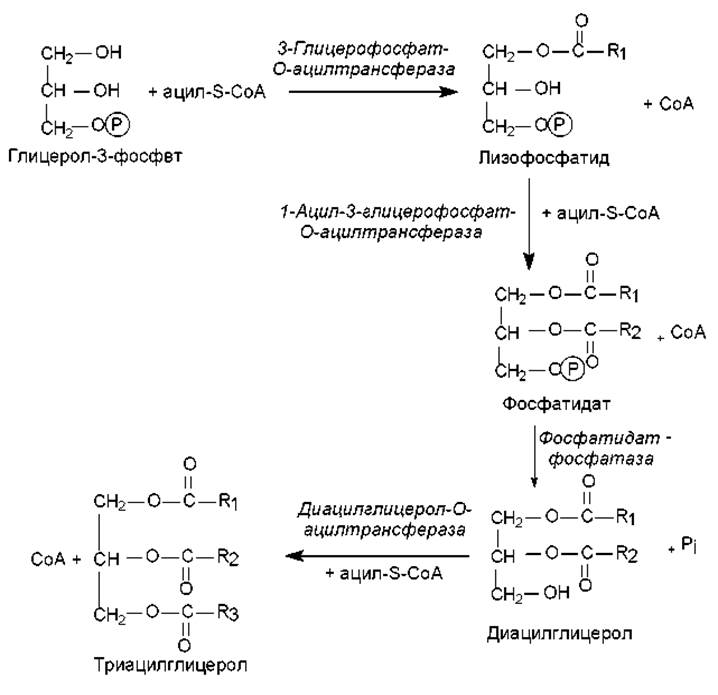
Fig. 15.3. Biosynthesis of triacylglycerols: R1, R2, R3 are hydrocarbon chains of fatty acids
The next stage involves the hydrolytic Cleavage of the phosphate group from the phosphatidate molecule to yield 1,2-diacylglycerol, which then reacts with a third fatty acid CoA derivative to form triacylglycerol (triglyceride).
In addition to the pathway described above, the synthesis of neutral lipids can proceed using degradation products of dietary lipids absorbed from food as precursors. These processes are particularly intensive in the intestinal mucosa of animals. Neutral fats are broken down in the digestive tract by pancreatic lipases into fatty acids and 2-monoacylglycerols, which are then absorbed by the intestinal mucosa. Within the mucosal cells, 2-monoacylglycerol undergoes sequential acylation by fatty acid CoA-esters to form triacylglycerols. These reactions are catalyzed by specific Acyltransferases.
As already noted, triglycerides serve as the primary energy reserves in the cells of animals and certain other organisms. They are of particular importance for hibernating and long-distance migrating animals. For instance, camels store triacylglycerols in their humps and utilize them as a source of metabolic Water generated during oxidation. In polar animals (such as seals and walruses), triglycerides frequently function as thermal insulators. Some animals employ non-polar lipids for buoyancy regulation. For example, the spermaceti organ of sperm whales contains several tons of triacylglycerols containing Unsaturated fatty acids. The density (consistency) of these triglycerides depends on the ambient Temperature, increasing as the temperature drops. Feeding on squids, sperm whales dive to great depths where the water temperature is lower than usual. This induces triglyceride crystallization, increasing their density in accordance with the increased density of seawater at depth, allowing the animal to remain at great depths for extended periods without expending extra effort.
Biosynthesis of polar lipids. The Initial Stages of phospho- and glycolipid biosynthesis coincide with those of triacylglycerol synthesis: these reactions also yield phosphatidate and diacylglycerol (Fig. 15.3). In subsequent steps, an activated polar "HEAD" group (most commonly an amino alcohol) can be attached to the diacylglycerol molecule via a specific carrier. Conversely, in other instances, an activated diacylglycerol molecule is transferred to the polar "head".
Figure 15.4 illustrates the reactions involved in phosphatidylcholine biosynthesis. In this pathway, Choline is activated by binding to CDP, and this nucleoside diphosphate serves as a carrier of choline phosphate to the diacylglycerol molecule. A similar principle is observed in Polysaccharide Biosynthesis, except that the monosaccharide itself is transferred rather than its phosphorylated form (Fig. 14.3).
Another vital membrane component, phosphatidylethanolamine, is synthesized via an analogous pathway (utilizing cytidine diphosphate ethanolamine).
Other Phospholipids, such as phosphatidylinositol, phosphatidylglycerol, diphosphatidylglycerol, and phosphatidylserine, are synthesized with the participation of an activated diacylglycerol—cytidine diphosphate diacylglycerol. This compound is formed through the interaction of CTP with phosphatidate (Fig. 15.5). The transfer of the phosphodiacylglycerol moiety to one of the alcohols is catalyzed by specific phosphatidyltransferases, leading to The formation of the aforementioned Glycerophospholipids.
In addition to the polar lipid biosynthesis pathways characterized above, glycerophospholipids can also be interconverted (Fig. 15.5). For instance, the decarboxylation of phosphatidylserine yields phosphatidylethanolamine, which in turn can be converted into phosphatidylcholine through the triple methylation of its nitrogen atom by S-adenosylmethionine. Phosphatidylglycerol-1-phosphate is capable of being transformed into diphosphatidylglycerol.
The described principles of glycerophospholipid biosynthesis are also characteristic of the Synthesis of Other polar lipids. The rate of lipid biosynthesis in animals is profoundly influenced by Hormones, primarily Insulin, which stimulates the synthesis of fatty acids from glucose (its breakdown products).

Fig. 15.4. Biosynthesis of phosphatidylcholine: R1, R2 are hydrocarbon chains of fatty acids; CTP is cytidine triphosphate

Fig. 15.5. Alternative pathways of polar lipid biosynthesis
Biosynthesis of sterols. All organisms are capable of synthesizing these compounds, yet many utilize sterols obtained from their diet. For example, a human's daily Cholesterol requirement is met 50% by dietary intake and 50% through de novo biosynthesis.
The primary precursor for sterol biosynthesis is acetyl-CoA, which is converted in a stepwise manner through specific stages (Ruzicka's rule) into farnesyl pyrophosphate (Fig. 17.2), an intermediate also utilized in carotenoid synthesis. The head-to-head dimerization of two farnesyl pyrophosphate molecules yields the 30-carbon linear isoprenoid squalene, which subsequently undergoes cyclization and modification to form sterols (Fig. 15.6). This process is identical to carotenoid synthesis, and its principles, as well as the steps of farnesyl pyrophosphate biosynthesis, are described in Chapter 17.
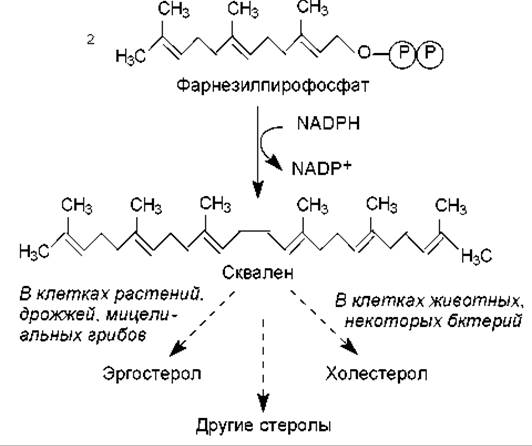
Fig. 15.6. Selected stages of sterol biosynthesis
Ergosterol is produced biotechnologically by cultivating Yeasts (Saccharomyces cerevisiae, Saccharomyces carlbergensis, Candida guilliermondii) as well as filamentous Fungi (Penicillium notatum). Ergosterol serves as the precursor for ergocalciferol (vitamin D2), whereas cholesterol, synthesized by animals and certain Bacteria, acts as the precursor for cholecalciferol (vitamin D3).
Last update: 06/08/2026
Editorial and Educational Adaptation: This material has been compiled based on the primary/original source text. The project team performed an editorial review, corrected technical inaccuracies, structured sections, and adapted the content for an educational format.
What was processed:
- elimination of formatting defects (OCR errors, structural breaks, corrupted characters);
- editorial organization of content;
- standardization of terminology in accordance with academic sources;
- verification of factual statements against the original source text.
All mentions of the author, publication year, and origin of the primary text have been preserved in accordance with the source.