Biochemistry - The Chemical Reactions of Living Cells Volume 2 - D. Metzler 1980
Types of reactions catalyzed by enzymes
Substitution reactions at carbonyl groups
Acyltransferases
In biosynthetic reactions, acyl groups are frequently transferred from amides or esters to various acceptors. For example, the final step in peptide bond formation during ribosomal Protein Synthesis is The transfer of a peptidyl group—attached via an ester bond to a tRNA molecule—to the amino group of an "activated" amino acid (Ch. 11, sect. D,1).
The transacylation (transpeptidation) stage is also the final step in the synthesis of Introduction/37.html">Bacterial Cell wall peptidoglycans. The amino group of a diamino acid (Fig. 5-9) in one peptide chain attacks the amide bond of an adjacent chain, resulting in the displacement of a D-Alanine molecule and The formation of a cross-link (Box 7-G). Acyl groups, particularly acetyl groups, are often transferred to the nucleophilic centers of coenzyme A thioesters (Ch. 8, sect. B). An example is the formation of acetylcholine (Box 7-B) from Choline and acetyl-CoA via a transacetylation reaction. Notably, the high group-transfer potential inherent in thioesters ensures that these reactions proceed to completion.
Box 7-G
Penicillins and Related Antibioticsa
Class="center">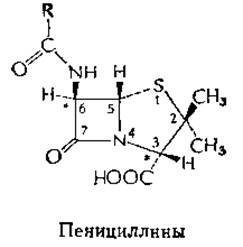
Penicillin (derived from the fungus Penicillium) was the first antibiotic to find Structure/182.html">Practical Application in medicine, with industrial production beginning in the early 1940s. Benzylpenicillin (penicillin G)—one of several natural penicillins that differ in The Nature of the R group (see structure above)—has become one of the most important medicinal agents. It is particularly effective against Gram-positive Bacteria, although at high concentrations it can also attack Gram-negative bacteria, including E. coli.
Ampicillin (R = D-α-aminobenzyl), a widely known semisynthetic penicillin, is a broad-spectrum antibiotic capable of attacking both Gram-positive and Gram-negative organisms. Like penicillin, ampicillin exhibits very low toxicity, though it can provoke allergic reactions. Other Semisynthetic penicillins are resistant to penicillinases. These Enzymes, produced by penicillin-resistant bacteria (Ch. 15, sect. G,7), cleave the four-membered β-lactam ring of natural penicillins and inactivate them.
Penicillin affects only growing bacteria by interfering with the proper cross-linking of the peptidoglycan layer in bacterial cell walls (Ch. 5, sect. G). The amino group of a diamino acid from one peptidoglycan peptide chain displaces the D-alanine group in the transpeptidation (transacylation) reaction:
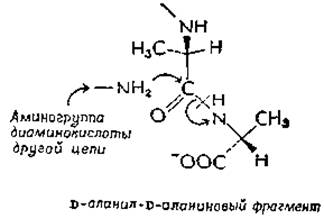
It has been suggested that penicillins are structural analogs of D-alanyl-D-alanine and bind to the Active Site of transacylaseb-c. The β-lactam ring of penicillins is unstable, making them powerful acylating agents. Assuming that transacylase operates via a double-displacement mechanism, the initial attack of penicillin—bound at the enzyme's active site by a nucleophilic group of the enzyme—should lead to the formation of an inactive penicillinylated enzyme. Experimental data not only support this proposed mechanism of penicillin action but also indicate that it modifies more than one protein; consequently, other targets for penicillin action may existb,d,e.
Closely related to penicillin is another antibiotic, cephalosporin C.
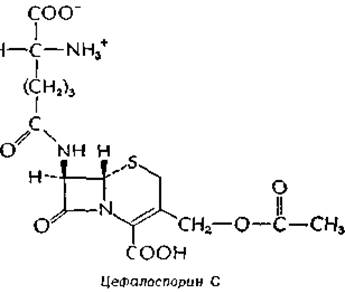
It contains a D-α-aminoadipoyl side chain; substitution of this chain with other groups yields various semisynthetic Cephalosporins.
a Hoover J. R. E., Stedman R. J. (1970). In: Medicinal chemistry (A. Burger, ed.), 3rd ed., Part I, pp. 371—408. Wiley (Interscience), New York.
b Blumberg P. M., Strominger J. L. (1972). J. Biol. Chem., 247, 8107—8113.
c Gale E. F., Cundliffe E., Reynolds P. E., Richmond M. H., Waring M. J. (1972). The Molecular Basis of antibiotic action. Wiley, New York.
d Blumberg P. M., Strominger J. L. (1974). Bacteriol. Rev., 38, 291—375.
e Spratt B. G., Pardee A. B. (1975). Nature (London), 254, 516—517.
Last update: 06/08/2026
Editorial and Educational Adaptation: This material has been compiled based on the primary/original source text. The project team performed an editorial review, corrected technical inaccuracies, structured sections, and adapted the content for an educational format.
What was processed:
- elimination of formatting defects (OCR errors, structural breaks, corrupted characters);
- editorial organization of content;
- standardization of terminology in accordance with academic sources;
- verification of factual statements against the original source text.
All mentions of the author, publication year, and origin of the primary text have been preserved in accordance with the source.