Biochemistry and Molecular Biology - Belyasova N.A. 2002
Metabolism. Processes Requiring Energy Input
Lipid Biosynthesis
Biosynthesis of Saturated Fatty Acids
Lipid METABOLISM IN the Cells of various organisms comprises two mutually opposing processes: Biosynthesis AND DEGRADATION. The Key Intermediates in these pathways are acetyl-CoA and glycerol. Acetyl-CoA is generated at each stage of fatty acid ß-Oxidation (Chapter 9) and serves as a precursor for their biosynthesis. Glycerol can be produced through The breakdown of Lipids as well as the modification of glycolytic intermediates (such as dihydroxyacetone phosphate).
Lipid metabolism proceeds quite actively, which is primarily associated with membranogenesis (alteration of Membrane Structure, synthesis of novel components). In addition, certain organisms utilize fats (triacylglycerols) as their primary energy reserve. For instance, in animals, triacylglycerols are synthesized and stored within specialized cells of adipose tissue. The body of an average adult male contains up to 12 kg of reserve lipids, which can sustain basal metabolism for up to 8 weeks, whereas Glycogen stores (several hundred grams) are sufficient to meet the body's energy demands for no more than 12 hours. Plants (particularly within fruits and seeds) and many microorganisms are likewise capable of synthesizing triacylglycerols as reserve nutrients.
The Biosynthesis of Fatty acids takes place in the Cytoplasm of Eukaryotic cells; in animals, this occurs predominantly within the Liver, adipose tissue, Kidneys, and Lungs. The immediate precursor for their synthesis is malonyl-CoA, which is formed from acetyl-CoA. In turn, the bulk of acetyl-CoA is produced in the mitochondrial matrix via The oxidative decarboxylation of Pyruvate, during fatty acid ß-oxidation, and through the breakdown of amino acid carbon skeletons. Being a charged molecule, acetyl-CoA cannot cross the mitochondrial membrane barrier; therefore, a specialized "shuttle mechanism" exists to transport acetyl groups into the cytoplasm (Fig. 15.1). Through this mechanism, acetyl moieties enter the cytoplasm as part of citrate, which is then cleaved to yield acetyl-CoA (requiring ATP and CoA) and oxaloacetate. The latter is reduced to malate and returned to the mitochondrial matrix, where citrate is regenerated.
Class="center">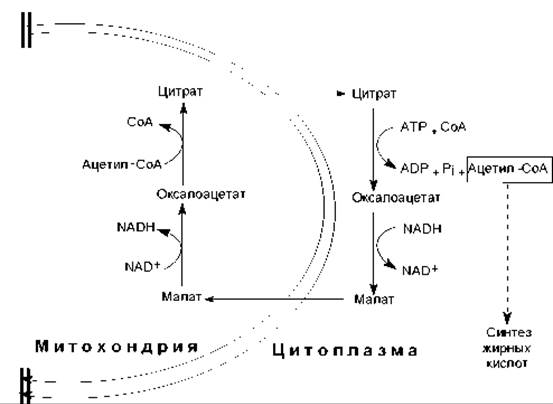
Fig. 15.1. Transport of acetyl groups across the mitochondrial membrane via the shuttle mechanism
Upon entering the cytoplasm, acetyl-CoA undergoes carboxylation catalyzed by acetyl-CoA carboxylase, the key regulatory enzyme of FATTY ACID BIOSYNTHESIS. This ATP-dependent reaction yields malonyl-CoA (Fig. 15.2). Biotin acts as the prosthetic group of acetyl-CoA carboxylase, functioning as a "mobile arm" that transfers CO2 to the acetyl-CoA molecule. The reaction proceeds in two stages (Fig. 15.2, see also Chapter 7, Fig. 7.7). The formation of malonyl-CoA is the rate-limiting step of the entire fatty acid synthesis pathway, as regulation of this pathway occurs at the level of acetyl-CoA carboxylase, with citrate serving as its primary allosteric activator. This metabolite accumulates in the Cell/35.html">Mitochondria when acetyl-CoA levels are high—meaning The Citric Acid Cycle is overloaded with "fuel," and the excess must be stored as triacylglycerols. Under such conditions, citrate is exported to the cytoplasm, where it acts simultaneously as a donor of acetyl-CoA and an activator of acetyl-CoA carboxylase. The binding of citrate to inactive monomers of acetyl-CoA carboxylase induces their assembly into a filamentous oligomer, which acquires functional activity. Furthermore, The activity of acetyl-CoA carboxylase is regulated through covalent modification: it decreases upon phosphorylation and increases upon dephosphorylation.
The malonyl-CoA generated in the cytoplasm serves as the source for the majority of carbon atoms in fatty acid molecules. The formation of palmitic acid, which contains 16 carbon atoms, proceeds according to Equation 15.1.
Acetyl-CoA + 7 malonyl-CoA + 14 NADPH + 14 H+ →
→ Palmitate + 7 CO2 + 8 CoA + 14 NADP+ + 6 H2O (15.1)

Fig. 15.2. Biosynthesis of Fatty acids: 1 — formation of malonyl-CoA; 2 — Condensation of components and chain elongation on fatty acid synthase (E)
Fatty acid chain elongation occurs stepwise through the sequential addition of two-carbon units to acetyl-CoA, facilitated by a complex multienzyme system known as fatty acid synthase. Fatty acid synthase is a homodimer, meaning it consists of two identical polypeptide chains combined into a single complex. Each of the two subunits can catalyze seven successive reactions of fatty acid chain elongation, operating in a coordinated manner such that the enzyme is active only as a dimer.
Each subunit of fatty acid synthase contains sulfhydryl groups essential for substrate binding. One SH-group is part of the phosphopantetheine moiety (Fig. 7.9), which serves as the prosthetic group of a domain known as the acyl carrier protein (ACP). The second SH-group belongs to a Cysteine residue in a different domain of the enzyme, 3-ketoacyl-ACP synthase.
The activity of the multienzyme complex is spatially distributed across several domains that participate in catalyzing the seven reactions required to construct the palmitate molecule and release the product from the enzyme complex.
The Initial Stages of fatty acid chain formation (Fig. 15.2, 2) involve The transfer of an acyl residue to the sulfhydryl group of cysteine (cys-SH) and a malonyl residue to the sulfhydryl group of phosphopantetheine (pan-SH). Both residues are located in close proximity within the synthase molecule (E). Once both SH-groups are occupied by acyl residues, chain elongation proceeds via the transfer of the acyl component to the second carbon atom of the malonyl residue, accompanied by the release of a carboxyl group as CO2. This is the same molecule of carbon dioxide that was incorporated into malonyl-CoA during the carboxylation of acetyl-CoA. Thus, net CO2 fixation (incorporation into organic matter) does not occur during fatty acid biosynthesis! Decarboxylation is necessary to drive the reaction equilibrium forward, because the elimination of CO2 dramatically enhances the reactivity of the remaining acetyl component, enabling it to readily condense with the acetyl moiety attached to the phosphopantetheine SH-group.
The subsequent three reactions involve the reduction of the 3-keto group, dehydration, and the reduction of the double bond in the enoyl intermediate. Following this, an acyltransferase transfers the acyl intermediate (the product of a two-carbon chain elongation) to the cysteine SH-group, leaving the freed phosphopantetheine SH-group ready to accept another malonyl residue.
After seven such cycles, a 16-carbon palmitoyl chain linked to the phosphopantetheine sulfhydryl group is formed. It is recognized and cleaved from the synthase by acyl-ACP hydrolase, releasing the final product, palmitic acid, into the medium. Palmitic acid serves as a precursor for the Synthesis of Other longer-chain saturated fatty acids. In eukaryotes, these processes take place in the mitochondria and The Endoplasmic reticulum, where acetyl residues—donated by acetyl-CoA or malonyl-CoA—are added to activated fatty acid CoA esters.
Last update: 06/08/2026
Editorial and Educational Adaptation: This material has been compiled based on the primary/original source text. The project team performed an editorial review, corrected technical inaccuracies, structured sections, and adapted the content for an educational format.
What was processed:
- elimination of formatting defects (OCR errors, structural breaks, corrupted characters);
- editorial organization of content;
- standardization of terminology in accordance with academic sources;
- verification of factual statements against the original source text.
All mentions of the author, publication year, and origin of the primary text have been preserved in accordance with the source.