BIOCHEMISTRY - Main Regulators and Biological Fluids of the Human Body - 2016
3. NUCLEIC ACIDS
3.7. Practical Part. Determination of the Chemical Composition of Nucleoproteins
Objective - to learn how to determine The chemical composition of a nucleoprotein hydrolysate.
Nucleoproteins are complex Proteins containing Selection/9.html">Nucleic Acids AS a prosthetic group. They constitute the bulk of the Cell Nucleus; therefore, these Proteins can be isolated from Tissues rich in nuclear material (such as The Thyroid Gland, Testes, spermatozoa, etc.).
As Structure/83.html">Structural elements of cell Organelles (nucleus and Cytoplasm) that perform critical specific Functions in living organisms, nucleoproteins play a vital biological role. Cell Division, METABOLISM/35.html">Protein Biosynthesis, and the transmission of hereditary information are closely associated with nucleoproteins, particularly with their constituent nucleic acids (DNA and RNA).
Nucleic acids - are high-molecular-weight compounds built from A large number of nucleoproteins, which consist of a heterocyclic base (purine or pyrimidine) and a carbohydrate component (ribose or 2-deoxyribose), as well as phosphoric acid.
3.7.1. Study of the Composition of Nucleoproteins
During partial Hydrolysis, nucleoproteins break down into their constituent parts: proteins, predominantly of a basic nature (Protamines and Histones), and nucleic acids.
More complete hydrolysis leads to The breakdown of both proteins and nucleic acids:
Class="center">
The Chemical composition of nucleoproteins is investigated using Yeast as an example, which is subjected to hydrolysis followed by the analysis of its degradation products (Polypeptides, purine bases, carbohydrate components, and phosphoric acid).
Hydrolysis is carried out as follows. Place 1 g of fresh baker's yeast or 0.2 g of dry yeast into a 100 ml round-bottom flask, add 20 ml of a 10% sulfuric acid solution (Н2SO4) and 20 ml of distilled Water. Fit the flask with an air-cooled condenser stopper, secure it at a slight angle, and boil in a fume hood for 1 hour. Cool the mixture, bring the volume back to the initial level with distilled water, and filter through a fluted filter. Perform the reactions described below using the filtrate.
3.7.1.1. Reactions for Polypeptides
Experiment 1. Biuret test for polypeptides
To 5 drops of the yeast hydrolysate, add 10 drops of a 10% sodium hydroxide solution (NаОН) and 1 - 2 drops of a 5% copper (II) sulfate solution - СиSO4 until a blue-violet or red-violet coloration appears in the solution.
In your report, record your observations and draw a Conclusion regarding the presence of polypeptides in the nucleoprotein.
3.7.1.2. Reactions for Purine Bases
Experiment 2. Silver test for purine bases
This method is based on the ability of purine bases to form a light brown precipitate of silver salts of purine bases (adenine, guanine) when reacted with an ammoniacal silver nitrate solution (АgNO3):

Place 10 drops of the yeast hydrolysate into a test tube, add concentrated ammonia solution (NН4ОН) dropwise until the reaction is alkaline according to universal indicator paper (1 - 10 drops), and add 10 drops of ammoniacal silver nitrate solution (АgNO3), which is prepared by adding concentrated ammonia to a 2 - 3% silver nitrate solution until the precipitate dissolves. After 3-5 minutes, a loose brown precipitate of silver compounds of purine bases is formed.
In your report, note your observations and conclude whether purine bases are present in the nucleoproteins. Which Purine bases can they contain?
3.7.1.3. Qualitative Reactions for Pentoses
Experiment 3. Diphenylamine test (Dische reaction)
The method is based on the ability of DNA deoxyribose to react with diphenylamine, forming blue-colored compounds upon heating in a medium containing a mixture of glacial acetic acid and concentrated sulfuric acid. A similar reaction with RNA ribose yields a green coloration.
To prepare the diphenylamine reagent, 1 g of diphenylamine is dissolved in 100 ml of glacial acetic acid (СН3СO2Н), and 2.75 ml of concentrated sulfuric acid (Н2SO4) is added to the resulting solution.
Add 0.5 - 1 ml of the diphenylamine reagent to 10 drops of yeast nucleoprotein hydrolysate. Mix the Contents of the test tube and heat in a water bath for 15 - 20 minutes. Note the characteristic coloration of the solution.
In your report, record your observations and draw a conclusion regarding the presence of pentoses in nucleoproteins. What pentoses may be contained in them?
Experiment 4. Trommer's Test
This test, like the two following ones, is based on the ability of ribose and 2-deoxyribose, which possess a free glycosidic hydroxyl group, to reduce oxidized metal forms (Сu, Fе, Вi) in an alkaline medium to lower oxidation states, and the latter to the free state. Under these conditions, sugars yield various oxidation products.
Trommer's test is based on the reactions described below.
1. When an aqueous sodium hydroxide (NаОН) solution is added to a copper(II) sulfate (СuSO4) solution, a blue precipitate of copper(II) hydroxide (Сu(ОН)2) is formed:

2. Upon heating in the presence of reducing sugars (ribose, 2-deoxyribose), copper(II) hydroxide (Сu(ОН)2) is reduced to copper(I) hydroxide (СuОН, a yellow precipitate), then to copper(I) oxide (Сu2O), ultimately resulting in a brick-red precipitate.
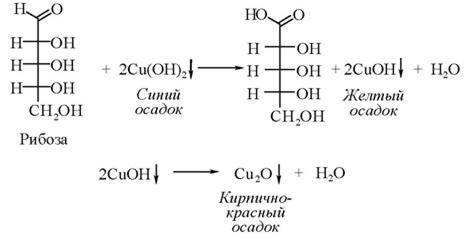
An excess of copper(II) sulfate (СuSO4) interferes with the reaction, as it leads to The formation of a large amount of copper(II) hydroxide (Сu(ОН)2), which decomposes upon heating to form a black precipitate of copper(II) oxide (СuО):
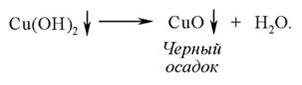
Add 5 drops of a 30% sodium hydroxide (NаОН) solution and a few drops of a 7% copper(II) sulfate (СuSO4) solution to 5 drops of yeast hydrolysate until a persistent turbidity of copper(II) hydroxide (Сu(OН)2) appears. Upon heating to boiling, a yellow precipitate of copper(I) hydroxide (СuОН) or a brick-red precipitate of copper(I) oxide (Сu2O) separates out.
In your report, record your observations, conclude whether pentoses are present in nucleoproteins and assess their reducing properties, and indicate which structural feature accounts for these properties (if in doubt, refer to Part 1 of this manual, Section 3).
Experiment 5. Fehling's Test
Fehling's test is a modification of Trommer's test. It utilizes Fehling's reagent, prepared by mixing 5 drops of a 7% copper(II) sulfate (СUSO4) solution and 5 drops of Rochelle salt solution (345 g of potassium sodium tartrate tetrahydrate, KNaC4H4O6 • 4Н2O, dissolved in distilled water), adding 140 g of sodium hydroxide (NаОН), and bringing the volume to 1 L with water in a volumetric flask.
Add 5 - 7 drops of yeast hydrolysate to Fehling's reagent, mix, and heat to boiling. Observe the formation of a colored precipitate.
In your report, indicate the color of the precipitate, describe how the solution's color changes, and draw a conclusion regarding the presence of pentoses in nucleoproteins.
Experiment 6. Tollen's Reaction
Unlike the two previous reactions, Tollen's reaction is specific for pentoses. It is driven by the interaction between phloroglucinol and furfural, which is formed from pentose upon heating with Hydrochloric acid (НСI). This yields a red Condensation product.
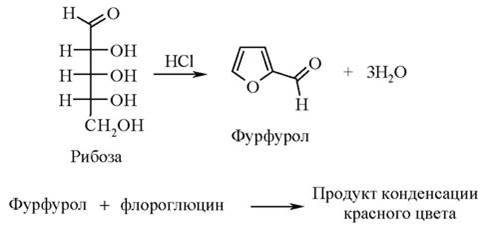
Place 5 - 7 drops of yeast hydrolysate and 2 - 3 drops of a 0.5% solution of phloroglucinol in concentrated hydrochloric acid (НСI) into a test tube and boil for 1 minute. Observe The change in the solution's color.
In your report, note how the solution's color changes and draw a conclusion regarding the presence of pentoses in nucleoproteins.
Experiment 7. Molisch's Test
Add 10 drops of yeast hydrolysate to a test tube, followed by 3 drops of a 1% thymol solution. Then, carefully pour 20 drops of concentrated hydrochloric acid (HCl) down the side of the test tube and boil for 1 minute. Observe any Changes in the color of the solution.
In your report, describe how the color of the solution changes and draw a conclusion regarding the presence of pentoses in nucleoproteins.
3.7.1.4. Color reactions for phosphoric acid
Experiment 8. Molybdenum test for phosphoric acid
To prepare the molybdenum reagent, dissolve 7.5 g of ammonium molybdate – (NH4)2MoO4 in 100 ml of distilled water, and add 100 ml of a 32% nitric acid solution (HNO3) with a density of 1.2 g/cm3.
Place 5 drops of yeast hydrolysate into a test tube, add 10–20 drops of the molybdenum reagent, and boil for a few minutes. Upon cooling the test tube under running cold water, a lemon-yellow crystalline precipitate of ammonium phosphomolybdate forms:

3.7.1.5. Color reactions for nucleotide-based pharmaceutical drugs
A solution of adenosine triphosphate (ATP, an agent that improves tissue Metabolism and Energy supply) is used as a representative nucleotide-based drug.
Experiment 9. Detection of ribose in adenosine triphosphate
This method is based on the detection of ribose using the diphenylamine reaction.
Add 5 drops of sodium adenosine triphosphate solution to a test tube, add 10 drops of diphenylamine reagent, and heat in a boiling water bath for 10 minutes.
Record the reaction result in your report and conclude whether ribose is present in the adenosine triphosphate structure.
3.7.2. Practical significance of the work
Reactions for nucleic acid components can be utilized for their identification and quantitative analysis in biochemical research, as well as for quality control of nucleotide-based Pharmaceuticals in pharmacy.
Last update: 06/08/2026
Editorial and Educational Adaptation: This material has been compiled based on the primary/original source text. The project team performed an editorial review, corrected technical inaccuracies, structured sections, and adapted the content for an educational format.
What was processed:
- elimination of formatting defects (OCR errors, structural breaks, corrupted characters);
- editorial organization of content;
- standardization of terminology in accordance with academic sources;
- verification of factual statements against the original source text.
All mentions of the author, publication year, and origin of the primary text have been preserved in accordance with the source.