BIOCHEMISTRY - Main Regulators and Biological Fluids of the Human Body - 2016
3. NUCLEIC ACIDS
3.8. Questions for Practical Class Preparation
1. Complete the statement.
The major purine bases include...
2. Complete the statement.
The major pyrimidine bases include...
3. Establish the correspondence.
Class="center">
4. Choose the correct answer option.
A minor purine base is:

5. Choose the correct answer option.
The nitrogenous base found exclusively in RNA is:
1) thymine;
2) cytosine;
3) uracil;
4) guanine;
5) adenine.
6. Choose the correct answer option.
The nitrogenous base found exclusively in DNA is:
1) N6 - methyladenine;
2) hypoxanthine;
3) uracil;
4) thymine;
5) adenine.
7. Complete the statement.
DNA contains the following purine and pyrimidine bases...
8. Complete the statement.
RNA contains the following purine and pyrimidine bases...
9. Choose the correct answer option.
A nucleoside consists of:
1) two nitrogenous bases;
2) a nitrogenous base and a pentose;
3) a nitrogenous base, a pentose, and a phosphoric acid residue.
10. Choose the correct answer option.
A nucleotide consists of:
1) two nitrogenous bases;
2) a nitrogenous base and a pentose;
3) a nitrogenous base, a pentose, and a phosphoric acid residue.
11. Choose the correct answer option.
In NUCLEOTIDES, the nitrogenous base and pentose are linked by:
1) a phosphoester bond;
2) an N - glycosidic bond;
3) an O - glycosidic bond.
12. Choose the correct answer option.
RNA contains:
1) D - ribose;
2) α - D - ribofuranose:
3) β - D - ribofuranose:
4) β - D - 2-deoxyribofuranose.
13. Select the correct answer option.
DNA contains:
1) L - deoxyribose:
2) α - D - 2- deoxyribofuranose:
3) α - D - ribofuranose:
4) β - D - 2 - deoxyribofuranose.
14. Select the correct answer option.
A pyrimidine nucleoside is:
1) adenosine;
2) adenine;
3) adenosine triphosphate;
4) cytidine;
5) cytosine.
15. Select the correct answer option.
A purine nucleoside is:
1) uridine;
2) guanosine;
3) guanine;
4) uracil;
5) adenosine triphosphate.
16. Select the correct answer option.
A minor nucleoside is:
1) adenosine triphosphate;
2) adenosine;
3) cytidine;
4) guanosine;
5) inosine.
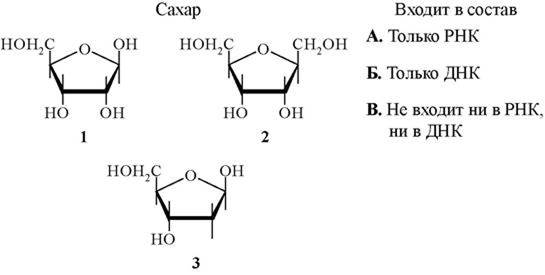
17. Match the following.
18. Choose the correct answer option.
Complete acid Hydrolysis of Nucleic Acids yields all of the following substances except:
1) phosphoric acid;
2) purine bases;
3) adenine;
4) pentose;
5) adenosine triphosphate.
19. Choose the correct answer option.
The products of RNA acid hydrolysis contain:
1) adenine only;
2) guanine only;
3) cytosine only;
4) uracil only;
5) all of the bases listed in items 1–4.
20. Choose the correct answer option.
Mild acid hydrolysis of RNA yields:
1) D-deoxyribose, cytosine, adenine;
2) D-ribose, thymine, guanine;
3) D-ribose, cytosine, uracil, thymine;
4) D-ribose, uracil, adenine, guanine, cytosine;
5) D - deoxyribose. Cytosine, thymine, adenine, guanine.
21. Choose the correct answer option.
The compounds characterized by the structures shown below are:

1) optical isomers;
2) tautomeric forms;
3) cis-trans isomers;
4) geometric isomers;
5) conformational isomers.
22. Choose the correct answer option.
Action of nitrous acid via Oxidative Deamination converts adenine into:
1) guanine;
2) xanthine;
3) hypoxanthine;
4) uric acid;
5) allantoin.
23. Choose the correct answer option.
Action of nitrous acid via oxidative deamination converts guanine into:
1) xanthine;
2) hypoxanthine;
3) adenine;
4) uric acid;
5) allantoin.
24. Choose the correct answer option.
Action of nitrous acid via oxidative deamination converts cytosine into:
1) xanthine;
2) hypoxanthine;
3) allantoin;
4) uric acid;
5) uracil.
25. Choose the correct answer option.
In a DNA molecule, the number of guanine residues is equal to the number of:
1) thymine residues;
2) adenine residues;
3) hypoxanthine residues;
4) cytosine residues;
5) uracil residues.
26. Choose the correct answer option.
In a DNA molecule, the number of adenine residues is equal to the number of:
1) thymine residues;
2) guanine residues;
3) cytosine residues;
4) xanthine residues;
5) uracil residues.
27. Choose the correct answer option.
In a DNA molecule, according to Chargaff's rule, The amount of purine bases is equal to:
1) the amount of thymine and uracil;
2) the amount of pyrimidine bases;
3) the amount of bases containing a hydroxyl group at position 4 of the pyrimidine ring and position 6 of the purine ring;
4) the amount of bases containing an amino group at position 4 of the pyrimidine ring and position 6 of the purine ring;
5) the amount of cytosine and thymine.
Last update: 06/08/2026
Editorial and Educational Adaptation: This material has been compiled based on the primary/original source text. The project team performed an editorial review, corrected technical inaccuracies, structured sections, and adapted the content for an educational format.
What was processed:
- elimination of formatting defects (OCR errors, structural breaks, corrupted characters);
- editorial organization of content;
- standardization of terminology in accordance with academic sources;
- verification of factual statements against the original source text.
All mentions of the author, publication year, and origin of the primary text have been preserved in accordance with the source.