BIOCHEMISTRY - Main Regulators and Biological Fluids of the Human Body - 2016
3. NUCLEIC ACIDS
3.6. Protein Biosynthesis. Translation
METABOLISM/35.html">Protein Biosynthesis involves a series of sequential processes.
1. Transcription (reading information from DNA to mRNA).
2. Transport of mRNA to the Cytoplasm and Ribosomes. Through the pores of the nuclear envelope, mRNA moves into the cytoplasm to the sites of ribosome aggregation, where Amino Acids will be delivered with the help of tRNA (see Part 1 of this manual, Section 1).
3. Translation (Synthesis of the protein chain by reading information from mRNA).
Translating information from the nucleotide language into The amino acid language occurs using The Genetic Code.
The genetic code is a system for recording information about The sequence of amino acids in Proteins via the sequence of NUCLEOTIDES in Messenger RNA.
How is information transferred from mRNA, which contains only 4 types of nucleotides, to a protein containing 20 types of amino acids?
It has been established that coding for a single amino acid requires a triplet — a sequence of three nucleotides (Table 5).
The properties of the genetic code include triplet nature, degeneracy, non-ambiguity, the presence of punctuation marks between genes, and universality.
Triplet nature. Each of the 20 amino acids is encoded by three consecutively arranged nucleotides, called a triplet or codon.
Degeneracy. Each amino acid is encoded by more than one codon (from 2 to 6). The only exceptions are the amino acids Methionine (AUG) and Tryptophan (UGG), each of which is encoded by a single triplet.
Non-ambiguity. Each code encodes only one amino acid.
Presence of punctuation marks between genes. There are three triplets that do not encode any amino acid. These are stop codons: UAA, UAG, UGA. Each of them terminates the synthesis of a polypeptide chain and is located at the end of every Gene.
Universality. The genetic code is identical for All living organisms on Earth (Bacteria, Fungi, plants, animals, humans).
Class="center">Table 5
Genetic Code
1st base |
2nd base |
3rd base |
|||||||
U |
Amino acid |
C |
Amino acid |
A |
Amino acid |
G |
Amino acid |
||
U |
UUU |
(Phe/F) Phenylalanine |
UCU |
(Ser/S) Serine |
UAU |
(Tyr/Y) Tyrosine |
UGU |
(Cys/C) Cysteine |
U |
UUC |
UCC |
UAC |
UGG |
C |
|||||
UUA |
(Leu/L) Leucine |
UCA |
UAA |
Ochre (Stop) |
UGA |
Opal (Stop) |
A |
||
UUG |
UCG |
UAG |
Amber (Stop) |
UGG |
(Trp/W) Tryptophan |
G |
|||
C |
CUU |
(Leu/L) Leucine |
CCU |
(Pro/P) Proline |
CAU |
(His/H) Histidine |
CGU |
(Arg/R) Arginine |
U |
CUC |
CCC |
CAC |
CGC |
C |
|||||
CUA |
CCA |
CAA |
(Gln/Q) Glutamine |
CGA |
A |
||||
CUG |
CCG |
CAG |
CGG |
G |
|||||
A |
AUU |
(Ile/I) Isoleucine |
ACU |
(Thr/T) Threonine |
AAU |
(Asn/N) Asparagine |
AGU |
(Ser/S) Serine |
U |
AUG |
ACC |
AAC |
AGC |
C |
|||||
AUA |
ACA |
AAA |
(Lys/K) Lysine |
AGA |
(Arg/R) Arginine |
A |
|||
AUG |
(Met/M) Methionine, Start |
ACG |
AAG |
AGG |
G |
||||
G |
GUU |
(Val/V) Valine |
GCU |
(Ala/A) Alanine |
GAU |
(Asp/D) Aspartic acid |
GGU |
(Gly/G) Glycine |
U |
GUC |
GCC |
GAC |
GGC |
C |
|||||
GUA |
GCA |
GAA |
(Glu/E) Glutamic acid |
GGA |
A |
||||
GUG |
GCG |
GAG |
GGG |
G |
|||||
Translation, i.e., the synthesis of a protein molecule whose Structure is encoded in mRNA, is carried out by a complex protein-synthesizing system that includes:
- ribosomes (where rRNA accounts for 60% and other proteins for 40%);
- messenger (template) RNA (mRNA);
- initiation and elongation factors (i.e., factors responsible for the formation and elongation of the polypeptide chain);
- a set of amino acids;
- Transfer RNA (tRNA);
- energy source (ATP).
Prior to translation proper, Processing (splicing) takes place, specifically the excision of introns (non-coding genes) followed by the ligation of exons (the protein-coding segments of mRNA).
Translation consists of six stages.
1. The small ribosomal subunit (Fig. 12) attaches to the mRNA (like an eye of a needle on a thread), encompassing precisely 2 codons at a time.
2. A tRNA molecule enters the A-site (acceptor site) of the large ribosomal subunit, and its anticodon temporarily pairs with the codon located on the mRNA.
3. The amino acid carried on the "tail" of the tRNA is detached and attached to the growing protein chain.
4. The ribosome shifts to the next triplet.
5. The "empty" tRNA leaves the P-site (donor site) and returns to the cytoplasm to pick up a new amino acid.
6. A new aminoacyl-tRNA enters the vacant acceptor site of the ribosome, and steps 2 through 5 are repeated.
The initiation of Protein Synthesis is triggered by the start codon—the AUG codon located first (at the 5' end) in the mRNA chain. It interacts with the anticodon of a specialized tRNA bound to formylmethionine. If an AUG codon appears internally within the mRNA (not as the first codon), it encodes the amino acid methionine.
Synthesis of any polypeptide chain begins with formylmethionine. Subsequently, the elongation of the polypeptide chain proceeds According to the genetic code (executing translation steps 2–5). When one of the three stop triplets (UAA, UAG, UGA) reaches the ribosome, no tRNA can occupy the ribosomal acceptor site because there are no tRNAs with anticodons complementary to stop codons. Protein synthesis terminates, and the completed protein molecule detaches from the ribosome. Upon completion of Polypeptide chain synthesis, formylmethionine is cleaved off and is absent from the mature protein.
Fig. 12. Diagram of protein biosynthesis:
1 - aminoacyl-tRNA; 2 - tRNA; 3 - amino acid; 4 - small ribosomal subunit; 5 - mRNA; 6 - codon; 7 - anticodon; 8 - large ribosomal subunit; 9 - amino acid

Several identical protein molecules are synthesized simultaneously on a single mRNA strand through the action of polyribosomes.
A polysome is a structure consisting of a single mRNA molecule and multiple ribosomes attached to it (Fig. 13).
Fig. 13. Diagram of a polysome
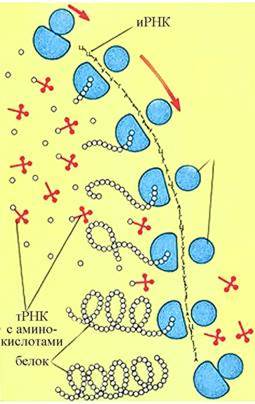
Aminoacids are continuously delivered to the ribosomes by tRNA. After releasing its amino acid, the tRNA leaves the ribosome and, aided by the enzyme codase, rebinds to the same amino acid.
The high coordination of all Stages of Protein biosynthesis enables the synthesis of polypeptide chains comprising hundreds of amino acids within a matter of seconds.
The amino acids in the synthesized protein molecule are linked in the exact sequence corresponding to the codons encoding them on the mRNA, which in turn is a mirror copy of the coding DNA strand.
Protein synthesis is a complex, multistep process dependent on the functional state of DNA, Rna, and the protein-synthesizing machinery. Regulatory mechanisms controlling the Rate of protein formation operate both in The Nucleus and in the cytoplasm.
Last update: 06/08/2026
Editorial and Educational Adaptation: This material has been compiled based on the primary/original source text. The project team performed an editorial review, corrected technical inaccuracies, structured sections, and adapted the content for an educational format.
What was processed:
- elimination of formatting defects (OCR errors, structural breaks, corrupted characters);
- editorial organization of content;
- standardization of terminology in accordance with academic sources;
- verification of factual statements against the original source text.
All mentions of the author, publication year, and origin of the primary text have been preserved in accordance with the source.