Vertebrate Zoology - V. M. Konstantinov 2011
Chordates
Terrestrial, or Four-Legged, Vertebrates — Vertebrates with Embryonic Membranes
Class Reptilia, or Reptiles — Subclass Lepidosauria — Order Squamata — Suborder Serpentes (Snakes)
Snakes are specialized legless squamates that have adapted to creeping through dense vegetation, along tree branches and bushes, and to feeding on relatively large prey which they swallow whole. Unlike legless lizards, snakes are distinguished by a movable joint between the left and right halves of the jaws, the absence of movable eyelids and eardrums, a Pectoral Girdle, and free limbs, along with several other features. Only boas possess small rudiments of the Femur and ilium (Figs. 106 and 107). Pelvic remnants are also present in blind snakes (Typhlopidae).
The upper side of a snake's body is covered with small horny scales, and the underside with scutes. There are no Skin glands (with the exception of certain species of grass snakes). Molting occurs in a rather peculiar manner: the old surface layer of skin detaches at the jaws and gradually sloughs off the body, turning inside out like the finger of a glove. During molting, the surface layer of the fused eyelids also sheds, which is why snakes' eyes appear most transparent right after molting. Due to their mode of locomotion, THE Vertebral Column consists of A large number (140 — 435) of uniform vertebrae. Their Structure provides exceptional strength combined with The flexibility of the spinal column, which is essential for creeping through lateral body undulations. The vertebrae bear freely ending Ribs, the free tips of which press against a layer of musculature connected to the ventral horny scutes. Movements of the ribs facilitate more efficient body propulsion, particularly when a snake moves through a narrow burrow.
The Skull of snakes is unique, exhibiting several adaptive features. The movable Articulation of the jaw bones with the associated palatine, pterygoid, and squamosal bones enables the swallowing of large animals whole. When engulfing prey, the snake alternately advances the left and right halves of the lower jaw, effectively creeping over its victim. The ingestion of a large food bolus is facilitated by abundant secretions from the Salivary Glands. Most snakes are non-venomous and kill their prey through the mechanical action of their Teeth or by constricting them. In venomous snakes, the larger anterior teeth possess grooves or channels through which venom—a secretion of modified salivary glands—flows. The arrangement of fangs and their displacement during a bite are shown in Fig. 108.
Regarding The structure of other Organs, the following features should be noted: only the right lung is developed, while the left lung is rudimentary. There is no Urinary Bladder, and the Kidneys and Gonads are greatly elongated. The reproductive glands are located anterior to the kidneys.
The total number of modern snake species is about 3,000. They are found in all PARTS OF THE world, though they predominate numerically in hot climates. In northern Europe, snakes occasionally extend beyond the Arctic Circle, while in the south they range to the tip of South America.
Snakes are absent from Tierra del Fuego, New Zealand, and several Polynesian islands. These reptiles inhabit A wide variety of ecological environments: forests, steppes, deserts, and mountains. The majority of species are terrestrial, while some dwell arboreally, subterraneously, or in Water.
They reproduce via oviposition, ovoviviparity, and viviparity. Feeding exclusively on animal matter, they consume creatures of diverse sizes—from deer fawns to small rodents and insects. They acquire food by ambushing animals and striking with lightning speed. It is worth adding that venomous snakes will only attack humans when disturbed.
Snake systematics is complex. Let us highlight some of their families.
The family Boidae includes the largest Representatives of the order—pythons and boas (85 species). Among the boas, some are very small (reaching a length of only up to 1 m). Compared to other snakes, the HEAD of boas is clearly demarcated from the neck. Rudiments of hind limbs are present, appearing as two projections on the sides of the cloaca. The Skeleton retains remnants of the pelvis and femur. The coloration is most often mottled.
Class="center">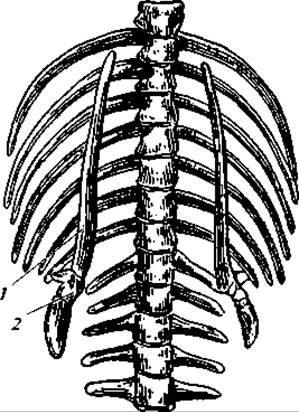
Fig. 106. Skeleton of the Pelvic Girdle of a boa. Rudiments of the ilium (1) and femur (2) are visible
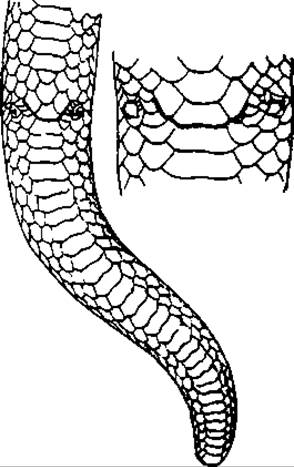
Fig. 107. Hind limb rudiments in the Tartary sand boa
Almost all boas are distributed in the tropical Regions of the Eastern and Western Hemispheres. Only a few species are found in the subtropics and even in the deserts and steppes of Central Asia and the Caucasus. In the tropics, boas predominantly inhabit dense humid forests, where they are numerous near rivers and lakes. Boas also live in thickets of bushes and in swamps. They are most active at night, especially in open areas. In dense forests, where twilight lingers even during the day, they hunt in daylight hours. They crawl slowly and very cautiously toward their prey, catching it by striking from a short distance and suffocating it by coiling their bodies around it in several loops.
The best known is the reticulated python (Python reticulatus), which reaches a length of 10 m and is distributed in southern Asia and the Indo-Malayan Archipelago. The boa constrictor (Boa constrictor), with a body length of 5–6 m, inhabits South America. In Central Asia and the Caucasus lives the smallest representative of the family—the sand boa (Eryx jaculus), whose body length does not exceed 1 m. It inhabits sandy deserts and arid steppes and leads a nocturnal lifestyle. By day, it hides in rodent burrows or burrows into the sand, moving freely beneath its surface layer. It preys on jerboas, gerbils, and small reptiles. The family Colubridae is the largest group of snakes, encompassing over 2,000 species, ranging from harmless to highly venomous. Unlike vipers, the fangs of colubrids lack a canal, and venom flows along a groove on the anterior surface of the teeth.
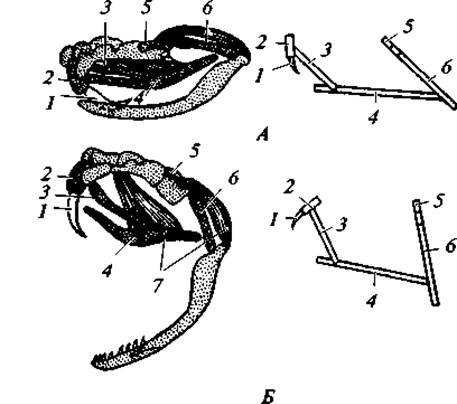
Fig. 108. SKULL OF A rattlesnake with closed (A) and open (B) jaws: 1 — fang; 2 — Maxilla; 3 — Palatine bone; 4 — pterygoid bone; 5 — squamosal bone; 6 — quadrate bone; 7 — Muscles
The grass snake (Natrix natrix) is easily distinguished by its dark, almost black coloration and two yellow spots symmetrically located behind the temples (only a few individuals lack these spots).
It is distributed across the European part of Russia and in Siberia—eastward to Transbaikalia. It frequents the banks of marshes, rivers, and ponds. It feeds on frogs, lizards, rodents, and less frequently insects. It reproduces by laying eggs, which it deposits in decaying vegetation in damp places.
In the southern zones of our country lives the dice snake (N. tessellata), easily distinguished from the previous species by its light olive-gray coloration with darkish spots. This species is even more closely tied to aquatic habitats and consumes fish more often than the grass snake.
Racer snakes (Coluber, Elaphe), which often reach 2 m in length, lack fangs but will aggressively charge humans and deliver painful bites when pursued. They are distributed in the southern Russian steppes, the Caucasus, Central Asia, and the Russian Far East.
The smooth snake (Coronella austriaca) is a small snake (up to 75 cm long) of a reddish-brown color, featuring an indistinct pattern of dark brown spots. Found in the middle and southern belts of the European part of Russia, it usually stays in bushes or forests and avoids damp places. It is non-venomous and feeds primarily on lizards.
The family Elapidae includes the largest venomous snake, the king cobra (Ophiophagus hannah). The spectacled cobra (Naja naja) features a distinct pattern of two light, spectacle-shaped spots on the upper side of its neck. They are distributed in South and Southeast Asia.
In southern Turkmenistan lives the Central Asian cobra (Naja oxiana). Its coloration is uniform gray, lacking the spectacle-shaped spots characteristic of southern species. It inhabits gorges and areas near human settlements, and its bite is extremely dangerous. Cobras are characterized by The ability to raise the anterior third of their body and broaden their neck by spreading the ribs of their cervical vertebrae—a posture assumed when they are agitated.
The family Hydrophiidae comprises inhabitants of the tropical regions of the Pacific and Indian Oceans, characterized by a broad, paddle-like tail. The nostrils are positioned on the upper side of the head, facilitating air breathing. Most are viviparous, and all species are venomous.

Fig. 109. Overwintering vipers
The viper family (Viperidae) comprises venomous snakes equipped with a well-developed venom apparatus. Their fangs feature internal canals and swing forward as the Mouth opens. There are 210 species in total.
The common adder (Vipera berus) is widely distributed across both European Russia and Siberia. Adders exhibit varied coloration: they are most commonly grey with a dark zigzag stripe along the back, or entirely black. They typically inhabit forests and avoid bogs. During the day, they can often be spotted basking on brushwood piles, tree stumps, or the southern slopes of ravines. They hunt at night, preying on mice, voles, and occasionally birds, lizards, frogs, and insects. They are ovoviviparous, giving birth to live young. For the winter, adders congregate in underground shelters, sometimes forming large aggregations (Fig. 109). An adder bite is particularly dangerous for the sick and children, and can occasionally be fatal.
In Central Asia and the Caucasus lives the blunt-nosed viper, or gurza (Macrovipera lebetina), which reaches lengths of up to 2 m. It inhabits dry steppes and foothills, and its bite is highly dangerous. In the southern regions of Central Asia, Africa, and Arabia, the saw-scaled viper (Echis carinatus) is widespread—a fierce snake growing up to 70 cm in length with a sandy-yellowish overall coloration. Its bite is likewise dangerous. Closely related to vipers are the American pit vipers (Crotalidae). They derive their name from a specialized rattle—a series of loosely articulated, keratinous segments located at the tip of the tail (Fig. 110). When agitated, the snake vibrates its tail, producing a buzzing sound. Their bite is extremely dangerous.

Fig. 110. Rattle of a rattlesnake (external view (A) and longitudinal section (B))
Last update: 13/08/2026
Editorial and Educational Adaptation: This material has been compiled based on the primary/original source text. The project team performed an editorial review, corrected technical inaccuracies, structured sections, and adapted the content for an educational format.
What was processed:
- elimination of formatting defects (OCR errors, structural breaks, corrupted characters);
- editorial organization of content;
- standardization of terminology in accordance with academic sources;
- verification of factual statements against the original source text.
All mentions of the author, publication year, and origin of the primary text have been preserved in accordance with the source.