Vertebrate Zoology - V. M. Konstantinov 2011
Chordates
Terrestrial, or Tetrapod, Vertebrates — Amniotes
Class Reptilia, or Reptiles — Subclass Lepidosauria — Order Squamata — Suborder Lizards
The suborder Lizards (Lacertilia) comprises about 4,300 species. Their external appearance varies significantly. Most lizards have an elongated body with a long, flexible tail and a distinctly defined neck. While many possess well-developed limbs, some species have reduced limbs or lack them entirely. Externally, such legless lizards resemble snakes; however, unlike snakes, legless lizards retain a Sternum and, in most cases, limb girdles. The upper jaw bones are immovably attached to the Skull, and the left and right halves of the lower jaw are fused together. They feature movable eyelids and an externally visible tympanic membrane (eardrum). When caught by a predator, many species are capable of shedding a portion of their tail (autotomy). After some time, the tail regenerates, though in a shortened form.
Geographically, lizards are very widely distributed. The majority of species inhabit the tropics, some representatives reach the Arctic Circle, and in mountainous regions, they ascend to altitudes of up to 4,000 meters. Some lizards lead a subterranean or semi-arboreal lifestyle. They are rarely found in Water—these exceptions belong to a small group of marine iguanas (Amblyrhynchus) (Fig. 104).
The gecko family (Gekkonidae) includes 900 species of small, highly primitive lizards, mostly possessing amphicoelous vertebrae. They are nocturnal animals that skillfully climb rocks, tree trunks, and house walls. The underside of their toes is equipped with expanded lamellae covered in microscopic bristle-like hairs capable of gripping the finest surface irregularities. This feature allows them to move across smooth vertical surfaces and even upside down on ceilings. By day, most geckos hide in crevices, under rocks, beneath tree bark, or burrow into sand. They are distributed in hot deserts, tropics, and subtropics of both hemispheres, and are found in Crimea, Transcaucasia, Central Asia, and Kazakhstan.
The agama family (Agamidae) comprises 350 species of small to medium-sized lizards with a long, flexible, and non-fragile tail. Their limbs are well developed, typically with long toes. Agamas are terrestrial or arboreal animals inhabiting primarily the desert regions of Africa, Asia, and Australia, though some are found in mountainous areas and tropical forests. In Central Asia, the steppe agama (Agama sanguinolenta), a relatively large species (25–35 cm long) inhabiting clay and sandy shrub deserts, is common. Closely related to it is the Caucasian agama (A. caucasicus), which lives in the mountains of Dagestan, Transcaucasia, and the Kopet Dag. The toad-headed agama, or secret toadhead (Phrynocephalus mystaceus), features a broad, convex HEAD with large Skin-fringed folds located at the corners of its Mouth. When frightened, this agama opens its mouth wide and spreads these folds like "ears." The sand toadhead (Ph. interscapularis) is a small lizard (6–8 cm long) inhabiting the sandy deserts of Central Asia. When threatened, toadheads instantly burrow into the sand by making undulating movements with their bodies pressed against the ground.
The flying dragon (Draco volans) is widespread in the forests of South Asia. It is a small lizard capable of gliding flight thanks to lateral skin folds along the sides of its body, which are supported during flight by 6–7 elongated false Ribs. When jumping from tree to tree, it can cover distances of up to 30 meters.
Class="center">
Fig. 104. Lizards:
1 — steppe gecko; 2 — steppe agama; 3 — toad-headed agama; 4 — frilled lizard; 5 — swift lacertid; 6 — sand lizard; 7 — desert monitor; 8 — European Glass lizard
The iguana family (Iguanidae) contains about 700 species of large lizards (up to 1.5 m long) that share many similarities with agamas, but are distributed almost exclusively in the Western Hemisphere. Iguanas inhabit mountains, forests, and deserts, with some species living in water, even in the sea. They reproduce through oviposition and ovoviviparity. The meat and eggs of iguanas are consumed by the local population.
The glass lizard family (Anguidae) comprises harmless lizards characterized by a complete evolutionary series ranging from forms with fully developed limbs to legless ones that externally resemble snakes. Most species are distributed in North America, with a few inhabiting South America, Europe, and Southeast Asia. In Russia, two completely legless species are found: the slowworm (Anguis fragilis) and the European glass lizard (Ophisaurus apodus). The slowworm inhabits the forests of the European part of Russia and reproduces via viviparity. The larger European glass lizard (up to 1 m long) is distributed in Crimea, the Caucasus, and Central Asia, frequenting dry steppes and often ravine slopes. It reproduces by laying eggs.
The beaded lizard family (Helodermatidae) consists of clumsy lizards with short limbs and a thick, blunt tail, reaching up to 60 cm in length. They are venomous, and their bite is dangerous to humans. Two species are found in the southwestern part of North America.
The monitor lizard family (Varanidae) includes very large, slender lizards with a long, mobile tail and well-developed legs. They run swiftly, holding their bodies high above the ground. They are distributed in Africa, South Asia, Australia, and the islands of Oceania. Many species live near water and frequently submerge into aquatic habitats. The desert monitor (Varanus griseus) inhabits the sandy deserts of Turkmenistan and Uzbekistan. The largest species, the Komodo dragon (V. komodoensis), lives in Indonesia on the islands of Komodo and Flores, reaching up to 3.65 meters in length. It is carnivorous, preying on small mammals and birds, and frequently scavenges on wild boars killed by hunters. There are 30 known species of monitor lizards.
The true lizard family (Lacertidae) comprises small- to medium-sized, slender animals with a long, fragile tail and well-developed pentadactyl limbs. The total number of species is around 200. The greatest diversity occurs in steppes, deserts, and foothills, whereas in the forest zone, they prefer areas with dry, well-warmed soil. A notable exception is the viviparous lizard (Lacerta vivipara), which is widespread across Russia in shaded forests, often on damp, moss-covered ground; it is the only species that extends beyond the Arctic Circle. In central Russia, the sand lizard (L. agilis) is common, while the large green lizard (L. viridis) is prevalent in Ukraine and the Caucasus. Several species also inhabit Asia and Africa.
Many Representatives of the skink family (Scincidae) are fossorial, living in the soil. Their limbs are more or less reduced. A number of species inhabit mountainous regions and climb rocks skillfully. Skinks possess smooth, overlapping horny scales that outwardly resemble the scales of teleost fish. They are distributed in temperate and warm climates worldwide.
Armenia and southern Central Asia are home to the gold-mabouya (Mabuya aurata), which has well-developed limbs, and the desert lidless skink (Ablepharus deserti), which features somewhat reduced limbs.
The chameleon family (Chamaeleontidae) is distributed in Madagascar, Africa, Asia Minor, India, and southern Spain. Most species live in forests (Fig. 105).
These are highly specialized reptiles closely related to lizards and adapted to an arboreal lifestyle. They are small to medium in size: most species have a body length of 25–35 cm, the largest reach 50 or even 60 cm, and the smallest measure 3–5 cm.
A chameleon's body is laterally compressed and bears a sharp crest along the back. Its legs are long and adapted for climbing; the toes are fused into two opposing groups forming pincer-like structures that can firmly grasp tree branches. The animal uses its long, prehensile tail when climbing. Their eyes are highly distinctive. Fused, thick, convex eyelids are covered with small scales, leaving a tiny central aperture for the pupil. The left and right eyes move independently of each other, which widens the field of Vision and is crucial when catching insects. Chameleons can inflate themselves significantly due to the filling of pulmonary air sacs with air. They are well known for their ability to change color, driven by the redistribution of skin pigments under METABOLISM/18.html">The Influence of light, Temperature, fear, and other stimuli.
When hunting insects, a chameleon lightning-fast projects its long Tongue—which exceeds half its body length and terminates in a thickened, cylinder-like tip with a front indentation. Chameleons spend hours sitting motionless on tree branches, watching for flying and crawling insects. While the body remains completely still, the eyes are in constant motion. Occasionally, chameleons slowly stalk their prey.
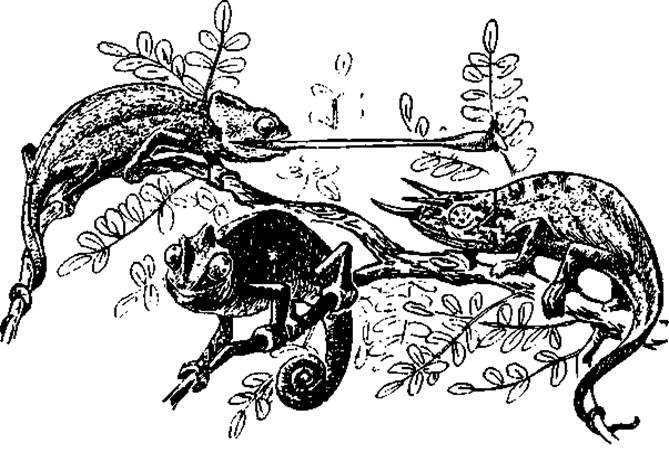
Fig. 105. Chameleons
Last update: 13/08/2026
Editorial and Educational Adaptation: This material has been compiled based on the primary/original source text. The project team performed an editorial review, corrected technical inaccuracies, structured sections, and adapted the content for an educational format.
What was processed:
- elimination of formatting defects (OCR errors, structural breaks, corrupted characters);
- editorial organization of content;
- standardization of terminology in accordance with academic sources;
- verification of factual statements against the original source text.
All mentions of the author, publication year, and origin of the primary text have been preserved in accordance with the source.