INVERTEBRATE ZOOLOGY IN THREE VOLUMES - VOLUME 3 - H.Y. Shcherbak - 1997
DEUTEROSTOMIA
PHYLUM ECHINODERMATA
SUBPHYLUM ASTEROZOA
CLASS OPHIUROIDEA (BRITTLE STARS)
Ophiuroids, much like sea stars, are typical inhabitants of the ocean floor; they are found on all types of substrates and at various depths, though they are less demanding regarding Water salinity. Four species inhabit the Black Sea, one of which, *Amphiura stepanovi*, is endemic to this basin. Over 2,000 extant and 180 fossil species of brittle stars have been described.
Externally, ophiuroids closely resemble sea stars; however, their rays, or arms, are articulated and distinctly set off from the central disk. The size of brittle stars (measured from the tip of one arm to the tip of the opposite one) ranges from a few centimeters to one meter, with the arms being several to even 20 times longer than the disk. The average disk diameter in most ophiuroids is one to two centimeters, although in certain species it may reach up to 10 cm.
Ophiuroids are less brightly colored than sea stars, although some exhibit vivid red or crimson hues; mostly, however, they are yellow, greenish, or brown with various contrasting spots.
The body of brittle stars, like that of sea stars, is flattened; the disk is pentagonal or rounded, typically bearing five arms, and more rarely six to nine. The arms are usually simple and taper toward the tips, though in some species they are tree-like and branched.
A characteristic feature of ophiuroids is the presence of both an exoskeleton and an endoskeleton. The exoskeleton, with few exceptions (order Phrynophiurida), is well developed and, unlike that of many other Echinoderms, is not covered by an epithelium—this is present only in young ophiuroids and subsequently degenerates, much like in sea lilies.
The disk of brittle stars (Fig. 230) is typically covered by disclike plates that form a continuous armor. The plates on the aboral side vary in size. Sometimes, larger (primary) plates can be distinguished among them; these form the Skeleton of young ophiuroids and persist throughout the animal's growth alongside newly emerging (secondary) plates. The primary plates are, in turn, divided into several groups.
Class="center">
Fig. 230. Disk of *Ophiura sarsi* — aboral (a) and oral (b) views:
1 — secondary plates; 2 — centrodorsal plate; 3 — infrabasal plate; 4 — paired radial plates; 5 — papillae; 6 — arm with skeletal plates and spines; 7, 8 — basal and unpaired radial plates; 9 — oral aperture; 10, 11, 12, 13 — oral, jaw, dental, and adoral plates, respectively; 14 — skeletal spines; 15 — ambulacral tube feet; 16, 17 — lateral and oral plates of the arms; 18 — bursal slit; 19 — circumoral ambulacral tube FOOT
The oral portion of the armor covering the disk includes a series of diverse skeletal plates surrounding the Mouth, the arm skeletal plates extending far along the radii onto the disk, and numerous secondary plates located in the interradii; occasionally, the interradii are covered by a thin Skin.
The mouth opening is star-shaped because it is surrounded by five triangular skeletal structures—jaws, at the tips of which are located dental plates with skeletal spines along their margins. Adjacent to the dental plates are paired lateral and large unpaired interradial oral plates. One of the unpaired plates bears a pore connecting to the ampulla of the stone canal, thus functioning as a madreporite.
The arms of ophiuroids possess both an exoskeleton and an endoskeleton (Fig. 231), with the skeletal elements grouped into segments that are movably connected to one another. Each segment contains four plates of the exoskeleton (oral, aboral, and two lateral) and a complex vertebra serving as the endoskeleton. The vertebrae are movably articulated by means of Muscles, rendering the arms extremely flexible (hence the common name — brittle stars).
The lateral shields of the exoskeleton bear variously structured skeletal spines. Occasionally, the exoskeleton may be underdeveloped or entirely absent.

Fig. 231. Cross-section through an arm of *Ophiura sarsi*:
1 — oral skeletal plate; 2 — radial canal of the ambulacral system; 3 — epineural canal; 4 — hyponeural Nervous system; 5 — Blood lacuna; 6 — ectoneural nervous system; 7 — perithecal (perioral/perihemal) canal; 8 — oral intervertebral muscles; 9 — lateral skeletal plate; 10 — vertebra; 11 — aboral intervertebral muscles; 12 — aboral plate; 13 — coelom
The coelom in ophiuroids is developed only within the disk, but even here its volume is significantly reduced due to The Development of 10 bursae—deep interradial invaginations situated in the interradii that communicate with the external environment via wide slits (Fig. 232) and play an active role in reproduction and gas exchange. Within the rays, the coelom takes the form of a narrow channel.
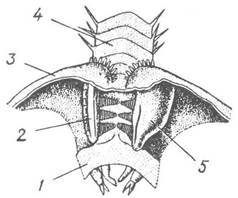
Fig. 232. Dissection of a body part within a single radius of a brittle star (the bursa wall on the left is cut away):
1 — skeletal plate; 2 — bursal slit; 3 — body wall; 4 — arm; 5 — bursa
The ambulacral system of ophiuroids is generally similar to that of starfish, but the madreporite, located on the oral surface, has only a single slit, as previously mentioned, while the radial canals originating from the ring canal are concealed within the oral groove of the arm vertebrae. The tube feet emerge to the exterior through pores on the oral skeletal plate of each arm segment; they lack both ampullae and suckers, functioning primarily as Organs of Touch and Respiration, although some species use them for locomotion.
The Digestive System of ophiuroids is structurally simple: it begins with a star-shaped oral aperture equipped with five movable jaws. The latter not only hold and grind food but also assist in capturing it. The Oral Cavity connects via a narrow opening to a flattened, sac-like Stomach. There is neither a hindgut nor an anus. The Stomach features thin, folded walls into which bursae deeply invaginate in the interradii (Fig. 233).

Fig. 233. Internal anatomy of an ophiuroid (part of the stomach removed):
1 — oral aperture; 2 — axial complex; 3 — ring canal of the ambulacral system; 4 — arm vertebrae; 5 — peristomal skeletal plate; 6 — Polian vesicle; 7 — perioral tube foot; 8 — body wall; 9 — stomach; 10 — bursa; 11 — Gonads
Ophiuroids feed mainly on plankton, fine organic detritus, and polyps, upon which they frequently settle. Certain species feed exclusively on Algae, while others consume worms, Molluscs, small sea urchins, and the like.
The axial complex has a Structure similar to that of starfish, but because the madreporite in ophiuroids is situated on the oral side, their aboral portion is curved downward.
The periehemal system of ophiuroids, In addition to the circumoral ring and five radial canals, possesses an aboral ring from which small canals extend to the gonads.
The Circulatory system resembles that of starfish, but it is considerably less developed, and in smaller-sized forms, it is entirely reduced.
The ectoneural division of The Nervous System is similar to that of starfish, but it is deeply submerged, and the radial nerves extending from the nerve ring lie at the bottom of the epineural canals. In the well-developed hyponeural division, one notes the presence of small ganglia on the radial nerves within each vertebra. The apical division resembles that of sea urchins: short nerve strands extend in the interradii from a slender nerve ring to the gonads and genital bursae.
Most ophiuroids are gonochoric, and hermaphrodites are less common. The botryoidal gonads (see Fig. 233) consist of short, thick tubules. They are located on the aboral side flanking the bursae, into each of which a tubule opens via a separate pore. Mature Gametes first enter the bursal cavity and are subsequently expelled to the exterior; sometimes the eggs remain within the bursa, where, during early developmental stages, the embryo is attached to the bursal walls, absorbing their secretions. Various Forms of brood care have been documented in nearly 60 species of ophiuroids, the majority of which are hermaphrodites.
In certain ophiuroids, egg development occurs directly within the Ovary, as, for example, in Ophionotus hexactis, in which only a single egg develops at a time while the remaining oocytes degenerate and are presumably utilized as nutritive material.
A young ophiuroid is born with a disc diameter of 8 mm and an arm length of up to 20 mm.
In most ophiuroids, the egg develops into a blastula that gradually transforms into a pelagic larva—the ophiopluteus (Fig. 234) with long appendages (arms), bearing a strong resemblance to the echinopluteus of sea urchins. All larval metamorphosis takes place in the water Column, and only after The formation of the small juvenile ophiuroid does it settle to the bottom.

Fig. 234. Ophiopluteus of ophiuroids
Some brittlestars can reproduce by transverse fission. These are primarily six-rayed ophiuroids of the genus Ophiactis. Fission invariably produces a three-rayed individual that rapidly regenerates the other three rays and a portion of the disc. Like starfish, ophiuroids possess a high capacity for the regeneration of body parts, being able to restore not only the rays but also the aboral part of the disc and a portion of the Internal Organs.
Ophiuroids are the most agile animals among echinoderms. They move by means of their rays. Some species pull themselves along by grasping objects with one or two rays while pushing off with the rest; others utilize their tube feet for locomotion, pressing them against the substrate. Laboratory studies have demonstrated that ophiuroids can climb vertical aquarium walls using their feet, secreting a special mucus that anchors the foot to the surface.
Certain ophiuroids possess The ability to emit a yellowish-green Bioluminescence, with luminescence restricted exclusively to the rays and their branches, and occasionally to the oral skeletal plates.
Parasites and commensals of ophiuroids are not very numerous, yet various copepods frequently settle on their bodies; ophiuroids are also parasitized by infusorians, molluscs, various crustaceans, and worms. Conversely, brittlestars frequently inhabit the spaces among sea urchin spines, Sponges, and corals.
The class Ophiuroidea comprises three orders.

We shall consider only two ophiuroid orders, since Oegophiurida includes mostly fossil forms and only a few extant species.
Order Phrynophiurida. This order encompasses all ophiuroids with branched rays as well as certain species with simple rays. The rays are typically highly flexible, capable of coiling spirally around various objects. The disc and rays are covered with thick skin, lacking a continuous external skeleton. One of the best-known Representatives of the order is Asteronyx loveni (Fig. 235, a), which is widespread in the warm and temperate waters of the World Ocean. This is a coral-red, fairly large ophiuroid with an arm span of up to 40 cm. Juvenile Asteronyx crawl along the bottom feeding on detritus, and subsequently attach themselves to sea pens, shifting to a diet of planktonic organisms and possibly coral polyps upon which they settle.

Fig. 235. Order Phrynophiurida:
a — Asteronyx loveni on a sea pen; b — Gorgonocephalus caryi
Equally well known are members of the family Gorgonocephalidae (Fig. 235, b), which during early developmental stages lead a parasitic lifestyle on coral polyps, feeding on their soft Tissues. After the first branching of their arms appears, they remain on the polyps for some time, consuming small prey that accumulates within the branching structure of their arms. Adult specimens lead a benthic lifestyle typical of ophiuroids, feeding on small animals gathered from the seabed or caught in the net of their branched arms.
Order Ophiurida (True Ophiuroids). This order encompasses the vast majority of ophiuroid species. They are characterized by the Skeletal structure described in the General characteristics of the class, and only in rare cases may the external Skeleton of the disc or arms be underdeveloped. The rays never branch and can flex only in a horizontal plane.
One of the largest families, Ophiacanthidae, unites a multitude of species that are widespread throughout the World Ocean and occur at great depths. Members of this family can be identified by The structure of the aboral side of the disc, which is covered with numerous spinelets, tubercles, and needles that mask the skeletal plates, while the rays bear A large number of often long needles.
Equally numerous is the family Ophiuridae, featuring a thick disc and comparatively short rays. Interesting representatives of this genus are Astrophiura (i.e., star-ophiuroids). Their spheroidal disc is covered above by a peculiar shield formed by the plates of the disc and rays, while the free PARTS OF THE arms lack oral and aboral skeletal plates (Fig. 236).
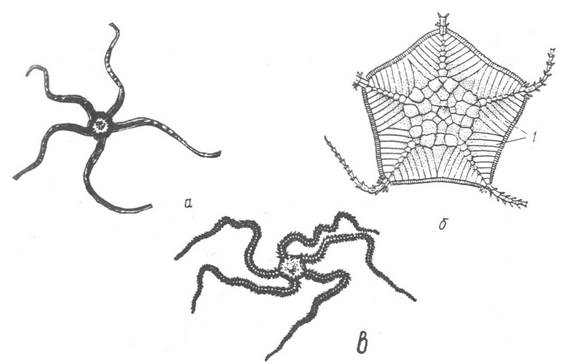
Fig. 236. Order Ophiurida:
a — Ophiura sarsi; b — Astrophiura permira; c — Amphiura stepanovi; 1 — lateral arm plates
Of considerable interest are members of the families Ophiocomidae and Amphiuridae, many species of which exhibit intense bioluminescence. Among the representatives of the latter family are hermaphroditic species that display parental care. For instance, in the Black Sea ophiuroid Amphiura stepanovi, which lives in oyster shells or burrows in the sand, the young are brooded in bursae, from which fully formed individuals emerge.
In addition to the two described classes of the subphylum Asterozoa, another class, Somasteroidea, is known, which includes only a single species.
Concluding the review of the phylum Echinodermata, mention should be made of a new, sixth class of this phylum — Concentricycloidea, described in 1986 for a new genus and species, Xyloplax medusiformes (Fig. 237).

Fig. 237. Xyloplax medusiformes:
a, b — aboral and oral views, respectively; c — diagram of the ambulacral system structure; 1 — terminal plates; 2 — hydropore; 3 — marginal spines; 4 — marginal plates; 5 — ring plates; 6 — adambulacral plates; 7 — gonad; 8 — ambulacral tube feet; 9 — outer and 10 — inner rings of the ambulacral system; 11 — Polian vesicles
These tiny creatures, up to 1 cm in diameter, bear a striking external resemblance to sea stars of the genus Caymanostella, which have also been found on pieces of wood dredged from depths exceeding 5,000 m.
Xyloplax medusiformes exhibits pentamerous radial Symmetry; the aboral side of its body is covered with skeletal plates, among which five terminal plates stand out. On the oral side, three rows of plates (ring, adambulacral, and marginal) cover only the margins, while the central portion is spanned by a thin membrane. The body is fringed with spines along the edges, giving it the appearance of a flower (hence their common name, «sea daisies»).
Xyloplax possesses an ambulacral system whose structure differs from that of other echinoderms. It comprises two ring canals connected by short interradial canals. The inner ring corresponds to the ring canal of other echinoderms, whereas the outer ring has no analogs. It bears a series of tube feet that emerge externally through Pores in the adambulacral plates.
Xyloplax lacks a digestive system. It is believed to feed via external Digestion by creeping with its ventral membrane over accumulations of Bacteria or other microscopic organisms.
Five pairs of gonads are located within the interradii of the body cavity, in which embryos at various Selection/3.html">Stages of development have been found, indicating viviparity.
The ESTABLISHMENT OF THE new class is not universally accepted. Some researchers believe that Xyloplax medusiformes should be included in the class
Asteroidea (Sea Stars), but only further study of these peculiar animals will allow a well-founded decision to be made.
Last update: 13/08/2026
Editorial and Educational Adaptation: This material has been compiled based on the primary/original source text. The project team performed an editorial review, corrected technical inaccuracies, structured sections, and adapted the content for an educational format.
What was processed:
- elimination of formatting defects (OCR errors, structural breaks, corrupted characters);
- editorial organization of content;
- standardization of terminology in accordance with academic sources;
- verification of factual statements against the original source text.
All mentions of the author, publication year, and origin of the primary text have been preserved in accordance with the source.