INVERTEBRATE ZOOLOGY - H. I. Shcherbak - 2008
KINGDOM MULTICELLULAR ANIMALS (METAZOA)
SUBKINGDOM TRUE METAZOANS (EUMETAZOA)
SECTION TRIPLOBLASTIC (TRIPLOBLASTICA), OR BILATERAL (BILATERIA) ANIMALS
SUBSECTION MOLTING ANIMALS (ECDYSOZOA)
PHYLUM ARTHROPODS (ARTHROPODA)
Arthropods represent the most species-rich phylum in the animal kingdom. Over 1.5 million arthropod species have been described, yet scientists estimate that the actual number of extant species reaches 3 to 5 million.
Arthropods have colonized all habitats within the biosphere and, alongside certain vertebrates, have evolved the capacity for active flight (the vast majority of insects). Their life forms, feeding habits, and environmental adaptations are exceptionally diverse. It is difficult to find a place on Earth devoid of arthropods. They inhabit all seas and oceans—living in the Water Column, on the benthic floor, and in freshwater bodies. Numerous arthropod groups have adapted to terrestrial life. Among them are many PLANT AND ANIMAL parasites. Based on their feeding habits, they include herbivores, carnivores, saprophages, polyphages, and parasites. There is not a single type of natural organic matter on the globe that is not consumed by arthropods.
Through progressive evolution, arthropods have achieved a high degree of Tissue and organ differentiation, most notably in their Nervous System and Sense Organs. Certain groups exhibit complex behavioral patterns—such as brood care, construction abilities, social living, and even a form of "language" (found in higher Hymenoptera).
Arthropods are metameric animals, with their metamerism being markedly heteronomous. Groups of similar segments are consolidated into distinct body regions known as tagmata (HEAD, Thorax, and abdomen, or cephalothorax and abdomen). A process of paramount importance is cephalization—The formation of a head, a tagma where the Brain, sense organs, and primary food Processing structures (mouthparts) are concentrated.
A defining characteristic of arthropods, from which the phylum derives its name, is the presence of jointed appendages. These are composed of individual segments interconnected by movable joints, forming multi-articulated levers capable of complex and precise movements. In addition to locomotion, the appendages perform numerous other Functions: acting as Sensory Organs, capturing and grinding food, Respiration, and reproduction.
An essential feature of arthropods is the presence of a chitinized cuticle. Beyond its protective function, it also serves as an exoskeleton to which Muscles attach. The cuticle is composed of Proteins, Amino Acids, Lipids, Glycoproteins, phenols, pigments, water (up to 40%), and its most characteristic component—Chitin (a complex polysaccharide). Chitin molecules possess a fibrous Structure that imparts elasticity, flexibility, and strength to the cuticle. In various arthropods, chitin accounts for 1 to 90% of the dry weight of the cuticle. The hardness of the cuticle is due to the hardening (sclerotization) of its proteins, which transform into exceptionally tough sclerotins.
The cuticle comprises several layers that differ in fine Structure and Chemical composition: an outer layer, the epicuticle, and an inner layer, the procuticle, which is further subdivided into the exocuticle and endocuticle (Fig. 287). The hypodermal Cells lie beneath the endocuticle. The epicuticle is primarily present in terrestrial arthropods, rendering their integument impermeable to water and preventing dehydration under conditions of moisture stress. The entire thickness of the endo- and exocuticle is penetrated by numerous pore canals containing extensions of hypodermal cells.
Class="center">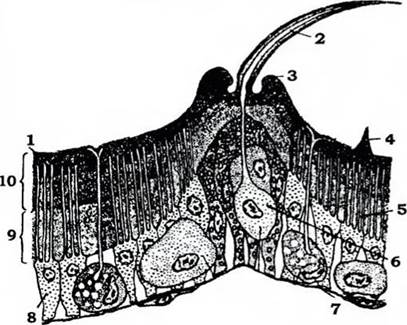
Fig. 287. STRUCTURE OF THE insect integument:
1 - epicuticle; 2 - seta (Hair); 3 - annular fold at the Base of the seta; 4 - spine; 5 - pore canals;
6 - hair-forming Cell (trichogen); 7 - basement membrane; 8 - hypodermis; 9 - endocuticle; 10 - exocuticle
The arthropod cuticle features areas covered with thick, rigid, non-stretchable cuticle (sclerites) alternating with soft, elastic, stretchable regions (membranes). This alternation of areas accounts for the mobility of the body and its appendages. The cuticle not only covers the entire body of the arthropod but also lines the foregut, hindgut, and tracheae in tracheate arthropods.
The musculature of arthropods is differentiated into discrete bundles connecting movable sclerites or limb segments. Muscle bundles attach to internal cuticular ridges (apodemes/apodemal ingrowths). Arthropods have evolved a novel type of locomotion anchored to an external Skeleton. Nearly all arthropod musculature, with the exception of certain visceral muscles, is striated. This confers a distinct advantage, as striated muscles contract more rapidly than smooth muscles. Thanks to this locomotor architecture, arthropods are capable of exceptionally rapid (relative to their size) and diverse movements, with some (most insects) also capable of flight.
The body cavity is a mixocoel (hemocoel), formed by the fusion of the coelom with the primary body cavity (blastocoel). It lacks a true cellular epithelial lining and consists of a system of lacunar spaces or sinuses among the Internal Organs. Circulating within the mixocoel is a fluid called hemolymph, which functions simultaneously as both coelomic fluid and Blood.
The Digestive System consists of three distinct regions: the ectodermal foregut, the entodermal midgut, and the ectodermal hindgut. Each of these regions is further differentiated in accordance with the animal's feeding habits. A hallmark trait distinguishing arthropods from other animal phyla is the differentiation of oral appendages adapted for holding and mechanically processing food. In some cases, supplementary to the mouthparts, the foregut features a specialized region for mechanical processing (a gizzard/proventriculus) or temporary food storage (crop). In most terrestrial arthropods, Salivary Glands open into the foregut. The midgut typically bears various diverticula that increase its surface area (hepatic caeca, pyloric appendages).
The excretory system in primary aquatic forms (crustaceans, horseshoe crabs) is represented by modified paired coelomoducts, which go by different names depending on their anatomical position (antennal, maxillary, coxal glands). In terrestrial arthropods, Malpighian tubules take over this function, working in conjunction with the hindgut into which they empty.
The Circulatory system is open and partially reduced. It retains only the major vessels—the dorsal vessel, occasionally a ventral vessel, and a few lateral ones—while completely lacking fine vessels and capillaries. There is a central pulsating organ, The Heart. All major vessels are Arteries that open directly into the body cavity. Hemolymph circulates through the body cavity and Blood Vessels, directly bathing the internal organs.
Respiratory organs are represented by gills in aquatic arthropods, and by book Lungs or tracheae in terrestrial ones. Miniature forms respire through the general body surface.
The Nervous System consists of a supraesophageal ganglion (or brain), circumesophageal connectives, and a ventral nerve cord with segmental ganglia. The supraesophageal ganglion is formed by the fusion of three distinct ganglia: the protocerebrum, deutocerebrum, and tritocerebrum. Throughout the phylum, there is a general evolutionary trend toward the fusion and shortening of the ventral nerve cord ganglia; in some cases, all ganglia coalesce into a single fused synganglion. Individual ganglia contain neurosecretory cells alongside Neurons, which facilitate the Neurohumoral regulation of bodily functions.
In addition to the Central Nervous System, arthropods possess an Autonomic nervous system closely linked to the central one. It innervates internal organs, influencing the functioning of the digestive, respiratory, excretory, and circulatory systems, as well as the body's overall METABOLISM.
Most arthropods feature well-developed sensory organs (for Touch, chemical perception, balance, and Vision). Eyes are of two types: simple eyes, containing a single lens, and compound, or facet, eyes, which consist of a vast number—sometimes several thousand—of individual units called ommatidia.
The rigid arthropod cuticle is insensitive to stimuli, meaning that the Senses of touch and chemical perception are localized to specific Regions of the integument where the cuticle is thin or possesses specialized accessory structures. In thinner cuticular areas, touch is mediated by sensory cells with free nerve endings located beneath the cuticle, which detect its deformation. On rigid PARTS OF THE cuticle, there are neuro-sensory units called sensilla, which are either scattered across various body parts or grouped into clusters known as sense organs. A sensillum consists of a cuticular part, one or
several sensory cells, and accessory cells (Fig. 288). Cuticular structures may take the form of hairs, bristles, cones, plates, etc., and are connected to the cuticular surface by an elastic articular membrane. Beneath the cuticular part of the sensillum lies a channel that penetrates the entire thickness of the cuticle. Through this channel, one or several sensory cells extend toward the base or the tip of the cuticular structure. A sensory cell comprises a cell body containing a Nucleus and two processes: a peripheral sensory process and a central process that forms part of a nerve. The peripheral process terminates in a modified cilium enclosed within a cuticular sheath. A tactile sensillum resembles a hair, with the sensory process attached to the base of the hair at the articular membrane. Upon the slightest touch to the hair, it deflects, deforming the articular membrane and stimulating the sensory process of the nerve cell. Chemoreceptive sensilla operate on the exact same principle, except that their cuticular components feature microscopic pores through which stimulus molecules can interact with the processes of sensory neurons.
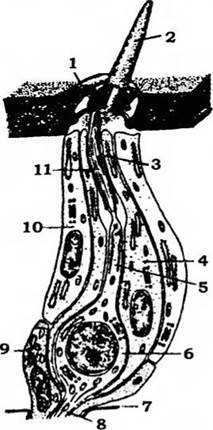
Fig. 288. Ultrastructural Organization of an insect trichoid mechanoreceptory sensillum (after Ivanov):
1 - articular membrane; 2 - hair; 3 - cuticular envelope; 4 - trichogen cell;
5 - peripheral process of the sensory cell; 6 - sensory cell;
7 - basal membrane; 8 - central process of the sensory cell;
9 - glial cell; 10 - tormogen cell; 11 - non-motile cilium
Reproduction. Arthropods reproduce exclusively through sexual means, and the vast majority are dioecious, although hermaphrodites are also known. Distinct Sexual Dimorphism is frequently observed. The structure of the Reproductive System varies across different groups. Fertilization is internal or spermatophoric—accomplished via membrane-enclosed packets of sperm called spermatophores, which the male introduces into the female's genital apertures or attaches to them. Certain species exhibit parthenogenesis.
Arthropod eggs are rich in yolk; consequently, Cleavage is superficial and incomplete, concentrated in a specific region of the egg surface known as the germinal
band. Embryonization of development is characteristic of arthropods, with early stages occurring safely within the protective egg membrane. A larva hatches from the egg, its body consisting of a limited number of segments. If the formation of new segments continues post-hatching, this type of development is termed anamorphosis; if the animal hatches with its full Complement of segments, it is termed epimorphosis. In some arthropods, development is direct, yielding a fully formed miniature individual upon hatching.
Postembryonic development is accompanied by periodic molting, during which the old cuticle is shed and replaced by a new one. Body growth occurs during the brief window when the newly formed cuticle remains soft. Molting is regulated by the neuroendocrine system.
The phylum Arthropoda is divided into three subphyla.
Last update: 13/08/2026
Editorial and Educational Adaptation: This material has been compiled based on the primary/original source text. The project team performed an editorial review, corrected technical inaccuracies, structured sections, and adapted the content for an educational format.
What was processed:
- elimination of formatting defects (OCR errors, structural breaks, corrupted characters);
- editorial organization of content;
- standardization of terminology in accordance with academic sources;
- verification of factual statements against the original source text.
All mentions of the author, publication year, and origin of the primary text have been preserved in accordance with the source.