GENERAL MICROBIOLOGY - T.P. Pyrog - 2004
5. STRUCTURE OF THE MICROBIAL CELL
5.2. MICROBIAL CELL MEMBRANES
5.2.3. Eukaryotic Membranes
Eukaryotic membranes represent a more complex system than those of prokaryotes. A characteristic feature of The Introduction/5.html">Eukaryotic Cell is the division of the Cytoplasm into a series of distinct compartments. This compartmentalization is partially created through the invagination of The Plasma Membrane, resulting in The formation of cisternae and vesicles. In addition, the eukaryotic cytoplasm contains Organelles (such as Mitochondria and The Nucleus) that are entirely enclosed by membranes.
Eukaryotic membrane structures include the Plasmalemma, the nucleolema (the nuclear envelope surrounding the nucleus), the mitochondrial membrane (surrounding the mitochondria), The Endoplasmic reticulum, the Golgi apparatus (dictyosomes), and the vacuolar membrane (Fig. 5.8).
Class="center">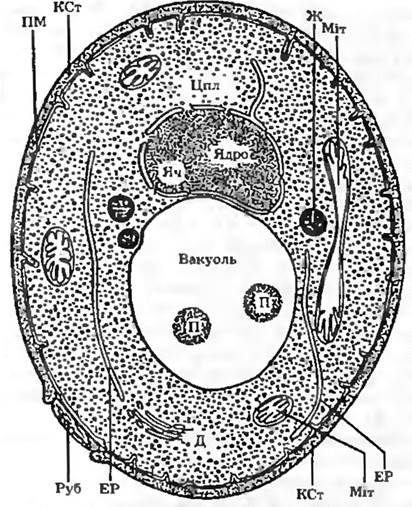
Fig. 5.8. Schematic cross-section of a Yeast cell:
D — dictyosome; F — fat inclusions; CW — Cell wall; Mit — mitochondrion; P — polyphosphate granules; PM — plasma membrane; Sc — bud scar; Cyt — cytoplasm; ER — endoplasmic reticulum; Nu — nucleolus
Under an Electron microscope, the nuclear membrane appears as a double membrane perforated by pores. Little is known about the Enzymes associated with the nuclear membrane, although it is hypothesized that the membrane contains channels facilitating The transport of RNA and Protein molecules. In the eukaryotic cell, the nucleus is the primary, but not the only, carrier of Genetic information, as a portion of this information is also housed within Mitochondrial DNA.
Mitochondria are separated from the cytoplasm by two membranes. The inner membrane forms folds called cristae, which significantly increase its surface area. The inner membrane contains the Components of the Electron Transport Chain and ATP synthase (the enzyme involved in ATP synthesis). The majority of the enzymes of The Tricarboxylic Acid Cycle are also located within the mitochondria.
The endoplasmic reticulum (ER) is formed through the invagination of the plasma membrane. While the precise connections between the ER and other cellular organelles remain unclear, continuity exists between the ER, the outer mitochondrial membrane, and the plasma membrane. Part of the ER forms the outer nuclear membrane, thereby enclosing the nucleus. Portions of the ER membranes are studded with tiny granules known as Ribosomes, forming what is called the rough endoplasmic reticulum, where Protein Synthesis takes place. The ER is also involved in the formation of intracellular vesicles.
The Golgi apparatus is traditionally considered characteristic of animal Cells, whereas analogous structures in plant cells are termed dictyosomes. Mycologists view the Golgi apparatus and dictyosomes as the exact same Membrane Structure, treating the terms as synonyms. Yeast microbiologists maintain that dictyosomes are specifically present in yeast cells, while the existence of a true Golgi apparatus in Yeasts remains a subject of debate.
The Golgi apparatus (dictyosomes) and the ER are responsible for the secretion of various products, particularly enzymes. Enzymes are synthesized on the cisternae (vesicles) and accumulate within them. Over time, such a vesicle detaches, migrates to the plasma membrane, and fuses with it, releasing its entire contents into the external environment. This process is known as exocytosis.
Endocytosis. Eukaryotic cells are characterized by The ability to uptake nutrients in the form of dissolved solutes or organized solid particles. A well-known example of solid particle uptake is phagocytosis, as seen in Blood Leukocytes or amoebas. The uptake of liquid nutrients is referred to as pinocytosis. Both modes of extracellular material uptake are collectively termed endocytosis; prokaryotes are entirely incapable of endocytosis. The cytoplasmic membrane plays a direct role in pinocytosis. For instance, in yeast cells, it can actively engulf droplets of Lipids, Proteins, and Hydrocarbons that have penetrated the periplasmic space. This process forms a vesicle that presumably transports the captured nutrients through the cytoplasm to the vacuole.
The ability of eukaryotes to engulf solid particles, including living cells, is of fundamental biological importance. Endocytosis provides insight into the prerequisites and mechanisms of endosymbiosis. Symbiosis is a mutually beneficial coexistence of organisms. The capacity of eukaryotic cells to acquire endosymbionts strongly Supports the theory regarding the symbiotic origin of Mitochondria and METABOLISM/14.html">Chloroplasts.
Endosymbiotic Hypothesis. Eukaryotic cellular organelles share many features with Prokaryotic Cells. According to the symbiotic hypothesis, mitochondria originated from colorless aerobic Bacteria, whereas chloroplasts (in plant cells) evolved from cyanobacteria (unicellular blue-green Algae, which are prokaryotes).
Last update: 13/08/2026
Editorial and Educational Adaptation: This material has been compiled based on the primary/original source text. The project team performed an editorial review, corrected technical inaccuracies, structured sections, and adapted the content for an educational format.
What was processed:
- elimination of formatting defects (OCR errors, structural breaks, corrupted characters);
- editorial organization of content;
- standardization of terminology in accordance with academic sources;
- verification of factual statements against the original source text.
All mentions of the author, publication year, and origin of the primary text have been preserved in accordance with the source.