Fundamentals of Molecular Biology - V.I. Rezyapkin 2009
Genome Organization
Mitochondrial Genome
Most Mitochondrial Genomes are double-stranded, circular, supercoiled DNA molecules. In plants, linear molecules also occur alongside circular DNA. In Ciliates, only linear DNA molecules have been found in Cell/35.html">Mitochondria.
As a rule, a cell contains more than one mitochondrion, with each mitochondrion harboring multiple copies of its genome. For instance, human Liver Cells contain about 2,000 mitochondria, each carrying 10 mitochondrial genomes; the Yeast S. cerevisiae contains up to 22 mitochondria with four genomes each; and mouse fibroblasts contain 500 mitochondria with two genomes each.
In the mitochondria of many organisms, except for higher animals, a portion of the DNA molecules exists as oligomers: linear, circular, and catenated structures consisting of interlocked monomeric rings (Fig. 11.27).
Class="center">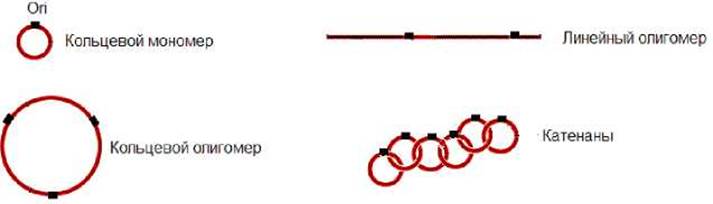
Fig. 11.27. Mitochondrial DNA can exist as monomers and as linear, circular, and catenated oligomers. Ori represents THE ORIGIN OF Replication.
The plant mitochondrial genome typically consists of several circular DNA molecules of varying sizes—one large molecule accompanied by several smaller ones. These molecules are capable of recombining with one another. For example, the maize mitochondrial genome can exist as a single DNA molecule of 570,000 bp or as multiple smaller molecules (Fig. 11.28). The existence of the maize mitochondrial genome in various forms is made possible by recombination processes.
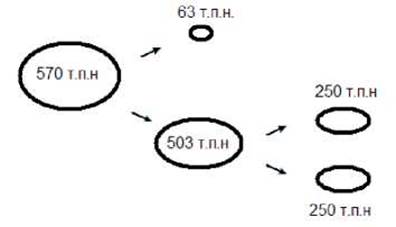
Fig. 11.28. The maize mitochondrial genome can exist as a single DNA molecule or as several smaller molecules.
The size of the mitochondrial genome varies widely among organisms, ranging from several thousand to several million bp (Table 11.6). In vertebrates, mitochondrial genomes are typically between 16,000 and 18,000 bp in size. Their DNA is compact; most genes are arranged back-to-back, occasionally overlapping by a single nucleotide where the last nucleotide of one Gene serves as the first nucleotide of the next. Plant mitochondrial genomes are the largest, reaching up to several hundred thousand or even millions of bp in some species. Unlike vertebrates, the mitochondrial DNA of plants, as well as Fungi and protists, contains a substantial proportion—up to 80%—of non-coding sequences.
Table 11.6. Size of the mitochondrial genome
|
Genome Size, bp |
|
|
Malarial parasite |
∽6000 |
|
Protists |
22000 — 40000 |
|
African clawed frog |
17533 |
|
Pig |
16350 |
|
Human |
16569 |
|
Yeast |
∽80000 |
|
Arabidopsis |
∽370000 |
|
Pumpkin |
∽850000 |
|
Melon |
∽2400000 |
The composition and number of genes in mitochondrial genomes vary significantly across species. In most higher animals, the mitochondrial genome contains 37 genes: 13 genes encoding Respiratory Chain Proteins, 22 tRNA genes, and two rRNA genes (16S rRNA and 12S rRNA). Figure 11.29 illustrates the human mitochondrial genome. In plants and protists, the mitochondrial genome also encodes certain additional proteins that are part of the Ribosomes. The largest number of genes, 97, has been found in the mitochondrial genome of the flagellated protist Rectinomonas americana.
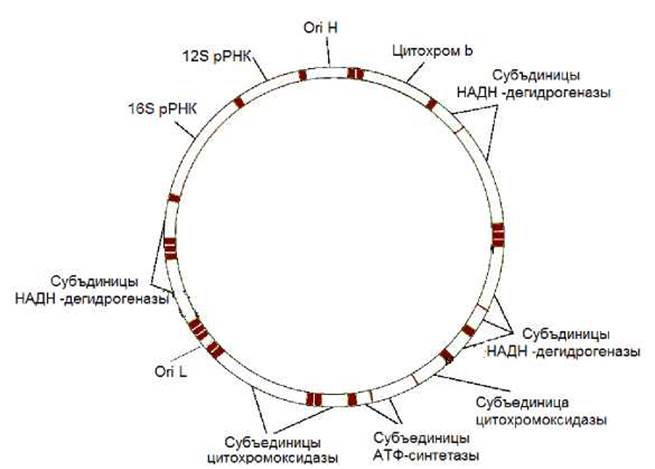
Fig. 11.29. The human mitochondrial genome. Its size is 16,569 bp. It contains 13 polypeptide-encoding genes: 7 subunits of the NADH dehydrogenase complex, 2 subunits of ATP synthase, 3 subunits of cytochrome c oxidase, and 1 subunit of ubiquinone-cytochrome c reductase (cytochrome b); 22 tRNA genes; and 2 rRNA genes (16S RNA and 12S RNA). Ori H denotes the origin of replication for the heavy DNA strand, and Ori L denotes the origin of replication for the light DNA strand.
Obviously, the mitochondrial genome does not provide for the synthesis of all proteins within these Organelles, as hundreds of different proteins participate in mitochondrial Organization and function. The vast majority of these are encoded in the nuclear genome. Synthesis of such proteins occurs in the Cytoplasm, after which they are transported into the mitochondria to perform their Functions. Nuclear-encoded mitochondrial proteins include numerous Enzymes, electron carriers, transport proteins, and factors involved in the METABOLISM/31.html">Transcription, Translation, and replication of mitochondrial DNA, among others. Interestingly, some Mitochondrial Genes are also represented by copies in the nuclear genome.
One of the defining Properties of the Genetic Code is its universality, meaning that the same triplets code for the same Amino Acids in All living organisms. However, investigation of the mitochondrial genetic code revealed that it departs from the universal code. Furthermore, the mitochondrial codes of different organisms not only differ from the universal code but also from one another. The mitochondrial genetic code of vertebrates is the most thoroughly studied (Fig. 11.30). In vertebrates, the codon AUA encodes Methionine instead of isoleucine as in the standard code; the codons AGA and AGG, which specify Arginine in the standard code, act as stop codons; and the UGA codon, which serves as a stop codon in the standard code, encodes Tryptophan. Thus, the animal mitochondrial code features 4 stop codons and 60 sense codons. Interestingly, just 22 tRNAs are sufficient to read all 60 mRNA sense codons, whereas at least 32 tRNAs are required to read the nuclear genetic code.
Mammalian mitochondrial mRNAs practically lack 5'- and 3'-untranslated regions. They may also lack stop codons, terminating instead in U or UA. Polyadenylation of their 3' ends generates a functional UAA stop codon.
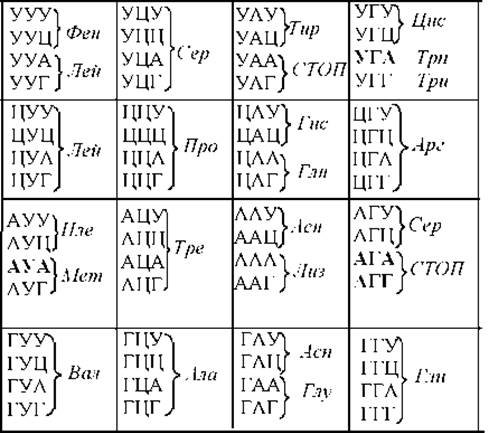
Fig. 11.30. The vertebrate mitochondrial genetic code. Differences from the universal nuclear code are highlighted in bold.
Another characteristic feature of the mitochondrial genome in many organisms is RNA editing (see the section "Introduction/30.html">Regulation of Gene Expression"). Let us consider a fascinating example of mitochondrial mRNA editing. In Trypanosoma brucei, the mRNA for one of the cytochrome c oxidase subunits is edited via the insertion of four U NUCLEOTIDES. This generates a new mRNA that serves as a template for synthesizing a novel enzyme subunit, whose Amino Acid Sequence differs from that encoded by the unedited mRNA. This altered amino acid sequence results from a reading frame shift, as the number of inserted nucleotides is not a multiple of three. Interestingly, this new subunit is synthesized in the parasite's mitochondria only when it enters the body of a cold-blooded fly, whereas no editing occurs when the trypanosome inhabits a warm-blooded mammal.
In most animals, the complementary strands of mitochondrial DNA differ significantly in buoyant density. Consequently, one is designated as the H-strand (heavy) and the other as the L-strand (light). Each strand has its own origin of replication: replication of the H-strand initiates at ori H, and that of the L-strand at ori L (Fig. 11.31). Initiation of H-strand replication occurs first, while Synthesis of the L-strand begins only after a substantial portion of the H-strand has been synthesized (approximately two-thirds of the heavy strand's total length in humans). Thus, the daughter strands of mitochondrial DNA are synthesized asynchronously.
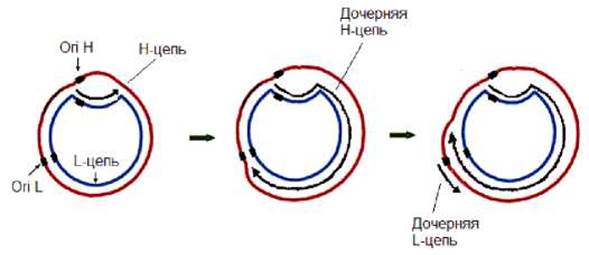
Fig. 11.31. Scheme of mitochondrial DNA replication in mammals.
In mammals, transcription of both mitochondrial DNA strands initiates in the ori H region. This transcription yields two long RNA transcripts corresponding in size and complementarity to the H- and L-strands. In addition, shorter RNAs are transcribed from the H-strand, terminating at the 3' end of the 16S rRNA gene (Fig. 11.32). These short transcripts are produced in quantities an order of magnitude higher than the long transcripts. Processing of the short RNAs yields 12S rRNA and 16S rRNA, which participate in ribosome assembly, as well as two tRNAs (tRNAPhe and tRNAVal). mRNAs and the remaining tRNAs are excised from the long RNA transcripts. A poly(A) tail is added to the 3' ends of the mRNAs, typical of eukaryotes, whereas their 5' ends remain uncapped. Because mammalian genes lack introns, their mRNAs do not undergo splicing. Nevertheless, some mitochondrial genomes do contain intron-containing genes. For instance, the yeast mitochondrial genome features genes with an intron-exon organization. The yeast mitochondrial genome is approximately 5 times larger than the human one, spanning about 80,000 bp; however, it contains roughly the same number of genes as human mitochondrial DNA. About 25% of yeast mitochondrial DNA consists of AT-rich regions whose functions remain incompletely understood.
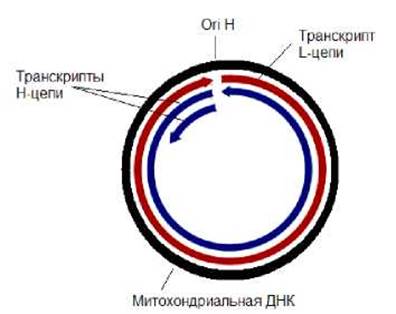
Fig. 11.32. Scheme of mammalian mitochondrial DNA Transcription. The Chloroplast Genome
The chloroplast genome is a circular DNA molecule ranging in size from 130,000 to 200,000 bp. It comprises approximately 130 genes: two genes for each rRNA (4.5S, 5S, 16S, 23S); about 30 tRNA genes; genes for ribosomal proteins, RNA polymerase; about 40 genes encoding thylakoid Membrane Proteins; and other protein genes. Some genes feature an intron-exon organization, while others are continuous. The organization of promoters and terminators is similar to that of prokaryotes. Interestingly, unlike nuclear DNA, chloroplast DNA can be transcribed by RNA polymerase from E. coli. Certain genes with related functions (such as those encoding ribosomal proteins) are organized similarly in the genomes of Chloroplasts, E. coli, and cyanobacteria.
Not all chloroplast proteins are encoded within their own genome; the majority are of nuclear origin. Furthermore, Polypeptides encoded in chloroplasts are part of enzyme complexes that also contain subunits encoded by the nuclear genome. It is likely that during eukaryote evolution, a significant portion of chloroplast genes was transferred to the nuclear genome.
The Protein Synthesis machinery of chloroplasts resembles that of Bacteria rather than eukaryotes. Their ribosomes share many features with E. coli ribosomes, including similar polynucleotide sequences. Chloroplast ribosomes are capable of utilizing prokaryotic tRNAs for protein synthesis. Like in bacteria, Protein synthesis in chloroplasts begins with N-formylmethionine rather than methionine, which is used in the cytoplasm of Eukaryotic cells. Chloroplast mRNAs are efficiently translated by the E. coli protein-synthesizing machinery.
It is hypothesized that chloroplasts, much like mitochondria, evolved from prokaryotic symbionts that once inhabited the cytoplasm of eukaryotic cells. There is a wealth of evidence supporting this view.
Last update: 12/08/2026
Editorial and Educational Adaptation: This material has been compiled based on the primary/original source text. The project team performed an editorial review, corrected technical inaccuracies, structured sections, and adapted the content for an educational format.
What was processed:
- elimination of formatting defects (OCR errors, structural breaks, corrupted characters);
- editorial organization of content;
- standardization of terminology in accordance with academic sources;
- verification of factual statements against the original source text.
All mentions of the author, publication year, and origin of the primary text have been preserved in accordance with the source.